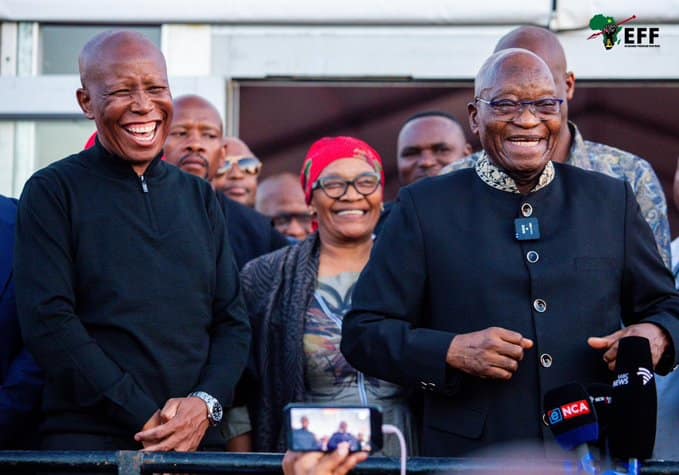
Polokwane – In a striking display of political symbolism, former President Jacob Zuma led a high-level delegation from the uMkhonto weSizwe (MK) Party to the home of Economic Freedom Fighters (EFF) leader Julius Malema on Friday, where he paid his respects following the death of Malema’s maternal aunt, Martha Motlanalo Malema.
The visit, which took place in Seshego’s Ward 13 in Polokwane, saw the two political rivals—often at odds in the fractious landscape of South African politics—come together in a moment of shared grief. Addressing the gathering of family members, friends, and supporters, Zuma used the occasion to issue a powerful call for black South Africans to unite beyond the narrow confines of party politics.
“Martha Motlanalo Malema was 54 years old, a mother, a grandmother, and a dedicated supporter of the EFF. Her passing has brought us here today, not as politicians, but as human beings,” Zuma said, speaking in isiZulu and English to the assembled mourners.
“We are here to mourn with the family, to share in their pain. But I also want to say something that I believe is important: we, as black people, must unite. The divisions among us keep us enslaved. When we are divided, we cannot move forward.”
The former president’s remarks drew murmurs of agreement from the crowd, with some clapping and nodding as he spoke. Zuma emphasized that death and loss transcend political affiliations, urging South Africans to set aside their differences in moments of shared humanity.
A Rare Moment of Political Solidarity
The visit was notable not only for the presence of Zuma—whose MK Party has positioned itself as a direct competitor to the EFF in the battle for the radical, populist vote—but also for the warm reception extended by Malema and his family.
Julius Malema, dressed in a dark suit, stood alongside Zuma as they addressed the gathering. The EFF leader, known for his fiery rhetoric and sharp critiques of Zuma’s ANC legacy, struck a conciliatory tone, thanking the former president for making the journey.
“We appreciate this gesture. It shows that beyond politics, there is humanity,” Malema said. “We may disagree on many things, but when death visits a home, we put those things aside. We thank President Zuma and the MK Party delegation for coming to share this moment with our family.”
The EFF later released a statement praising the visit as an act of humility and respect. “Comrade Jacob Zuma’s presence at the home of our Commander-in-Chief, Julius Malema, demonstrates that in times of grief, we are all one people,” the statement read. “We commend this gesture of human decency and solidarity.”
The Deceased: A Dedicated EFF Supporter
Martha Motlanalo Malema, 54, was described by family members as a devoted mother and grandmother who was deeply involved in community life in Seshego. She was known as a committed supporter of the EFF, actively participating in party activities in Ward 13, where she lived.
Neighbors and community members who gathered outside the family home spoke warmly of her, describing her as a kind and welcoming woman who was always willing to help others.
“She was a good person. She loved her family, and she loved her party,” said one neighbor. “When she walked through the streets, she greeted everyone. She will be missed.”
Zuma’s Call for Black Unity: A Political Message?
While the visit was ostensibly a condolence call, Zuma’s address carried unmistakable political undertones. His call for black unity, delivered from the home of one of his most prominent political adversaries, was interpreted by many as a broader appeal for consolidation among the factions that have fractured the South African political landscape.
Since the launch of the MK Party in 2023, Zuma has positioned himself as a unifier of black radical traditions, often invoking the legacy of the armed struggle and calling for a realignment of forces opposed to what he terms “neo-liberal” and “white monopoly capital” interests.
His presence in Polokwane—a city that holds deep significance for the ANC, having hosted the watershed 2007 conference where Zuma defeated Thabo Mbeki—added an extra layer of symbolism. Some political analysts saw the visit as an olive branch, while others viewed it as a strategic move to position Zuma as a statesman above partisan squabbles.
“Zuma is carefully cultivating an image of elder statesman, a figure who transcends the petty rivalries of party politics,” said political analyst Professor Susan Booysen. “Visiting Malema in a time of grief allows him to appear magnanimous while also sending a message that he is open to broader alliances. Whether that translates into electoral cooperation remains to be seen.”
Mixed Reactions: Praise and Criticism
The visit drew a mixed response from the public and political commentators. Many praised the show of unity, seeing it as a welcome departure from the often toxic nature of South African political discourse.
“This is what leadership looks like. Putting differences aside to comfort a fellow human being,” one user posted on X (formerly Twitter). “We need more of this.”
Another wrote: “Zuma and Malema may be political rivals, but today they showed us that family and humanity come first. Respect to both of them.”
However, critics were quick to highlight the contradictions and past tensions between the two figures. Zuma and Malema have a long and complicated history. Malema rose to prominence as a youth leader within the ANC, fiercely defending Zuma during his presidency, before their relationship soured and Malema was expelled from the party. Since then, Malema has been one of Zuma’s sharpest critics, particularly over issues of corruption and state capture.
“Let’s not rewrite history,” one critic commented. “These two have been at each other’s throats for years. One visit doesn’t erase that. And Zuma using a funeral to make political speeches is in poor taste.”
Others questioned whether Zuma’s call for black unity was sincere, given his own role in the divisions that have plagued the governing party.
“Zuma speaks of unity, but his leadership was defined by division. He factionalized the ANC, he presided over state capture, and now he leads a breakaway party,” said political commentator Sizwe Mpofu-Walsh. “The irony is staggering.”
A Deeper Significance?
For those gathered in Seshego, however, the political analysis mattered less than the simple act of showing up. Family members expressed gratitude that a former head of state had taken the time to visit their home in their time of mourning.
“We are grateful. That is all,” said a relative who asked not to be named. “When you lose someone, you appreciate everyone who comes to share your pain. Today, we are just family. The politics can wait.”
Martha Motlanalo Malema will be laid to rest on Saturday, with family and friends expected to gather in Seshego for a funeral service. The presence of Zuma and the MK Party delegation has ensured that her passing will be remembered not only as a family loss but as a moment when two of South Africa’s most formidable political figures stood side by side—if only for a day.
As one mourner put it: “Death is the great equalizer. It reminds us that no matter how high we rise, we all share the same human heart. Today, that heart was in the right place.”
About The Author