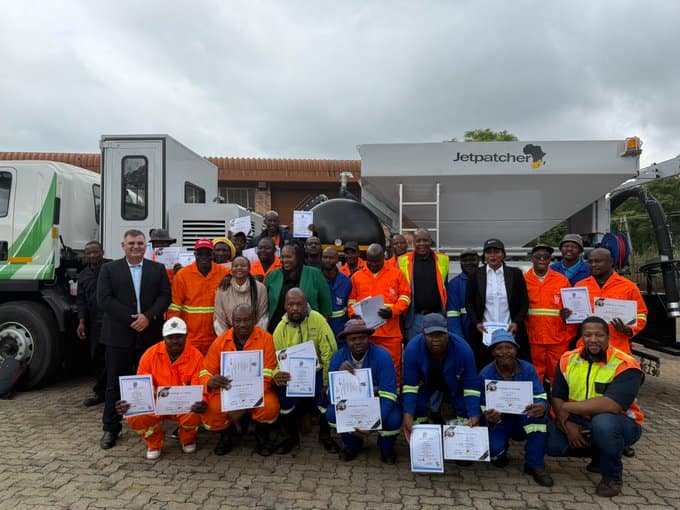
In a decisive move to reclaim its road network from decay, the City of Tshwane has launched a high-tech assault on its notorious pothole problem, deploying a fleet of state-of-the-art Jetpatcher machines in a R7.6 million investment aimed at delivering faster, more durable repairs for motorists.
The new Jetpatchers represent a significant leap in efficiency for the city’s maintenance crews. Unlike traditional methods that require multiple teams and pieces of equipment for cleaning, filling, and sealing, the Jetpatcher is a self-contained, mobile factory on a truck. It uses high-pressure compressed air to blast debris and water out of a pothole, before simultaneously spraying a tacky emulsion and filling it with a precise mix of stone chips—all in one seamless, rapid-fire process.
“This is a game-changer for our proactive maintenance strategy,” said City Manager Dr. Johann Moya during a demonstration. “Where a conventional crew might fix a handful of potholes a day, a single Jetpatcher can address between 3 to 5 kilometres of road surface defects daily. This speed is critical not only for catching up on the backlog but also for preventing minor cracks from evolving into car-breaking craters.”
The deployment of the Jetpatchers is the centrepiece of a broader, year-long road rehabilitation campaign that has already yielded substantial results. Official city data reveals that over the past 12 months, Tshwane has resurfaced more than 220 kilometres of major arterial roads. More impressively, the city’s dedicated teams have filled a staggering 14,072 out of the 18,067 potholes reported by the public, achieving a 78% repair rate in the face of a relentless challenge.
Dr. Moya emphasized that the strategy extends beyond just buying new machinery. A key pillar of the city’s approach is building internal capacity and self-sufficiency.
“We are deliberately investing in our own people and our own resources,” he stated. “We are upskilling our internal teams to operate this new technology and manage the entire repair lifecycle. Furthermore, we are leveraging the city’s own quarry to produce asphalt, which drastically reduces our reliance on external contractors, cuts costs, and gives us full control over the quality of our materials.”
This push for internal resilience is seen as a direct response to past criticisms over delayed repairs and reliance on outsourced services, which often proved costly and slow.
The timing of this intensified effort is also strategic. With the summer rainy season on the horizon, the city is in a race against time. Water is the primary enemy of road surfaces, seeping into cracks and weakening the substructure, leading to a rapid proliferation of potholes. By conducting these proactive upgrades and rapid repairs now, the city aims to create a more waterproof and resilient road network that can better withstand the seasonal deluges.
For Tshwane’s long-suffering motorists, who have endured costly tyre replacements, wheel alignments, and suspension repairs, the new Jetpatchers are a visible and welcome sign of the city’s commitment to tackling a problem that has long plagued daily commutes. The message from the city administration is clear: the war on potholes has entered a new, more technologically advanced phase, and the goal is not just to fix the roads, but to future-proof them.
About The Author