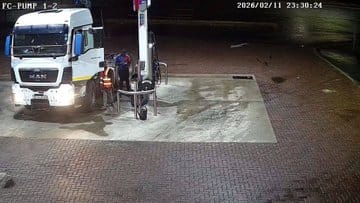
The night shift at Engen Simjees had settled into its usual rhythm by 11:30 PM on February 11, 2026. The M19 highway westbound through Clare Hills carried the intermittent rumble of long-distance haulage, trucks moving cargo between Durban’s sprawling port and the inland economic heartland of Gauteng. The forecourt lights cast their cold glow across the pumps, illuminating the occasional customer who pulled in for fuel, snacks, or the brief respite of a bathroom break.
The CCTV cameras recorded everything, as they always did. The footage is grainy in the way of commercial security systems—adequate for identification, insufficient for cinema—but clear enough to capture the sequence of events that would, within hours, become a subject of intense interest across South Africa’s trucking community and beyond.
A large truck, its configuration suggesting a refrigerated container unit common in the cross-border logistics trade, pulled into the diesel bay. The driver, a man whose features the cameras could not capture in sufficient detail for facial recognition, emerged from the cab and began the fueling process. He moved with the unhurried confidence of someone performing a routine task, someone who belonged there, someone whose presence would not attract attention.
He pumped diesel for approximately twelve minutes. When the nozzle finally clicked off, the pump registered R13,247.83—enough fuel to fill the tanks of a long-haul truck for a journey of more than 1,500 kilometers.
The driver did not enter the shop to pay. He did not approach the cashier. He did not present a fuel card or a bank card or any form of payment. He simply returned to the cab, started the engine, and drove away into the Durban night, leaving behind R13,000 worth of stolen fuel and a trail of questions that would only multiply in the hours and days that followed.
The Moment of Discovery
Garage attendant Sipho Mthembu was working the overnight shift when the truck pulled away without paying. By the time he registered what had happened—the pump still displaying the final amount, the truck already merging onto the highway—it was too late to intervene physically. He did the only thing he could do in the moment: he noted the registration plate visible on the truck’s rear and reported the incident to his supervisor.
“DC 04 JH ZN,” he recited into his cellphone, the numbers and letters already beginning to blur in his memory. “Write it down. DC 04 JH ZN. Big truck, white cab, refrigerated container. Heading west on the M19.”
The supervisor, Mohammed Essack, arrived within twenty minutes, roused from sleep by the urgency of the call. He reviewed the CCTV footage, confirmed the registration, and began the process of reporting the theft to the South African Police Service. The case was logged, a reference number issued, and the documentation filed in the inevitable bureaucracy of crime reporting.
But Essack did not stop there. He understood, from years of experience in the fuel retail industry, that the chances of recovering R13,000 through official police channels alone were minimal. The system was overstretched, the crime relatively minor in the context of the violent offenses that consumed investigative resources, and the trail would grow colder with each passing hour.
So he did what increasingly desperate business owners do in contemporary South Africa: he turned to social media.
The Digital Manhunt
Within hours of the theft, images extracted from the CCTV footage were circulating across WhatsApp groups serving the trucking industry, Facebook pages dedicated to logistics professionals, and Twitter accounts followed by transport operators across KwaZulu-Natal and beyond. The registration plate was highlighted, the truck’s distinctive features noted, the circumstances of the theft described in detail.
“ENGEN SIMJEES ON M19,” the caption read. “R13,000 DIESEL THEFT 11 FEB 11:30PM. TRUCK DC 04 JH ZN. IF YOU SEE THIS VEHICLE CONTACT MOHAMMED 072 661 0226 OR HASSAN 076 512 1205 OR SANELE 078 294 3146. SHARE WIDELY.”
The contact numbers spread as rapidly as the images. Mohammed, Hassan, and Sanele—the garage management team—braced for a flood of tips that they hoped would lead to the recovery of their stolen fuel and the apprehension of the thief.
The first tip arrived within an hour. A truck driver who had seen the post recognized the registration plate. He knew the owner of DC 04 JH ZN personally, he claimed. He would provide the contact details. He was certain the owner would cooperate fully with the investigation.
Mohammed made the call. The conversation that followed would transform a straightforward fuel theft into something considerably more complex.
The Clone
The owner of DC 04 JH ZN, a Durban-based transport operator named Rajesh Govender, answered his phone at 6:15 AM, already awake and preparing for another day of managing his fleet of six trucks. He listened as Mohammed described the theft, the CCTV footage, the registration plate clearly visible on the truck that had driven away without paying.
Govender’s response was immediate and unequivocal.
“That is not my truck,” he said. “My truck was in Pietermaritzburg at 11:30 last night. It was parked at the depot. My driver was asleep in the cab. I have GPS tracking records that will confirm this. You have been scammed by someone using cloned plates.”
Cloning. The word landed with the particular weight of recognition. Mohammed had heard of such things—criminals duplicating legitimate registration plates and affixing them to stolen or illicit vehicles to evade detection—but he had never encountered it directly. Now, standing in the forecourt of his garage, reviewing the CCTV footage that had seemed so promising just hours earlier, he understood that the investigation had just become exponentially more difficult.
Govender, for his part, was cooperative and concerned. He provided the GPS coordinates demonstrating his truck’s location at the time of the theft. He offered to make his driver available for identification purposes. He expressed sympathy for the garage’s loss while firmly establishing his own innocence.
“I am a victim too,” he said. “My registration is now associated with a crime. If that truck is involved in something more serious—if they use those plates for smuggling or trafficking or something worse—I will have to explain that my vehicle was cloned. This is a nightmare for me as much as for you.”
The Phantom Fleet
Cloned trucks represent a growing challenge for South African law enforcement and the transport industry. The practice is simple in concept and increasingly sophisticated in execution. Criminals identify a legitimate truck with clean registration and no outstanding warrants. They manufacture duplicate plates using readily available equipment. They affix these plates to a stolen or illicit vehicle that matches the general description of the legitimate truck. They operate with near-impunity, knowing that any inquiry directed at the registration will return a clean record belonging to an innocent owner.
The scale of the problem is difficult to quantify precisely, but industry estimates suggest that hundreds of cloned trucks operate on South African roads at any given time. They are used for fuel theft, cargo theft, smuggling, and, in some cases, more serious crimes including cash-in-transit heists and cross-border trafficking.
“The legitimate owner often has no idea their registration has been cloned until something like this happens,” said Mandla Dlamini, a spokesperson for the Road Freight Association. “They go about their business, paying their licenses, maintaining their vehicles, complying with all regulations—and then one day they receive a call about a crime committed hundreds of kilometers away by someone driving a truck that looks like theirs.”
The response from authorities has been uneven. The National Traffic Information System, which maintains vehicle registration data, has limited capacity to verify the authenticity of plates encountered in the field. Traffic officers, already overstretched, rarely have the time or resources to conduct the detailed inspections that might identify cloned vehicles. And the criminals, aware of these limitations, continue to operate with calculated impunity.
The Rising Tide
Fuel theft from commercial retailers has emerged as a significant and growing problem across South Africa. The combination of rising fuel prices, sophisticated criminal networks, and limited enforcement capacity has created conditions in which R13,000 diesel thefts are becoming disturbingly common.
Industry data compiled by the South African Petroleum Retailers Association suggests that fuel theft incidents increased by approximately 40% between 2023 and 2025. The total value of fuel stolen from retail outlets during this period is estimated to exceed R150 million annually, with the actual figure likely substantially higher given significant underreporting.
The methods employed by fuel thieves are diverse and increasingly sophisticated. Some use modified vehicles with concealed tanks that can be filled while appearing to conduct legitimate transactions. Others exploit weaknesses in payment systems, using stolen or cloned fuel cards. And some, like the driver at Engen Simjees, simply fill and flee, relying on the delays in response and the limitations of enforcement to escape accountability.
“Fuel is liquid gold,” said petroleum industry analyst Nomfundo Xaba. “It is easily convertible to cash, difficult to trace, and in constant demand. For criminal networks, fuel theft offers a relatively low-risk, high-reward opportunity. The chances of being caught in the act are minimal. The chances of being prosecuted successfully are even smaller. The economics of crime strongly favor the thieves.”
The Human Impact
For the management of Engen Simjees, the R13,000 stolen represents not merely a financial loss but a direct threat to the viability of their business. Fuel retail operates on razor-thin margins, with profits measured in cents per liter rather than rands. A theft of this magnitude can consume the entire profit from thousands of liters of legitimate sales.
“We are not a big corporation,” Mohammed Essack explained, his voice carrying the exhaustion of someone who has spent days pursuing leads that lead nowhere. “We are a small business. We employ local people. We pay local taxes. We serve the community. A R13,000 loss is not nothing to us. It is money we cannot spend on maintenance, on security improvements, on the small investments that keep a business running.”
The garage staff, too, have been affected. Sipho Mthembu, the attendant on duty during the theft, has been questioned repeatedly by management, by police, by the owner concerned about potential collusion. He has been cleared of any involvement—the CCTV footage confirms he was inside the shop when the truck departed—but the suspicion lingers, the stain of proximity to crime.
“I did my job,” he said quietly. “I was where I was supposed to be. I reported what happened immediately. But now, every time I come to work, I feel like people are watching me. Like they are wondering whether I was involved. Like they are waiting for me to make a mistake. It is not fair. But it is what it is.”
The Industry Response
In the wake of the Engen Simjees theft, the Road Freight Association has renewed its calls for enhanced security measures and improved enforcement against fuel crime. The association has urged its members to verify the authenticity of registration plates encountered in the field, to report suspicious vehicles to authorities, and to support technological solutions that could make cloning more difficult.
“We need a system that allows real-time verification of vehicle identity,” said Dlamini. “We need technology that can distinguish legitimate vehicles from clones. We need enforcement that treats fuel theft as the serious crime it is, not as a minor inconvenience. We need cooperation between retailers, transporters, and law enforcement that goes beyond sharing WhatsApp messages after the fact.”
Some technological solutions exist. Electronic vehicle identification systems, using RFID tags or similar technologies, could theoretically authenticate vehicles at key points such as border posts, weighbridges, and fuel retailers. The cost of implementing such systems across the national fleet, however, is prohibitive, and the political will to pursue such investments has not materialized.
“We are stuck between the technology we need and the technology we can afford,” Dlamini acknowledged. “In the meantime, the criminals continue to exploit the gaps. And businesses like Engen Simjees continue to pay the price.”
The Investigation Continues
As of February 13, 2026, no arrests have been made in connection with the Engen Simjees theft. The cloned registration plate has yielded no actionable leads. The CCTV footage, while clear enough to document the event, lacks the resolution necessary for facial identification. The truck itself, assuming it has not been repainted or reconfigured, could be anywhere in southern Africa by now.
The police investigation continues at whatever pace resource constraints permit. A case docket has been opened. A investigating officer has been assigned. The garage management has provided all available evidence and continues to share any new information that emerges.
But those familiar with the realities of fuel theft investigations are not optimistic.
“The chances of solving this case are minimal,” acknowledged a retired police officer who investigated commercial crime for twenty-three years. “Without a suspect in custody, without a vehicle in evidence, without witnesses who can provide identification—the trail goes cold very quickly. The case will remain open, technically, but it will not be actively pursued. There are simply too many other crimes competing for limited resources.”
The assessment is not cynical but practical. The South African Police Service faces extraordinary challenges: violent crime rates that strain investigative capacity, backlogs in forensic analysis, shortages of trained personnel, and administrative burdens that consume time that could otherwise be devoted to casework. In this context, a R13,000 fuel theft—however significant to the victim—cannot compete for priority.
The Vigilance Networks
In the absence of effective official enforcement, the trucking community has developed its own informal systems of mutual surveillance and information sharing. WhatsApp groups dedicated to specific routes and regions circulate alerts about suspicious vehicles, stolen cargo, and emerging threats. Drivers communicate with each other via radio and mobile phone, reporting unusual activity and warning colleagues of potential dangers.
The Engen Simjees alert, widely shared across these networks, exemplifies the system in operation. Within hours, thousands of drivers were aware of the theft, the cloned registration, and the need for vigilance. If the phantom truck reappears—if it attempts to fuel again at another garage, if it is spotted on a particular route, if it attracts attention for any reason—the chances of detection are substantially higher than they would have been in the absence of such networks.
“We look out for each other,” said long-distance driver Thabo Ndlovu, who operates between Durban and Johannesburg. “The police cannot be everywhere. The companies cannot protect us everywhere. But we are everywhere. We see everything. And when we share information, we become a force that criminals cannot easily evade.”
The networks are not perfect. They can generate false alarms. They can facilitate vigilantism. They can spread misinformation as easily as accurate intelligence. But for drivers operating in an environment where crime is endemic and enforcement is inconsistent, they represent an essential layer of protection.
The Economics of Crime
The R13,000 stolen from Engen Simjees represents a significant loss for the garage. For the criminals who orchestrated the theft, it represents a substantial return on a relatively modest investment. A cloned license plate can be manufactured for a few hundred rands. A stolen or illicit truck can be acquired for a fraction of its legitimate value. The fuel itself, once stolen, can be sold on the black market at a discount to legitimate prices, generating quick cash with minimal questions asked.
The economics explain why fuel theft persists despite the risks. The rewards are substantial. The chances of detection are low. The penalties, even if detected, are often modest relative to the gains. For criminal networks seeking reliable revenue streams, fuel theft offers an attractive combination of low risk and high return.
“The math is simple,” said Xaba, the petroleum industry analyst. “If you can steal R13,000 worth of fuel with a 10% chance of being caught, and if the penalty upon capture is a fine or short sentence that does not recover the stolen value, the expected value of the crime is positive. You will continue stealing until the probability of capture increases or the penalty upon capture increases. Neither has happened yet.”
The Cloned Identity
For Rajesh Govender, the legitimate owner of DC 04 JH ZN, the theft at Engen Simjees represents an ongoing vulnerability. His registration plate is now associated with a crime. If the phantom truck is involved in further offenses—if it is used for smuggling, if it is involved in an accident, if it attracts attention for any reason—he may be called upon repeatedly to establish his innocence.
“I have done nothing wrong,” he said, frustration evident in his voice. “I have followed every rule. I have paid every fee. I have operated my business with integrity for twenty years. And now, because some criminal decided to copy my license plate, I am associated with theft. I have to prove my innocence every time that truck does something illegal.”
The situation highlights a broader vulnerability in South Africa’s vehicle registration system. The current framework relies on visual inspection and paper documentation—methods that are increasingly inadequate in an environment where criminals have access to sophisticated duplication technology. Without a system for real-time verification of vehicle identity, legitimate owners will continue to be victimized alongside the businesses that suffer direct losses.
About The Author