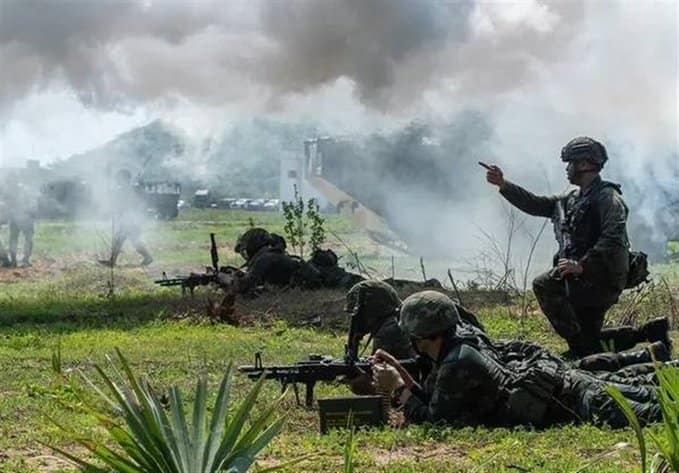
The simmering and historically fraught border dispute between Thailand and Cambodia erupted into open aerial warfare on Monday, December 8, 2025, marking a dangerous and dramatic escalation in Southeast Asia. The Royal Thai Air Force confirmed it conducted “precision strikes” against what it described as “encroaching Cambodian military installations” in the disputed border region surrounding the ancient Preah Vihear temple complex.
The operation, authorized by Thailand’s Security Council, comes after a weekend of intense skirmishes involving artillery and small arms fire that resulted in reported casualties on both sides. Thai military spokesmen stated the airstrikes were a “necessary and proportional response” to Cambodian forces “fortifying positions on sovereign Thai territory,” an assertion immediately and vehemently rejected by Phnom Penh.
Cambodian Prime Minister Hun Manet, in an emergency address, condemned the attacks as a “blatant act of aggression” and a “grave violation of international law.” He announced that Cambodia would immediately lodge a formal complaint with the United Nations Security Council and invoke its defense treaty with Vietnam, a move that threatens to draw a major regional power into the conflict. “Thailand’s reckless actions will have severe consequences,” Hun Manet warned, placing the country’s armed forces on their highest alert.
The Preah Vihear Flashpoint
The immediate conflict zone centers on the 11th-century Hindu temple of Preah Vihear (known as Phra Viharn in Thailand), a UNESCO World Heritage Site. The temple itself was awarded to Cambodia by the International Court of Justice (ICJ) in 1962, but the surrounding 4.6-square-kilometer territory remains fiercely contested. This area has been a recurring flashpoint, witnessing deadly clashes in 2008 and 2011 that displaced thousands. Recent months have seen a gradual buildup of forces and infrastructure by both sides, with diplomats warning of a potential tinderbox.
International Alarm and Calls for Restraint
The international response has been swift and deeply concerned. ASEAN Secretary-General, Dr. Kao Kim Hourn, called for an “immediate cessation of hostilities” and offered to facilitate emergency talks, highlighting the regional bloc’s fundamental principle of non-aggression. The United States, China, and the European Union have all issued statements urging maximum restraint and a return to dialogue.
Analysts note that the shift from border skirmishes to cross-border airstrikes represents a qualitative and perilous leap. “This is no longer a localized border clash,” said Dr. Thitinan Pongsudhirak of Chulalongkorn University in Bangkok. “The use of air power fundamentally changes the calculus. It internationalizes the conflict, invites potential foreign involvement, and makes de-escalation far more difficult. We are now in uncharted and very dangerous territory.”
Economic and Humanitarian Fallout
The clashes have already forced the evacuation of villages on both sides of the border, creating a new humanitarian crisis. Furthermore, the instability has spooked financial markets, with the Thai baht and Cambodian riel both weakening against the dollar, and regional stock indices falling on fears of prolonged conflict disrupting trade and tourism in the heart of mainland Southeast Asia.
The coming hours and days are critical. The world now watches to see if diplomatic channels can lower the temperature, or if retaliatory actions by Cambodia—potentially involving its own air force or long-range artillery—will plunge the two nations into their most serious military confrontation in over a decade, with unpredictable ramifications for the entire region.
About The Author