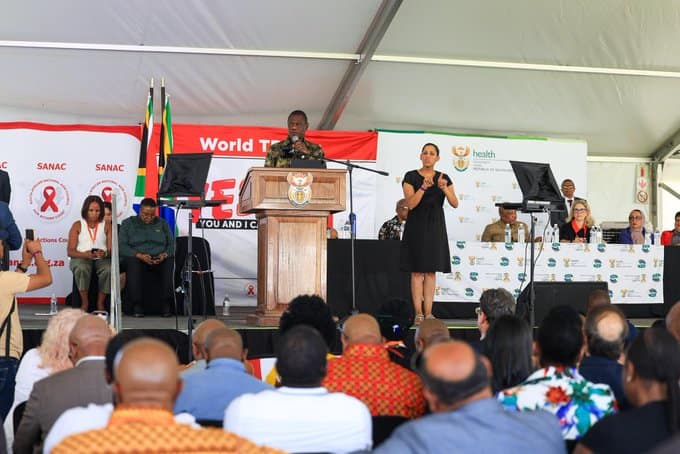
The sun rose over the Union Buildings in Pretoria on the morning of March 24, 2026, casting long shadows across the lawns where a large white tent had been erected for the national commemoration of World TB Day. Inside, hundreds of delegates had gathered—cabinet ministers and traditional healers, epidemiologists and former miners, activists who had spent decades in the trenches of South Africa’s twin epidemics of TB and HIV, and ordinary citizens whose lives had been irrevocably shaped by a disease that had, for generations, been whispered about as though it were a curse rather than a curable infection.
Deputy President Paul Mashatile arrived shortly before 10 a.m., his motorcade gliding through the gates with the quiet efficiency that accompanied high-level state functions. But this was not merely another political event on an overcrowded calendar. The announcement he was about to make had been weeks in preparation, the data verified by independent auditors, the implications debated in cabinet, the hopes of millions resting on the numbers that would soon be released to a nation that had grown weary of bad news about its public health system.
When Mashatile stepped to the podium, the crowd that had been buzzing with speculation fell silent. He adjusted the microphone, looked out over the sea of faces, and began to speak in a voice that carried both the weight of the moment and a measure of cautious triumph.
“Fellow South Africans, distinguished guests, health workers, and survivors who are with us today,” he began. “I stand before you to deliver a message that, twenty years ago, would have seemed impossible. A message that ten years ago was still a distant dream. A message that, even five years ago, many experts doubted we would live to see.”
He paused, allowing the anticipation to build.
“South Africa has achieved a 61 percent reduction in new tuberculosis cases compared to our baseline year of 2015. We have moved from being the country with the highest TB incidence rate in the world to a nation that is now recognized by the World Health Organization as having made the fastest progress of any high-burden country in the past decade.”
The applause that erupted was not the polite, perfunctory clapping that often accompanied political speeches. It was a spontaneous eruption of emotion—health workers embracing one another, some with tears streaming down their faces; activists who had lost friends and family members to the disease raising their fists in the air; survivors rising to their feet as though the standing ovation was for them, which in a very real sense it was.
Mashatile let the moment breathe, understanding that a statistic of this magnitude was not merely a number but a story composed of countless individual chapters of struggle, sacrifice, and survival. Behind the 61 percent figure lay years of policy battles, of funding fights, of communities organizing in the face of government neglect. It represented the lives of millions of South Africans who had been tested, diagnosed, and cured. And it represented, too, the lives that had been saved—the mothers who had lived to see their children grow, the fathers who had returned to work, the young people who had been spared a diagnosis that, in previous generations, had often been a death sentence.
When the applause finally subsided, Mashatile continued, his voice taking on a more somber register. “But let us be clear about what this achievement does and does not mean. A 61 percent reduction means that in 2015, we recorded approximately 450,000 new cases of tuberculosis in this country. Today, we are looking at roughly 175,000 new infections each year. That is 175,000 too many. Every single day, nearly 500 South Africans are diagnosed with TB. Every single day, more than 50 South Africans die from this disease. And every single death is a tragedy, because tuberculosis is a disease that we know how to cure.”
He turned to a large screen behind him, where a presentation began to unfold, breaking down the data into its component parts. The progress, it turned out, had not been uniform. The Western Cape and Gauteng had seen reductions exceeding 70 percent, driven by robust provincial health departments and strong civil society partnerships. The Eastern Cape and KwaZulu-Natal, by contrast, lagged behind, their reductions hovering around 45 percent, their rural districts still struggling with diagnostic delays and treatment interruptions that cost lives.
The Deputy President acknowledged these disparities without evasion. “We cannot celebrate a national victory while communities in Mthatha or Umlazi continue to bear a burden that their counterparts in Cape Town or Johannesburg no longer carry. The next phase of our fight must be about equity. It must be about ensuring that a person’s postal code does not determine their likelihood of being diagnosed, treated, and cured.”
About The Author