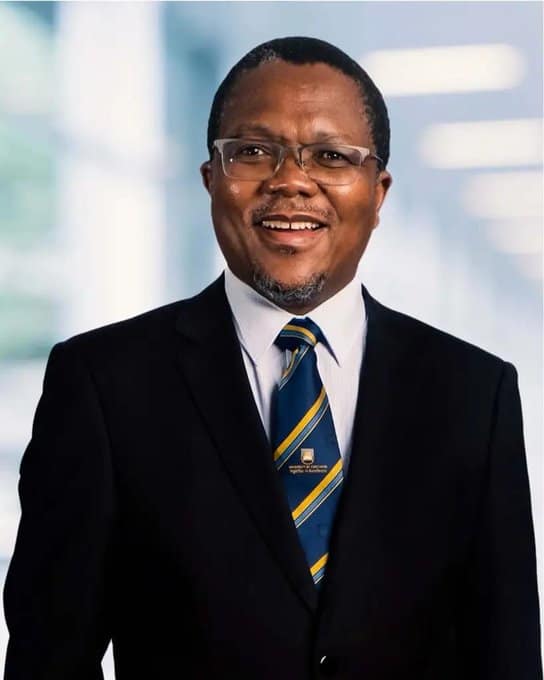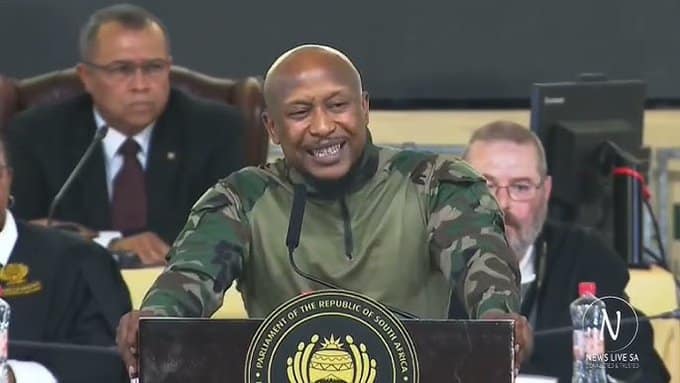
The Cape Town City Hall, already crackling with the high-voltage tension of the 2026 State of the Nation Address (SONA) debate, found a new flashpoint on Thursday, March 19. As President Cyril Ramaphosa sat listening to the parliamentary wrangling over his vision for the country’s future, a voice from the benches of the uMkhonto weSizwe (MK) Party rose to challenge not just the executive, but the very foundations of the state’s third arm.
Nhlamulo Ndhlela, the MK Party’s Member of Parliament and a former spokesperson for the party, took to the podium and immediately steered the conversation away from the usual topics of loadshedding and economic growth. He fixed his gaze on the judiciary, sparking fresh and urgent talks about who truly holds power in South Africa’s constitutional democracy.
“We speak of a better life for all,” Ndhlela began, his voice calm but carrying an undercurrent of steel, “but a better life cannot exist when the scales of justice are perpetually tilted. We cannot talk about economic freedom when judicial freedom—the freedom to get a fair hearing, the freedom from political persecution—is under threat.”
Ndhlela’s speech was a calculated and impassioned intervention in a long-simmering national debate. For years, critics from various political quarters, including his own party and the Economic Freedom Fighters, have alleged that the judiciary is not the neutral arbiter it claims to be. They point to a string of high-profile cases against progressive politicians, accusations of selective prosecution by the National Prosecuting Authority, and what they perceive as an “overreach” by courts willing to strike down executive decisions on procedural grounds.
“Stronger Checks and Balances”
The core of Ndhlela’s argument was not an attack on the concept of judicial independence, but a demand for greater accountability within that independence. He called for “stronger checks and balances” on the judiciary itself, a phrase that immediately sent ripples through the legal fraternity and the government benches.
“How do we hold the judges accountable?” Ndhlela asked the chamber. “We have the JSC (Judicial Service Commission), yes. But is it enough? Is it truly independent? Or has it become a club for the legal elite, protecting its own while the man on the street waits years for a judgment, or watches as politically connected individuals walk free while the poor rot in remand detention?”
He argued that the concentration of interpretative power in a few hands, without sufficient transparency in the appointment and disciplinary processes, was a danger to the democracy the judiciary was meant to protect. He did not name specific judges or cases, but the implication was clear: the MK Party believes the courts have been used as a tool to stifle radical political and economic transformation.
The Shadow of the “Zuma” Factor
It was impossible to separate Ndhlela’s address from the broader political context. The MK Party, formed in the wake of Jacob Zuma’s fallout with the ANC, has made judicial overreach a central plank of its platform. The former president’s own legal battles, including his imprisonment for contempt of court in 2021, have been framed by the party not as a consequence of rule-breaking, but as a political assassination by the judiciary.
Ndhlela, a close associate of Zuma, subtly invoked this sentiment. “We have seen what happens when a court decides it wants to be an activist,” he said, without mentioning names. “We have seen how the law can be used to remove leaders that the establishment does not like. The people see it. The people are not blind.”
This line of attack drew immediate, sharp responses from opposition parties. The Democratic Alliance’s legal affairs spokesperson jumped to their feet, accusing Ndhlela of “dangerous populism” and attempting to undermine the very institution that protects citizens from the abuse of state power. “The only check and balance the judiciary needs,” the DA MP retorted, “is the Constitution itself. To suggest otherwise is to walk the path of authoritarianism.”
A Nation Watching, A System Questioned
Despite the heated rebuttals, Ndhlela’s words resonated with a significant portion of the public watching the debate from home. For millions of South Africans, the justice system is a distant, expensive, and often incomprehensible entity. They see cases delayed for years, they see a vast disparity between the justice received by the wealthy and the poor, and they see high-profile political figures navigating the courts with expensive legal teams while the indigent accused wait endlessly for legal aid.
Ndhlela tapped into this frustration. He spoke of the “dual justice system”—one for the powerful and connected, and another for the poor. He called for reforms that would make the judiciary more representative, not just in terms of race and gender, but in terms of class and lived experience. He questioned why the highest courts in the land were still dominated by jurists from elite educational and professional backgrounds, arguing that this created a disconnect between the law and the lives of ordinary people.
“We need judges who know what it is like to queue for water,” he said passionately. “We need magistrates who understand why a mother steals bread to feed her child. The law must have a heart, and right now, for too many, it only has a hammer.”
The President’s Silence and the Road Ahead
President Ramaphosa, throughout Ndhlela’s speech, remained impassive, taking notes but offering no immediate reaction. The Presidency later declined to comment specifically on the MK MP’s remarks, reiterating the President’s longstanding position on respecting the independence of the judiciary.
However, the debate had been fundamentally shifted. Ndhlela had successfully introduced a motion of discomfort regarding the third arm of the state. Whether his call for “stronger checks and balances” would lead to any tangible parliamentary inquiry or legislative proposal remained to be seen. The MK Party is a relatively new and small opposition force, and such constitutional changes would require a supermajority.
Yet, as the City Hall emptied for the evening, the conversation among political analysts, journalists, and ordinary citizens lingered on Ndhlela’s central question: In a mature democracy, who watches the watchers? For the MK Party, and for Nhlamulo Ndhlela, the answer cannot be “no one.” His speech ensured that, for the remainder of the SONA debate and beyond, the spotlight would remain fixed on the judiciary, forcing a nation to confront the uncomfortable question of whether its temples of justice are accessible to all, or whether they have become fortresses for the few.
About The Author