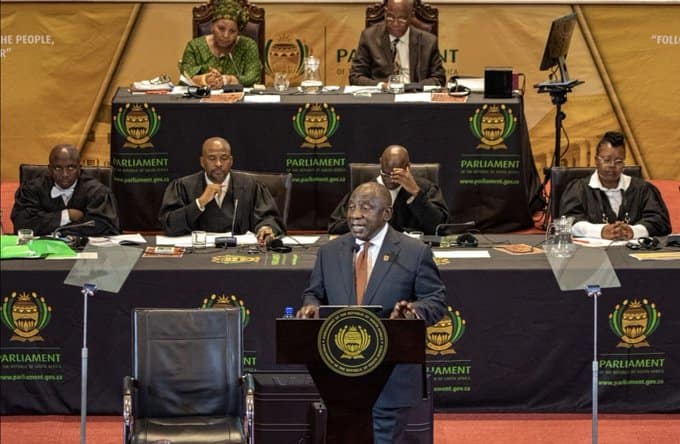
The gilded chambers of Parliament in Cape Town, usually a place of measured procedure and parliamentary etiquette, have been transformed into a gladiatorial arena. This week, as lawmakers dissected President Cyril Ramaphosa’s 2026 State of the Nation Address (SONA), the air crackled not with the static of microphones, but with the raw voltage of political tension. The debate, a constitutional requirement, has become a fierce battleground where the soul of the nation’s future is being hotly contested, with the economy, crime, and corruption serving as the principal weapons.
It was the Leader of the Opposition who drew first blood. Rising from his bench with the coiled energy of a predator, he dispensed with the customary pleasantries. “We have just heard a State of the Nation Address that was a masterpiece of fiction,” he thundered, his voice echoing off the mahogany woodwork. “A beautifully scripted fairy tale designed to mask a grim reality. The President spoke of a ‘phoenix rising,’ but Mr. Speaker, the people of South Africa are living in the ashes.” He slammed a sheaf of papers onto the podium—unemployment statistics, crime reports, forensic audit summaries. “These are not the embers of renewal. These are the cold, hard facts of failure.”
The ruling party benches erupted in a chorus of objections and counter-accusations, but the opposition had successfully landed the first blow, setting the tone for a day of bruising exchanges.
The economy, sluggish and gasping for air, was the first major wound to be probed. The Minister of Finance, seated stoically in the front row, became the silent target of a barrage of criticism. Opposition MPs from various parties took turns painting a picture of a nation in decline: load-shedding may have abated, they argued, but its scars remained in the form of shattered small businesses and massive debt. They pointed to youth unemployment figures, which hovered at catastrophic levels, as the single greatest indictment of the government’s economic policy.
“The President spoke of a ‘new dawn’ of growth,” jabbed a fiery MP from a smaller opposition party, known for her economic acumen. “But for the millions of young people sitting at home, unable to afford university, unable to find a job, unable to even buy a loaf of bread, it is not a dawn. It is a perpetual, unending midnight. Where are the jobs, Minister? Where is the tangible hope?”
The ruling party’s economic spokespersons fired back, pointing to tentative gains in investor confidence and the success of the infrastructure fund. They accused the opposition of “talkshop pessimism” and of trying to talk the country into a recession. “You cheer for failure,” one senior ruling party MP accused, pointing a finger across the aisle. “You want the patient to fail so you can say ‘I told you so.’ We are focused on the cure.”
But if the economy was a bleeding wound, crime was a festering infection that refused to heal. The debate took a darker, more personal turn as MPs recounted the harrowing stories from their constituencies. A grandmother from Soweto, beaten in her own home during a house robbery. A spaza shop owner in the Cape Flats, gunned down in a protection racket shakedown. A farmer in the Free State, living behind electrified fences in a state of constant siege.
“The SONA spoke of strengthening the police service,” an opposition MP from a rural constituency said, his voice heavy with frustration. “But Mr. Speaker, in my town, the police station closes at 4 PM because there aren’t enough officers for a night shift. The criminals know this. They have a watch, and they have a timetable. The state has abandoned the people to the mercy of armed thugs.” He called for a full declaration of a national state of emergency on crime, a proposal that was met with cautious silence from the government benches.
The ruling party’s defense rested on the recently launched crime-fighting strategy and the visible deployment of the South African National Defence Force in high-crime areas. But their arguments were constantly undermined by the third, and most toxic, element of the debate: corruption.
It was the ghost at the feast, the unspoken weight that bent every conversation. Opposition MPs were relentless, linking the government’s failures directly to the systemic rot of graft and patronage. They cited recent reports from the Auditor-General, pointing to billions of rands in irregular, fruitless, and wasteful expenditure across all spheres of government. They demanded to know what had happened to the promises of consequence management made years ago.
“We are asked to believe in a recovery,” a seasoned opposition veteran said, his voice dripping with sarcasm, “when the very hands steering the ship are still reaching into the treasury cookie jar. You cannot fight crime when some in your own ranks are in cahoots with the criminals. You cannot fix the economy when tenders are awarded not to the most capable, but to the most connected. The rot starts at the top, and it trickles down until it drowns us all.”
This accusation drew the most heated response. A senior cabinet minister, known for his fiery oratory, rose to defend the integrity of the administration. “We are not the ones who institutionalized corruption!” he shouted, his face flushed. “We are the ones who established the investigating agencies! We are the ones who are cleaning the Augean stables! The opposition wants you to believe the stables are just as dirty because they have nothing else to offer but cynicism!”
As the sun set over Table Mountain, casting long shadows through the parliamentary windows, the debate raged on. There were no knockout blows, no moments of sudden clarity. Instead, there was the slow, grinding work of democracy: accusation and defense, blame and counter-blame, hope and despair wrestling in the hallowed halls of power.
Outside, on the manicured lawns of the parliamentary precinct, a handful of protesters from a civil society group held up placards. “Our Lives Are Not a Debate,” one read. “Action Now.” Their silent vigil was a stark reminder that beyond the polished rhetoric and sharp political point-scoring, there were millions of South Africans simply waiting for their leaders to stop arguing about the fire and finally, together, start putting it out. The debate would continue for another day, but the questions it raised would linger long after the microphones were switched off.
About The Author