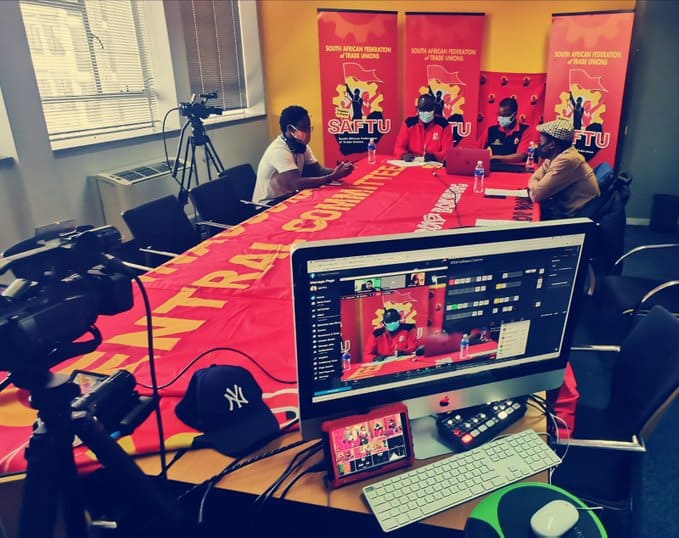
The South African Federation of Trade Unions (SAFTU) has issued a blistering condemnation and a urgent call to arms, declaring that the nation is in the grip of a “silent economic emergency.” The federation warns that a relentless wave of factory shutdowns and corporate disinvestment is systematically dismantling the country’s manufacturing base, threatening to relegate South Africa to a mere “warehouse economy”—a nation that merely imports and sells goods, rather than producing them.
“This is not a cycle; it is a culling,” said SAFTU General Secretary, Zwelinzima Vavi, addressing a sombre gathering of union officials and recently retrenched workers in Ekurhuleni, the historical heart of South African industry. “We are witnessing the deliberate deindustrialization of our nation. Every factory gate that is chained shut, every production line that falls silent, represents a direct attack on our sovereignty, our skills base, and the livelihoods of thousands. We are becoming a glorified mall for foreign goods, and our people are being reduced to shelf-stackers and delivery drivers.”
The Bleak Landscape: More Than Just Numbers
SAFTU’s alarm is backed by a grim tapestry of recent closures spanning sectors and provinces. The federation presented a dossier highlighting:
- The Food Security Shock: The sudden closure of a major fruit and vegetable canning plant in the Western Cape, citing unsustainable input costs and cheaper imported alternatives, has left 800 permanent and nearly 3,000 seasonal workers jobless, devastating several farming towns.
- Textile Trauma: In KwaZulu-Natal, a 40-year-old textile factory that once employed over 1,200 people will shutter its doors next month, the final victim of a long struggle against a flood of cheap Asian imports. The local municipality estimates the indirect loss of a further 2,000 jobs in supporting industries.
- Automotive Aftershocks: While new vehicle assembly plants grab headlines, the crucial component manufacturing sector is bleeding. Several medium-sized foundries and parts suppliers in the Eastern Cape and Gauteng have closed, citing unreliable energy supply, port delays crippling exports, and the exodus of major anchor clients.
“The narrative is always about ‘global pressures’ and ‘restructuring’,” said Nomsa Dlamini, a shop steward who worked at the KZN textile factory for 22 years. “But what it means is my daughter must now leave school to help at home. It means the pharmacy in town is closing because we have no medical aid. It means the factory isn’t just a building; it was the pulse of this community, and now it’s flatlining.”
The Warehouse Economy: A Nation of Traders, Not Makers
SAFTU’s central thesis is the dangerous transition to a “warehouse economy.” This model, they argue, is characterised by the proliferation of massive logistics parks and distribution centres for multinational retailers, juxtaposed against the skeletons of production facilities.
“Look at the maps of investment,” explained SAFTU economist, Dr. Naledi Mokoena. “Capital is flooding into storage sheds and toll roads for trucks, not into machine shops or R&D labs. We are investing in the infrastructure of consumption, not production. This creates a handful of low-wage, precarious jobs in logistics while annihilating higher-wage, skilled positions in manufacturing. It entrenches our trade deficit, weakens the Rand, and makes us utterly vulnerable to global supply chain shocks.”
The federation argues that this shift is a policy failure, exacerbated by persistent load-shedding, dysfunctional ports and railways, policy uncertainty, and a perceived lack of a coherent industrial strategy. They accuse the government of being “asleep at the wheel” while other nations actively protect and nurture their industrial capabilities.
Call for a “War Room” and Radical Policy Shift
SAFTU has moved beyond criticism to present a list of non-negotiable demands, framing them as essential for national survival:
- The Establishment of an Economic Crisis “War Room”: A tripartite taskforce—with real power and including labour, business, and government—to intervene at the first sign of a major planned closure, exploring all options from worker buyouts to state-assisted rescue packages.
- Strategic Use of Procurement and Tariffs: Demanding that the state leverage its massive procurement power to favour locally manufactured goods and review trade agreements that expose key industries to “dumping.”
- An Emergency Energy and Logistics Guarantee: Prioritising uninterrupted power supply and efficient port access for identified strategic manufacturers, with severe penalties for SOE failures in this regard.
- A Moratorium on Retrenchments: Calling for legislation that makes large-scale retrenchments an absolute last resort, forcing companies to transparently open their books and prove all alternatives have been exhausted.
“The soul of a nation is built in its workshops and factories, not in its shipping containers,” Vavi concluded, his voice rising. “We are calling for a national mobilisation. To the government: act with the urgency this disaster demands. To the private sector: your social license to operate is evaporating. And to our members and the working class: prepare for sustained, militant action. We will not stand by and watch the industrial pillars of our country be sold for scrap.”
The ball is now in the court of the state and corporate South Africa. Whether SAFTU’s fiery warning will ignite a substantive policy response or simply echo through the empty shells of former factories remains the country’s most pressing economic question.
About The Author