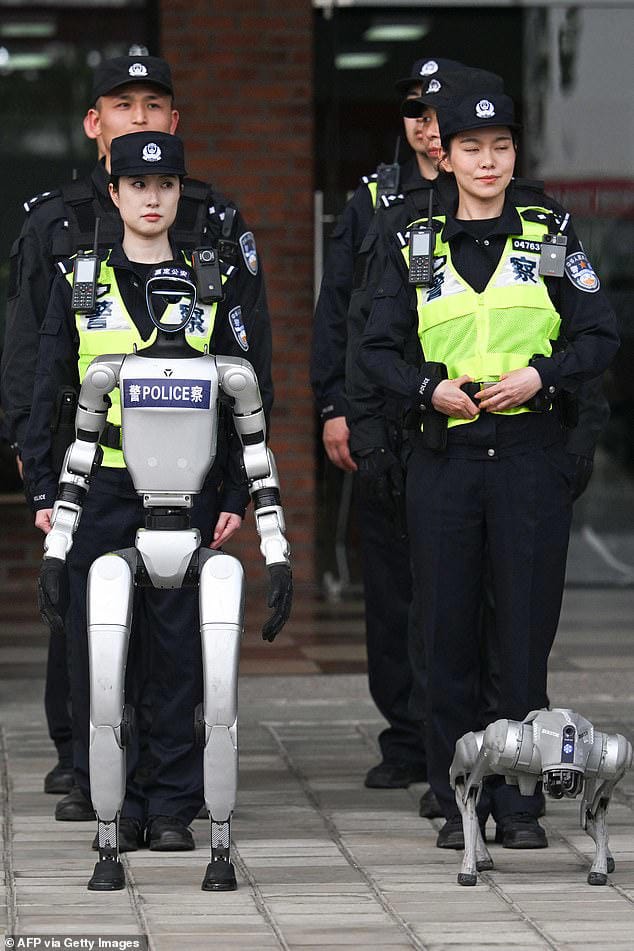
The future of law enforcement was on display at the Chinese Formula 1 Grand Prix, where police unveiled two advanced robotic units patrolling the Shanghai International Circuit. The new “officers”—a humanoid named G1 and a robotic dog called GO2—showcased China’s rapid advancements in robotics for public security.
Manufactured by the Chinese firm Unitree, the robots are designed for active monitoring. The G1 humanoid, standing 4 feet 3 inches tall, can carry up to 3kg and move at a brisk walking pace of 5mph. Its canine counterpart, the GO2, is even more robust, capable of carrying 12kg and reaching a running speed of 11mph. Both utilize LiDAR technology to navigate and map their surroundings with precision.
Promotional footage from Unitree highlighted their dynamic capabilities. The G1 was seen demonstrating agility by dancing and expertly maneuvering a bo staff, while the GO2 displayed animal-like movements, jumping and even playfully balancing on its front paws.
This real-world deployment comes amid a flurry of announcements in the global robotics race. Just days earlier, chipmaker Nvidia unveiled “Blue,” an adorable, Wall-E-esque robot developed in collaboration with Google and Disney. Introduced by CEO Jensen Huang at a major AI conference, Blue waddled on stage to the delight of the audience, though it was later revealed the demonstration was remotely controlled.
Not to be outdone, industry pioneer Boston Dynamics released a new video of its Atlas humanoid performing an impressive gymnastics routine complete with cartwheels, handstands, and breakdancing moves, showcasing the fierce competition driving innovation in the sector.
The use of Unitree’s robots at a high-profile international event like the F1 Grand Prix signals a significant step toward the integration of autonomous systems into public safety and crowd management, moving beyond controlled demonstrations and into active, real-world application.
About The Author