The public broadcaster’s headquarters in Auckland Park has the worn grandeur of a once-magnificent vessel now permanently moored in shallow waters. The corridors, lined with photographs of legendary presenters and historic broadcasts, retain the institutional memory of an era when the SABC was not merely a broadcaster but a national project—a voice that reached into every corner of the country, every language community, every living room where South Africans gathered to understand themselves and their world.
That era has receded into memory. The SABC of 2026 is a corporation in chronic crisis, bleeding talent and revenue, its infrastructure deteriorating, its audience fragmenting, its relevance diminishing with each passing budget cycle. It has survived through a combination of government guarantees, commercial loans, and the dogged persistence of employees who remain committed to the public broadcasting ideal despite conditions that would have driven less dedicated professionals to seek employment elsewhere.
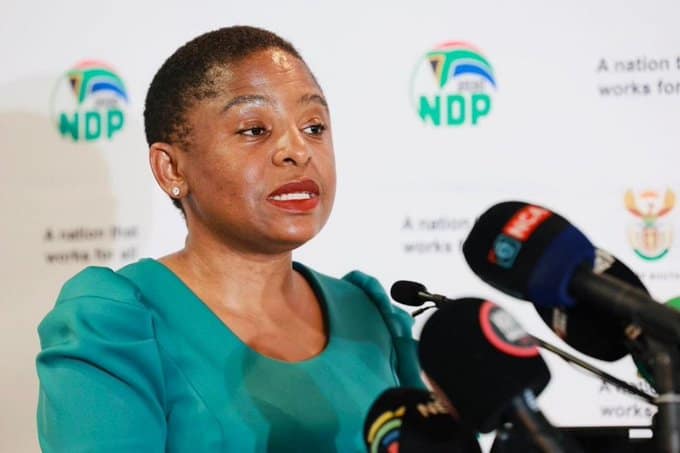
Now, the government signals that relief may finally be approaching. Minister in the Presidency Khumbudzo Ntshavheni, speaking to journalists following President Cyril Ramaphosa’s State of the Nation Address, confirmed that Finance Minister Enoch Godongwana will use his 25 February 2026 Budget Speech to unveil a comprehensive package of measures designed to place the SABC on a sustainable financial footing.
“The SABC is a strategic asset of the Republic,” Ntshavheni said. “It is not merely a broadcaster. It is the repository of our national memory, the platform for our cultural expression, the medium through which millions of South Africans access information essential to their participation in democratic life. Its survival is not optional. Its success is not negotiable. Minister Godongwana will outline the measures necessary to ensure both.”
The announcement, carefully calibrated to generate maximum anticipation without revealing specific details, has been received with cautious optimism by SABC management and qualified skepticism by media analysts who have observed multiple previous rescue attempts produce limited and temporary results.
The Anatomy of Decline
To understand why the SABC requires yet another government intervention, one must understand the accumulated pathologies that have brought the corporation to its current condition.
The public broadcaster’s financial crisis is neither sudden nor recent. It has been developing for more than two decades, the product of multiple reinforcing factors: declining advertising revenue as audiences fragment across digital platforms; chronic underfunding of the public service mandate; governance failures at board and executive level; political interference in editorial and operational decisions; and the accumulated burden of legacy costs, including pension obligations and redundant infrastructure.
The television license fee, theoretically the SABC’s primary source of public funding, has become a collection catastrophe. Compliance rates have fallen below 30%, with millions of households simply refusing to pay a levy they regard as unjustified given the declining quality and relevance of the services it supposedly funds. Attempts to reform the license fee model—including proposals to replace it with a household levy collected through municipal rates or a dedicated broadcasting tax—have foundered on political opposition and implementation complexities.
Advertising revenue, historically the SABC’s financial lifeline, has migrated to digital platforms at an accelerating rate. The corporation’s television channels and radio stations continue to reach substantial audiences, particularly among older and lower-income demographics, but these audiences are increasingly unattractive to advertisers seeking younger, more affluent consumers. The result is a structural revenue deficit that cannot be closed through operational efficiencies alone.
The SABC has responded through successive rounds of cost cutting that have impaired its ability to fulfill its public mandate. Newsrooms have been reduced to skeletal crews. Local content production has been outsourced to independent producers, eroding in-house creative capacity. Infrastructure maintenance has been deferred to the point where transmission equipment in several provinces operates at risk of catastrophic failure.
“We have been running the organisation on a diet of hope and duct tape,” said a senior SABC manager who spoke on condition of anonymity. “Every year, we produce a budget that assumes revenue growth that does not materialize. Every year, we implement cost reductions that impair our ability to deliver the services our mandate requires. Every year, we approach government for assistance and receive promises that are only partially fulfilled. We are exhausted. The organisation is exhausted. We cannot continue this way.”
The Promise of Intervention
Minister Godongwana’s forthcoming budget announcement has been positioned as a decisive break from this pattern of inadequate, temporary interventions. The measures under consideration, according to officials familiar with the planning process, include both immediate liquidity support and longer-term structural reforms.
The immediate component is expected to include a direct capital injection sufficient to address the SABC’s most pressing financial obligations, including outstanding supplier payments and imminent debt servicing requirements. The quantum of this injection has not been disclosed, but informed estimates suggest a figure in the range of R3 billion to R5 billion—substantial enough to stabilize the corporation’s balance sheet but insufficient to address its underlying structural deficits.
The structural component is both more significant and more politically contentious. Officials have confirmed that Godongwana will announce a comprehensive review of the television license model, with a view to replacing the current voluntary system with a mandatory household levy collected through an existing state revenue mechanism. The precise design of the new system remains under discussion, with options including collection through municipal property rates, the South African Revenue Service’s tax assessment process, or the Department of Home Affairs’ population registration database.
“The current license fee system is broken beyond repair,” said a Treasury official involved in the policy development process. “It is inequitable, inefficient, and almost entirely unenforceable. We are spending millions of rands pursuing collections from a shrinking minority of compliant households while the majority simply ignore their obligations. This cannot continue. We need a system that is universal, mandatory, and administratively sustainable.”
The official acknowledged that any new funding mechanism would face political opposition from constituencies resistant to additional household levies. “There is no perfect solution,” he said. “Every option has trade-offs. Our task is to identify the option that minimizes negative consequences while ensuring the SABC has the predictable, adequate funding it requires to fulfill its public mandate.”
About The Author