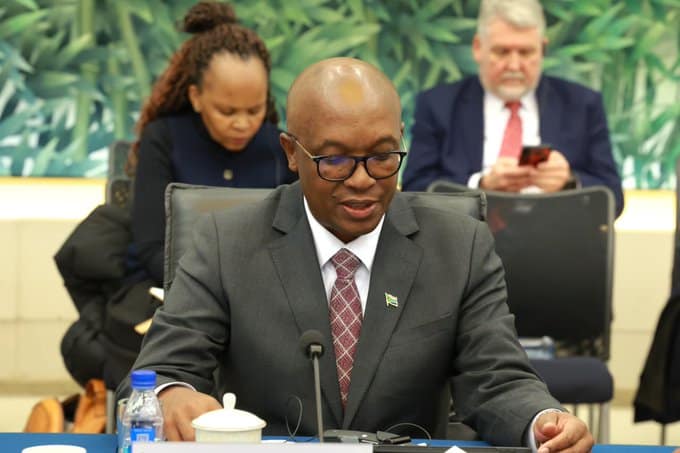
In a strategic move to deepen economic ties and navigate complex global trade headwinds, South Africa’s Minister of Trade, Industry and Competition, Parks Tau, is spearheading a high-level delegation at the 8th Session of the South Africa-China Joint Economic and Trade Commission (JETC) in Beijing. The high-stakes talks, held with his Chinese counterpart, Minister of Commerce Wang Wentao, aim to rebalance and future-proof a critical bilateral relationship that is both South Africa’s largest global trading partner and a source of growing economic complexity.
The delegation, comprising senior officials from the Department of Trade, Industry and Competition (the dtic), the Department of Mineral Resources and Energy, and business leaders from key sectors, underscores the multifaceted agenda. The meetings come at a pivotal time as South Africa seeks to leverage its membership in BRICS and the African Continental Free Trade Area (AfCFTA) while addressing domestic concerns over trade deficits, industrialisation, and job creation.
Core Agenda: Moving Beyond Raw Materials
While the broad framework of cooperation is well-established, Minister Tau’s mission is widely seen as an effort to pivot the relationship toward a more value-added and reciprocal model. Key discussion points include:
- Trade Imbalance and Market Access: South Africa aims to secure greater access for value-added products in the vast Chinese market, particularly for agro-processed goods (citrus, beef, wine), advanced manufactured components, and consumer goods. This is a direct strategy to address the persistent trade deficit, where South African exports are dominated by mineral resources like iron ore, manganese, and chromium.
- Industrial Development and Investment: A central pillar of the talks is attracting strategic Chinese investment into South Africa’s priority sectors under the “re-imagined industrial strategy.” This includes green energy (solar, wind, EV battery production), automotive manufacturing, pharmaceuticals, and digital infrastructure. Minister Tau is expected to advocate for partnerships that involve technology transfer and local skills development, moving beyond purely extractive or infrastructural projects.
- BRICS and AfCFTA Synergy: The discussions will explore how South Africa can act as a gateway for Chinese investment into the broader AfCFTA market, while also leveraging the BRICS platform for co-investment in African infrastructure and industrial projects. Aligning Chinese technological and financial capacity with Africa’s integration agenda is a key strategic goal.
- Policy Dialogue and Dispute Resolution: The JETC serves as a crucial mechanism to address long-standing regulatory and non-tariff barriers, such as phytosanitary standards for agricultural products. Streamlining processes and improving dialogue are essential for building trader confidence.
Navigating Geopolitics and Domestic Pressures
Minister Tau’s diplomacy requires a delicate balance. He must advance economic interests while navigating geopolitical sensitivities, including U.S. concerns about over-reliance on Chinese technology and South Africa’s own need for a diversified foreign policy. Domestically, he faces pressure from labour and industry to ensure new deals protect local manufacturers and create tangible employment, countering perceptions of a relationship that primarily benefits commodity exporters.
Analyst Perspective: A Test of Economic Diplomacy
“This JETC is more significant than most,” said Dr. Mmatlou Kalaba, a leading trade economist. “Minister Tau is not just managing a trade relationship; he is testing whether South Africa can use its political capital within BRICS and its geographic advantage in Africa to negotiate an economic partnership that genuinely supports its own re-industrialisation. Success will be measured not in MOUs signed, but in concrete, job-creating investments and measurable growth in non-mineral exports to China.”
The outcomes of the Beijing talks are expected to set the tone for bilateral economic relations for the coming years. As the delegation engages in closed-door sessions, the South African business community and public await signs that this critical partnership is evolving into one that more directly fuels the nation’s industrial growth and economic sovereignty.
About The Author