The dawn came grey and indifferent over Melville, the kind of Johannesburg morning that usually promises nothing more than the low growl of taxis on Main Road and the first queues for coffee on Fourth Avenue. But today, the coffee shops remained locked, their espresso machines silent, their owners standing instead on the pavement with empty buckets at their feet and homemade placards in their hands. The sound that rose with the sun was not the hiss of steam wands but the rhythm of chanting, the slap of cardboard against palms, the collective roar of people who had been patient for too long and had finally, irrevocably, run out.
The protest began quietly, almost reverently, as residents emerged from their front doors and walked toward the intersection of Main Road and Fourth Avenue. They came carrying the evidence of their suffering: five-litre bottles filled from mosque taps, collapsible jerry cans donated by neighbours, the small plastic buckets children normally used for bath toys, now pressed into service for drinking water. Josephine Kloeckner arrived before seven, her hands empty because she had nothing left to carry. For fifteen days, she told the woman beside her, it felt as though her street had ceased to exist on any municipal map. No updates. No tankers. No apologies. Just an automated response on Johannesburg Water’s social media pages suggesting she use less water, as though her taps had been running freely and she had simply chosen to turn them off .
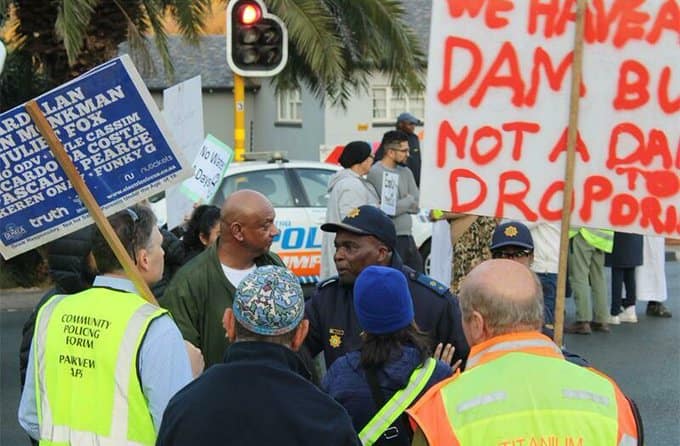
By eight o’clock, the intersection was impassable. Motorists approaching from Jan Smuts Avenue found their path blocked by a wall of bodies and placards. Some honked in irritation; others, after a moment’s hesitation, rolled down their windows and honked in solidarity. A delivery driver climbed out of his van and stood with the protesters for ten minutes before remembering his cargo. An elderly woman in a Mercedes lowered her passenger window and shouted, “About bloody time,” before executing a three-point turn and disappearing back toward Parktown. The protesters did not block traffic out of malice, one resident later explained. They blocked it because it was the only language the city seemed to understand .
The faces in the crowd told the true story of the crisis. There was John Brown, a father from Westdene, whose children had missed a full week of school because he could not wash their uniforms or prepare their breakfast. “My children cannot go to school because we cannot prepare them,” he said, his voice cracking not with anger but with the particular exhaustion of a man who has failed, through no fault of his own, in the basic parental task of sending clean, fed children into the world. “Schools are open and operating, but they are missing out because of this issue” .
Beside him stood Sarah Taylor, her phone open to a photograph of her son. “He takes medication,” she said quietly. “And I cannot afford to make him drink water from the tanker. I need to buy water and make sure it is always available at home for his medication.” The tankers that occasionally appeared in her street arrived without schedule and departed without warning. Sometimes the drivers attempted to sell the water, knowing that desperation has a price. Sarah Taylor had spent R400 in the past week on bottled water alone, money budgeted for her son’s school supplies, now flowing down the throats of a family who had paid their municipal account in full every month for nineteen years .
Further down the road, Alf and Veronique stood together, leaning against each other with the comfortable weight of forty-seven years of marriage. Alf was eighty years old; Veronique, seventy-one. They had lived in Melville since 1979, through apartheid’s dying days and democracy’s birth, through boom times and recessions, through burst pipes and temporary outages that never lasted more than a week. But this was different. This was day twenty-three. “There have been times where we haven’t had water for a week, sometimes maybe for ten days,” Alf said, his voice steady but his hands trembling slightly as he gripped his walking stick. “But we are moving into the third week of our taps being completely dry” .
The collection point where Alf and Veronique queued each morning was not provided by the city. It was built by residents, funded by residents, staffed by volunteers who rotated shifts to ensure their neighbours could collect fifty litres per person per day. The tanks themselves belonged to Johannesburg Water, but everything else—the piping, the taps, the roster system, the delivery service for those too frail or too ill to carry their own water—had been organised by a community abandoned by its government. The volunteers had become de facto social workers, identifying vulnerable households, arranging transport, mediating disputes when tempers flared over allocation. They had not signed up for this. They had signed up for neighbourhood watch and street clean-ups and the occasional fundraiser for the local primary school. Now they managed a humanitarian operation in the heart of one of Johannesburg’s most desirable suburbs .
The protesters were not the wealthy elite that popular imagination might conjure. Melville is a suburb of contradictions: students in cramped shared houses, pensioners in original period homes, artists in converted studios, young professionals in renovated cottages. Sharon Nkomo, a university student, had walked two kilometres to find a water truck, her plastic buckets clattering against her legs. “The academic year has just started, and we should be focusing on our studies,” she said, her voice thick with exhaustion. “But we are out here searching for water on a daily basis.” Her textbooks sat unopened on her desk. Her first assignment was due in four days. She had not yet written a word .
At the corner of the protest, a small group had gathered around Jenny Gillies, a Melville resident whose TikTok video had inadvertently become one of the morning’s most shared artifacts. In it, she simply spoke about her experience, her voice steady, her eyes betraying the fear she refused to name. The video was reposted hundreds of times, not because it was dramatic or inflammatory, but because it was ordinary. It was the voice of someone who had stopped believing that anyone was listening. “We want water,” the crowd chanted, the rhythm rising and falling like a heartbeat. “We want water. We want water” .
Ward 87 councillor Kyle Jacobs moved through the crowd like a doctor in a field hospital, assessing, listening, validating. He did not make promises; the residents would have rejected them anyway. Instead, he stood among them, his face grim, his notebook full. “The water crisis is unacceptable,” he said, his voice carrying above the chanting. “Some residents have been without water for 23, 24 days. It has honestly reached a crisis point. We cannot continue like this. People have been driven to protest because their constitutional rights are being affected” .
Section 27 of the Constitution of the Republic of South Africa guarantees every person the right to access sufficient water. The residents of Melville did not need a lawyer to tell them this. They felt it in their dry throats, in their unwashed hair, in the shame of offering guests a glass of store-bought water from a plastic bottle. They paid their rates and taxes. They voted in every election. They reported burst pipes through the official channels and received automated responses that disappeared into the municipal void. And now they stood on a street corner, chanting, because the Constitution did not seem to have made it as far as the Johannesburg Water control room .
The proximate cause of the crisis, insofar as anyone could determine through the fog of conflicting statements, was the Commando System. This network of reservoirs and pumps, which supplies Melville and several surrounding suburbs, had been operating under severe strain for weeks. The Brixton reservoir was low to empty, its outlets closed in a desperate attempt to build capacity. The Brixton tower was similarly depleted, a victim of reduced pumping and demand that the system was never designed to meet. Hursthill 1 and 2, the reservoirs that directly served Melville, had been placed on bypass. They relied on a stable supply into the Commando system, but that stability had collapsed. Johannesburg Water acknowledged that the system was constrained, that subsystems were critically low, that customers in higher-lying areas could expect poor pressure or no water at all. What it did not acknowledge was that this was not a temporary crisis but a permanent condition .
The explanations shifted like sand. First, it was maintenance. Then, a strike. Then, high consumption by residents who were, according to Rand Water, simply using too much. The Democratic Alliance, briefing the media in Johannesburg even as the protest swelled, called out this narrative with unusual ferocity. “The residents cannot be blamed for the incompetence,” said Gauteng leader Solly Msimanga. “They cannot be blamed for the lack of proper planning.” The intergovernmental relations task team that officials touted as a new solution had, Msimanga noted, been implemented two years ago with no discernible results. It was not a plan; it was a press release dressed in a suit .
But the residents were not listening to politicians. They were listening to each other. Bridget van Oerle, standing near the front of the protest, watched the crowd grow and felt something she had not experienced in weeks: hope. “It’s fantastic that people have come out,” she said. “Citizens need to be active if they want change.” She ticked off the affected suburbs on her fingers: Westdene, Richmond, Coronationville, Westbury, Emmarentia, Parktown. This was not an isolated outage; it was a systemic failure radiating outward from a municipal core that had been hollowed out by decades of neglect. The infrastructure was aging, the maintenance deferred, the expertise eroded by years of budget cuts and political interference. Residents had been complaining about burst pipes for over a year, Lizz Meiring told reporters. Nobody came. Nobody fixed them. The pipes continued to leak, and the water continued to disappear into the ground, and the residents continued to pay for water they never received .
In Parktown West, the protest had its own distinct texture. Hermain Geldenhuys stood with her neighbours on the corner of Jan Smuts Avenue and Seymour Road, clutching a placard that read simply: “22 Days. 0 Answers.” In the past, she explained, the longest her household had gone without water was five to seven days. This was unprecedented. This was unbearable. The strain on families with young children, elderly relatives, and frail care needs had become immense. “It affects everything,” she said. “From getting children ready for school and going to work, to basic hygiene and cooking. The mental and emotional pressure is immense” .
Nearby, ninety-two-year-old Gilly Pirow stood with the protesters, her frame frail but her resolve immovable. She had lived through the Depression, through the war, through the transition from apartheid to democracy. She had never expected to spend her ninety-third year queuing for water on a Johannesburg street corner. When a reporter approached her, she declined to speak at length; her voice, she said, was tired. But she held her placard steady, and her eyes, when they met the camera, were clear and unyielding. She had paid her taxes for seventy years. She had voted in every election since 1994. She had watched her country grow and stumble and grow again. She had not expected to end her life begging for water .
The protests were not, as some officials suggested, spontaneous eruptions of isolated discontent. Dr Ferrial Adam of JoburgCAN, who had been monitoring the water outages across Johannesburg for months, described them as a coordinated response to a coordinated failure. “We have been monitoring the water outages across Johannesburg, and there is a serious problem where the government continues to say there is no issue, despite what communities are experiencing on the ground,” she said. The protests in Melville, Parktown West, and Emmarentia were not orchestrated by any single organisation; they were organic convergences of people who had independently arrived at the same conclusion: the system was not broken. It was functioning exactly as designed, and its design did not include them .
The problem, Adam explained, was structural. The city had no ring-fenced budget dedicated solely to water and sanitation. Until it did, officials would continue to fight fires rather than prevent them. The crisis in Melville was not an anomaly; it was a preview. “We’re in a crisis,” she said. “If they do what we’re saying they must do now, I think we can avoid a worse crisis where this just becomes the norm.” But the clock was running, and the taps remained dry, and the norm was already shifting beneath their feet .
At the business owners’ end of the protest, Tatiana Grabow stood outside her music studio on Fifth Avenue, her arms crossed, her expression a study in controlled fury. She had installed two thousand-litre water tanks at her own expense, an investment that had seemed prudent when she made it. Now, after five or six days without any inflow from Johannesburg Water, even those tanks were running dry. That morning, she had paid R2,000 to have them refilled by a private supplier. That was money she had been saving for new equipment: microphones, a second-hand iPad, small investments in the business she had built from nothing. Those purchases would wait. The water would not .
She was one of the lucky ones. She acknowledged this freely, without bitterness. She had the financial resources to install tanks, to pay for deliveries, to absorb the unexpected costs that the crisis imposed. But what about the hair salon down the street? What about the restaurant on Fourth Avenue, its kitchen silenced, its reservations cancelled, its staff sent home without pay? What about the elderly couple in the cottage behind her studio, who survived on pensions and had no savings for emergency water purchases? The crisis was not democratic. It struck hardest at those least equipped to withstand it. And it revealed, in stark relief, the fragility of the social contract that was supposed to guarantee every citizen the dignity of sufficient water .
Darryl Gouws, chairperson of the Melville Residents Association, did not use the word “crisis.” He used the word “humanitarian.” Fifteen hundred households, each limited to fifty litres of water per day. Fifteen thousand litres of emergency storage for a population that needed ten times that amount. Community water tankers that were supposed to be filled by Johannesburg Water but sat empty because the utility had failed to replenish them. A completion date for repairs that had already slipped from April to December, with no guarantee that December would hold. “This morning, we had an angry crowd because the tanks were empty,” Gouws said. “There is a constitutional mandate to provide water tankers when there’s no water. That mandate is not being met” .
The angry crowd did not riot. They did not vandalise property or confront officials or commit the acts of civil disorder that authorities privately feared. They simply stood in the road, chanting, holding their placards, refusing to disperse until someone acknowledged that they existed. And eventually, someone did.
At 8:38 that morning, Johannesburg Mayor Dada Morero arrived at a media briefing near the protest site. He did not make it inside before a Brixton resident intercepted him. The confrontation was brief, intense, and entirely unscripted. The resident, whose name was never recorded, spoke not as a political activist or community organiser but as a man who had spent years watching his taps run dry each night and had finally lost patience with official explanations. He did not shout. He did not gesture wildly. He simply stood before the mayor of his city and described, in precise and damning detail, the accumulated failures of a decade. Morero listened. He did not interrupt, did not defend, did not deflect. When the resident finished, Morero committed to engaging directly with affected communities .
It was a small moment, easily lost in the noise of a day crowded with protests and press conferences and politicians trading blame. But it was also unprecedented. A mayor, confronted by a citizen, had not retreated behind spin and statistics. He had not ordered security to remove the man. He had stood still and absorbed the weight of his city’s frustration. Later, in his briefing, Morero acknowledged what his predecessors had spent years denying. “Yes, it does reflect on the governing party as and when there are particular service challenges,” he said. “But the ability to respond will help us to deal with what is called public trust. Going to communities will help us deal with public trust because we give an honest account of what has actually happened. We cannot hide and say the system did not collapse and give reasons that are not there” .
The system had collapsed. This was, finally, an honest account. What remained unclear was whether the honesty would translate into action, and whether the action would arrive before the next reservoir ran dry, before the next protest blocked the next intersection, before the next pensioner spent her last rand on water that should have flowed freely from her tap.
By midday, the protesters had begun to disperse. The intersection reopened; the traffic resumed; the coffee shops, those that had water, served customers who needed caffeine as much as they needed answers. But the anger did not dissipate. It settled into the bodies of people who had spent the morning standing in the sun, chanting until their voices cracked, demanding what was already theirs. It settled into the hands of Sarah Taylor, who returned home to her son and his medication and the R400 hole in her monthly budget. It settled into the arthritic back of Louise Renton, who spent the afternoon carrying buckets of donated water to keep her garden alive, wondering why she was paying for a service that had abandoned her .
And it settled into the silence of municipal offices across Johannesburg, where officials prepared statements and scheduled meetings and discussed the importance of intergovernmental coordination. The protests would continue, residents warned. Not because they wanted to, but because they had exhausted every alternative. They had submitted the forms and made the calls and waited patiently for resolutions that never arrived. They had conserved water and reported leaks and followed every instruction issued by authorities who now blamed them for the crisis. They had done everything asked of them, and their taps remained dry.
On Fourth Avenue, a child filled a small plastic bucket from a community tank and carried it carefully, slowly, toward his waiting mother. He did not spill a drop. He had learned, in twenty-three days, exactly how much water a bucket could hold and how carefully it must be carried. He had learned that water was not something that appeared when you turned a tap; it was something you queued for, waited for, sometimes fought for. He had learned these lessons at six years old, lessons no child should ever have to learn.
His mother watched him approach and thought, as she had thought every morning for three weeks, about the life she had imagined for her son and the life he was actually living. She had not planned to raise a child who understood the weight of water. She had planned to raise a child who believed the world was abundant and generous and reliable. That child still existed somewhere, beneath the exhaustion and the anxiety and the constant, grinding uncertainty. She did not know how to protect him from the truth she herself was only beginning to accept: that the abundance, the generosity, the reliability—these were not guarantees. They were gifts, extended by a system that could withdraw them at any moment, without warning, without explanation, without apology.
The child reached his mother and placed the bucket at her feet. She knelt and kissed his forehead. Behind them, the last of the protesters folded their placards and walked home. The intersection was quiet now, the asphalt still warm from the morning sun. Tomorrow, the residents would return to their water queues and their volunteer rosters and their unanswered complaints. Tomorrow, the politicians would convene another meeting and issue another statement and promise another investigation. Tomorrow, the taps would remain dry.
But today, a child had carried water. Today, a community had stood together and refused to be invisible. Today, a mayor had listened. Today, the silence had been broken, and what rushed in to fill it was not hope—hope was too fragile, too easily extinguished—but something more durable. Something that sounded, when you listened closely, like the first notes of a reckoning.
About The Author