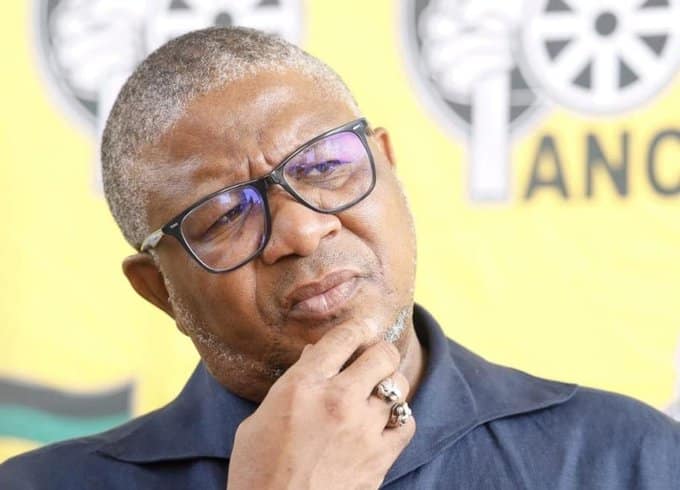
In the midst of an escalating and volatile conflict in the Middle East, the African National Congress (ANC) has chosen to draw a clear line in the sand. It is a line not merely drawn in the geopolitics of the present, but etched in the collective memory of its own liberation struggle. On Friday, ANC Secretary-General Fikile Mbalula delivered a forceful and unequivocal message of solidarity with the Islamic Republic of Iran, framing the party’s stance not as a controversial foreign policy gambit, but as a sacred duty rooted in historical gratitude.
Standing before the media in Johannesburg, Mbalula did not mince words. As tensions between Iran and the Western-backed alliance of Israel and the United States threaten to ignite a broader regional war, the ANC’s top official made it clear where the governing party’s loyalties lie.
“We stand with Iran,” Mbalula declared, his tone resolute. “We stand with them not because we are oblivious to the complexities of the world, but because we have a long memory. When we were isolated, when the apartheid regime had the support of the West, when our people were dying and the world looked away, Iran stood with us.”
The statement is the latest and most emphatic reaffirmation of a relationship that has long been a cornerstone of the ANC’s foreign policy, but one that places South Africa on a collision course with its traditional trading partners. Mbalula’s invocation of the past was deliberate and pointed. He reminded South Africans—and the world—that during the darkest days of the anti-apartheid struggle, when the United States and Israel maintained close ties with the Pretoria regime, Iran (under the Shah, and later the post-1979 Revolutionary government) provided political and, at times, material support to the liberation movements.
“People must not have a short memory,” Mbalula continued, directly addressing critics who question the ANC’s alignment. “They must know who stood with us. The West, many of them, were on the side of the oppressor. Iran was on the side of the oppressed. That is a debt we can never repay, but it is a friendship we can never abandon.”
The Secretary-General’s comments come at a time of extreme sensitivity. The recent escalation between Iran and Israel, involving direct missile and drone attacks, has drawn international condemnation and raised fears of a catastrophic war. The United States has rallied to Israel’s defense, further polarizing the conflict along familiar geopolitical lines.
For the ANC, however, the conflict is viewed through a very specific ideological lens: that of anti-imperialism and solidarity with movements it perceives as being under siege by Western hegemony. Mbalula drew parallels between the plight of the Palestinians and the Iranian position, framing the conflict as a continuation of the struggle against oppression.
“The question we must ask is: who is occupying whose land? Who is committing genocide in full view of the world?” Mbalula asked, pivoting to the situation in Gaza. “Our support for Iran is inseparable from our support for the Palestinian people. They are all part of the same resistance against domination.”
The remarks have, predictably, ignited a firestorm of debate in South Africa. The official opposition, the Democratic Alliance (DA), was swift in its condemnation, accusing the ANC of picking sides in a foreign war while failing to fix the country’s own crises.
“While Fikile Mbalula is busy choosing allies in the Middle East, the people of South Africa are choosing to sit in the dark,” said DA Shadow Minister of International Relations, Emma Powell. “This grandstanding does nothing to create jobs, stop the crime, or keep the lights on. It is a diplomatic embarrassment that aligns us with a theocracy that oppresses its own people, particularly women.”
Foreign policy analysts have noted the delicate balancing act Pretoria must now perform. South Africa maintains significant trade ties with the United States and the European Union, and any perception of overt partisanship could jeopardize these economic relationships. Yet, the ruling party’s grassroots base remains deeply sympathetic to the Palestinian cause and skeptical of Western intervention, a sentiment Mbalula’s rhetoric directly channels.
“We are a non-aligned country,” Mbalula insisted, pushing back against the notion that the ANC is merely a proxy for Iranian interests. “We will be friends with whom we choose. We will not be dictated to by powers who once considered us subhuman. Our foreign policy is not for sale.”
The reference to historical ties is a powerful rhetorical tool for the ANC. As a liberation movement turned government, it consistently leans on its struggle credentials to legitimize its contemporary decisions. By invoking Iran’s role in the anti-apartheid struggle, Mbalula is framing any criticism of the relationship as an insult to the memory of the liberation itself.
However, as the conflict in the Middle East shows no signs of abating, the ANC’s position is likely to face increasing scrutiny. The world is watching to see if South Africa’s historical gratitude will translate into tangible diplomatic or military support for Tehran, a move that would have seismic repercussions.
For now, Mbalula’s message is clear: the ANC’s memory is long, and its loyalties are fixed. In the party’s eyes, the friends who stood by them in the struggle against apartheid are friends for life, regardless of the shifting sands of global politics. Whether that unwavering stance serves the interests of modern South Africa, or merely traps it in the battles of the past, is a question that will continue to divide the nation.
About The Author