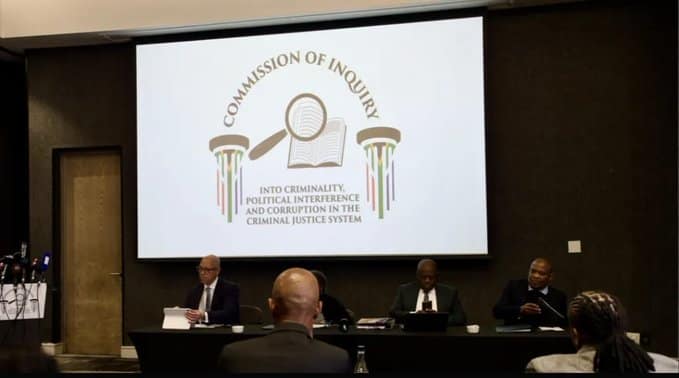
The hushed corridors of the Parktown conference centre, which for weeks have echoed with the grave testimonies of police officers and whistleblowers, fell into an uneasy silence on Friday afternoon. The Madlanga Commission of Inquiry, established to probe the rot in Gauteng’s provincial police leadership, had hit an unexpected and potentially critical roadblock. Witness F, a central figure whose testimony was expected to be the linchpin of the entire investigation, had been rushed to hospital, forcing an abrupt halt to the day’s proceedings.
As the news spread through the legal teams and the small gallery of journalists, commission chairperson retired Justice Sisi Khampepe emerged to address the room. Her expression was grim. “I have been informed that Witness F has been admitted to a medical facility,” she stated, her voice measured. “His condition is currently being assessed. In light of these circumstances, and given that his testimony is far from complete, it would be prejudicial to continue. Proceedings are hereby adjourned. We will reconvene on 16 March 2026, pending a medical update.”
The announcement, delivered just after 11 a.m., sent a ripple of shock through those assembled. For weeks, the commission had been building a complex case alleging a web of corruption, bribery, and racketeering within the highest ranks of the Gauteng police service. Witness F, a former high-ranking officer himself, was seen as the “golden witness”—the insider who could connect the dots between dirty money, compromised cops, and the criminal underworld that has tightened its grip on parts of Johannesburg and Tshwane.
Sources close to the commission, speaking on condition of anonymity, described Witness F’s testimony as “explosive.” He had already spent three days on the stand, detailing intricate schemes involving the protection of illegal mining operations and the manipulation of detective assignments to quash investigations into powerful figures. His testimony was corroborated by a trail of bank statements, encrypted messages, and GPS data that painted a damning picture of a police service allegedly working for private interests rather than the public.
But it was what he had yet to say that had the legal teams on edge. Before the sudden adjournment on Friday, Witness F had begun to allude to the involvement of a “prominent political figure” and a network of “untouchable” officers. He had promised to provide specific names and documentary evidence when the commission resumed after the weekend. Now, with him hospitalised, that promise hangs in the balance.
The circumstances surrounding his hospitalization remain unclear. Commission insiders have been tight-lipped, citing medical privacy and the sensitive nature of the inquiry. However, the timing has inevitably fueled speculation. Witness F had been under visible stress during his testimony, frequently requesting water breaks and appearing agitated when cross-examined by lawyers representing some of the implicated officers. The pressure of being the State’s star witness in a case involving dangerous people is immense.
Outside the commission venue, a small contingent of police officers maintained a visible presence. The security around Witness F has been tight since he entered witness protection months ago. His hospitalization, regardless of the cause, raises immediate concerns about his safety and the integrity of the evidence he carries.
Legal analysts were quick to assess the damage. “A three-week adjournment in a commission of this nature is significant,” commented legal affairs expert Thando Mkhize. “Momentum is everything in these inquiries. Witnesses are primed, lawyers are prepared, and the public is engaged. A delay risks losing that momentum. More critically, it gives the respondents time to regroup, to strategize, and potentially to intimidate other witnesses who might be waiting in the wings.”
For the families of police officers who have spoken out against corruption, and for the communities terrorized by crime syndicates that allegedly operate with police protection, the delay is a bitter pill. They have waited years for accountability; another month feels like an eternity.
The commission is now in a holding pattern. Legal teams will spend the weekend trying to gather information, while the Hawks and witness protection officials monitor the situation closely. The key question on everyone’s mind is simple: when—or if—Witness F will be well enough to return to the stand.
As the journalists packed up their equipment and the lawyers filed out into the Johannesburg sun, the empty witness chair at the front of the room stood as a stark symbol of the uncertainty. In the high-stakes world of corruption inquiries, a hospitalized witness is more than a procedural delay. It is a reminder of the human cost of truth-telling, and of the fragile thread on which justice often hangs. The commission will now wait until 16 March, hoping that when the gavel falls again, Witness F will be there to finish what he started.
About The Author