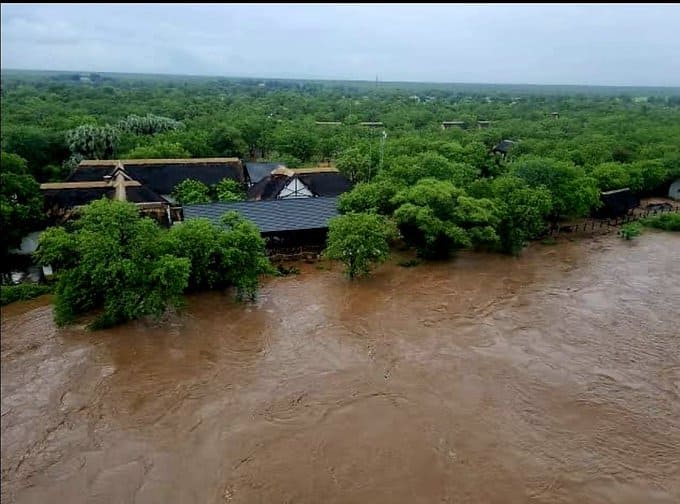
SKUKUZA, Mpumalanga – The Kruger National Park, South Africa’s crown jewel of conservation and a global tourism icon, lies battered and significantly compromised in the wake of devastating floods that have carved a path of destruction through its vast wilderness. Preliminary assessments indicate damage exceeding a staggering R500 million, with the park’s critical infrastructure – roads, bridges, and tourist facilities – bearing the brunt of nature’s fury.
The scale of the disaster has forced the immediate closure of fifteen tourist camps and lodges, plunging the high season into disarray and stranding some staff and visitors. Several of these camps, including remote and iconic destinations, remain completely isolated, accessible only by air, as connecting roads have been washed away or rendered impassable by deep gullies and debris.
Forestry, Fisheries and the Environment Minister Willie Aucamp, following an aerial and ground inspection tour of the worst-hit areas, delivered a sobering assessment that framed the event not as a mere weather incident, but as a fundamental clash between human enterprise and primal force.
“Nature looks after itself. But nature doesn’t care about infrastructure,” Minister Aucamp stated, standing before a collapsed section of the H1 arterial road near Skukuza. His words underscored the humbling reality facing park management. “Our engineering, our timelines, our tourist schedules mean nothing to a river reclaiming its floodplain or rainfall that defies historical models. We are witnesses here not just to damage, but to a profound realignment.”
A Landscape Transformed, Access Severed
The floods, resulting from days of torrential, sustained rainfall across the Lowveld and catchment areas in neighboring countries, saw major rivers like the Sabie, Olifants, and Letaba burst their banks with unprecedented force. Satellite imagery and ranger reports reveal a park visually transformed: where there were game-viewing loops, there are now sandy ravines; where sturdy low-water bridges stood, only pylons remain.
Key routes connecting the southern hubs of Skukuza and Lower Sabie to the central and northern regions of the park have been severed in multiple places. The famous Sabi River bridge near Skukuza Camp is compromised, while access to the prized Crocodile Bridge and Malelane gates in the south is sporadic. In the north, the remote Bateleur and Shingwedzi camps are cut off, with supply chains broken.
“Logistically, we are dealing with a crisis within a conservation area,” explained Kruger Park Managing Executive, Oscar Mthimkhulu. “Our priorities are threefold: first, ensure the safety and well-being of all stranded guests and staff; second, conduct a full assessment of ecological impact on animal populations and habitats; and third, begin the monumental task of rebuilding. This will not be a matter of weeks, but of months, and for some infrastructure, years.”
Ecological Cost and Animal Welfare
While the instinct is to tally the cost in rands and cents, park ecologists are deeply concerned about the unseen ecological toll. Early reports from ranger patrols and aerial surveys indicate significant animal displacement and casualties, particularly among smaller species, reptiles, and young mammals. Hippo and crocodile populations have been swept into unusual areas, creating potential future human-wildlife conflict scenarios.
There are also serious concerns about the health of rare antelope species in sensitive riparian zones whose grazing grounds have been scoured away. Vultures and other scavengers, however, are reported to be thriving in the aftermath.
“The ecosystem has a memory of flood and recovery,” noted veteran park biologist, Dr. Lindiwe Khumalo. “But the intensity and spatial extent of this event is outside the living memory of most species here. The drowning of animals is a immediate tragedy, but the longer-term issue is the alteration of habitat—where will herbivores graze now? How will predator territories shift? The social structure of elephant herds has been disrupted. The ripple effects will be studied for a decade.”
Tourism in Crisis and a Call for Understanding
The economic shockwave is immediate and severe. The high season, a vital financial period for SANParks and the surrounding tourism economy, has been effectively halted. Hundreds of bookings have been cancelled, and safari operators, hospitality staff, and local businesses face an uncertain future.
“The R500 million figure is just for direct infrastructure damage,” a SANParks financial officer explained. “The lost revenue from tourism, and the knock-on effect for the entire Lowveld region, could multiply that figure several times over. We are appealing for patience and understanding from our international and local guests. We will reopen, but it must be safe and sustainable.”
Minister Aucamp concluded his remarks with a resolve to rebuild, but also with a note of caution shaped by the new reality of climate volatility. “We will reconstruct. We will reopen. But we cannot simply replace what was there. We must rebuild with resilience, with an understanding that the climate has changed. The Kruger is not just a park; it is a barometer. And it is telling us, in the most forceful terms, that our old assumptions no longer hold.”
For now, the roar of lions competes with the rumble of distant earth-moving equipment. The Kruger, a symbol of timeless African wilderness, finds itself in a race against time—to heal its wounds, restore access, and redefine its coexistence with an increasingly unpredictable natural world.
About The Author