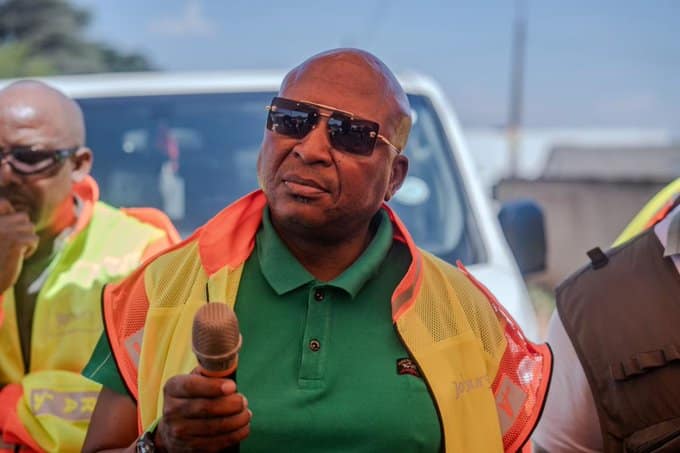
The war of words between two of South Africa’s most flamboyant and controversial political figures has reached a critical legal precipice, with Patriotic Alliance (PA) deputy president Kenny Kunene flatly rejecting a demand to apologize to Economic Freedom Fighters (EFF) leader Julius Malema. In a defiant statement issued on Friday, Kunene declared that he will not bow to pressure and is fully prepared to litigate the matter in open court, setting the stage for a high-stakes defamation battle that threatens to expose the deep fault lines within the country’s fractured political landscape.
The dispute, which has simmered for weeks, erupted into full view following a series of public remarks made by Kunene that Malema’s legal team claims were defamatory. While the exact statements are now subject to legal contention, sources close to the matter indicate they pertain to allegations of unethical conduct and character attacks that Malema argues have caused irreparable harm to his reputation. Malema, never one to shy away from a legal fight, issued a formal letter of demand through his attorneys, calling for a public apology, a retraction of the statements, and a payment of damages—terms that Kunene has now emphatically rejected.
“I have received their letter. I have read it. And I have torn it up,” Kunene said during a media briefing in Johannesburg, his trademark cigar nowhere to be seen but his combative spirit very much on display. “Julius Malema wants an apology? He will not get one from me. He can take me to court. I am ready. I will see him in the witness stand, and there, under oath, we will let the people of South Africa know the truth.”
Kunene, a former businessman-turned-politician whose colorful past includes a notorious sushi bar scandal and a subsequent political reinvention, framed the looming legal battle as a matter of principle rather than personal vendetta. He accused Malema of using legal threats to intimidate political opponents and silence legitimate criticism, a tactic he suggested the EFF leader has employed against journalists, activists, and rival politicians for years.
“Julius Malema believes he is above accountability. He believes that by sending lawyers with expensive letterheads, he can make people tremble and fall in line,” Kunene charged. “But I am not intimidated by him. I am not intimidated by his red overalls. I am not intimidated by his rallies. I am a freedom fighter in my own right, and I will not be silenced.”
The History of a Bitter Rivalry
The Kunene-Malema feud is not a sudden flare-up but rather the latest chapter in a long and bitter rivalry that stretches back more than a decade. Both men rose to prominence as young, ambitious firebrands—Malema as the brash leader of the African National Congress Youth League (ANCYL) before his expulsion, and Kunene as a flashy businessman and socialite who later reinvented himself as a politician. Over the years, their paths have crossed in the corridors of power, the pages of tabloids, and the rough-and-tumble arena of South African politics.
Their enmity intensified following the 2024 general elections, in which the Patriotic Alliance emerged as a surprising kingmaker, securing enough support to play a pivotal role in coalition negotiations. Kunene, alongside PA president Gayton McKenzie, leveraged the party’s newfound influence to position themselves as critical players in the Government of National Unity (GNU)—a role that put them in direct competition with the EFF, which had been sidelined from the GNU and has since positioned itself as the official opposition.
Political analysts suggest that the defamation dispute is as much about political positioning as it is about personal animosity.
“This is not just two men arguing in a parking lot,” said political analyst Dr. Nkosana Moyo. “This is a proxy battle for the soul of South Africa’s opposition politics. The EFF sees the PA as a threat—a party that has siphoned away some of its traditional support base, particularly in the coloured communities of the Western Cape and in parts of Gauteng. By going after Kunene legally, Malema is trying to weaken a rival. By refusing to back down, Kunene is signaling that the PA will not be bullied.”
The Legal Stakes
If the matter proceeds to court, as Kunene has now dared, it would rank among the most high-profile defamation cases in recent South African political history. Defamation law in South Africa is governed by a combination of common law and constitutional principles, with the burden resting on the defendant to prove that the allegedly defamatory statements were both true and made in the public interest—a defense known as “truth and public benefit.”
Kunene’s legal team, which he confirmed has already been briefed, is expected to argue that his statements were either substantially true or constituted fair comment on a matter of public importance. Given Malema’s status as a public figure and the leader of a major political party, the courts have historically afforded wider latitude to political speech, even when it is critical or harsh.
However, legal experts warn that defamation cases are notoriously unpredictable, and the reputational damage for the losing party can extend far beyond any monetary damages awarded.
“This is a high-risk strategy for both men,” said legal analyst Mpumelelo Zikalala. “If Kunene loses, he could face a significant damages award and a public humiliation that could damage his political career. If Malema loses, it could embolden other critics to speak out against him without fear of legal reprisal. Neither man is likely to back down now, which means this is almost certainly headed for trial.”
The EFF’s Response
The EFF has maintained a relatively measured public posture on the matter, with Malema himself declining to engage directly with Kunene’s latest provocation. However, party insiders suggest that the EFF leadership is privately furious and fully committed to pursuing the litigation to its conclusion.
EFF spokesperson Sinawo Tambo issued a brief statement reaffirming the party’s confidence in its legal position, stating, “Comrade Julius Malema’s reputation is beyond reproach, and any attempts to slander him will be met with the full force of the law. The courts will provide the appropriate forum for this matter to be resolved, and we are confident that justice will prevail.”
The statement notably did not repeat the demand for an apology, suggesting that the legal machinery is now in motion and that the parties are preparing for a courtroom showdown rather than an out-of-court settlement.
A Political Circus or a Defining Moment?
For the South African public, the Kunene-Malema feud has become something of a political circus—a clash of larger-than-life personalities that dominates headlines and social media timelines. Critics argue that the spectacle distracts from the urgent issues facing the country, including the cost-of-living crisis, unemployment, and service delivery failures that were the focus of labour union actions announced just days earlier.
But for the two parties involved, the stakes could not be higher. The Patriotic Alliance has worked hard to shed its image as a niche party and position itself as a serious political force capable of governing. A legal victory over Malema would cement Kunene’s status as a heavyweight in South African politics. Conversely, a loss could reinforce perceptions of the PA as a party of flashy personalities rather than substantive policy.
For Malema and the EFF, the outcome is equally consequential. The party has built its brand on fearlessness and a willingness to confront adversaries—both political and legal. Backing down from a fight with Kunene would be seen as a sign of weakness, while a decisive legal victory would reaffirm Malema’s dominance over his political rivals.
What Comes Next
With Kunene having rejected the apology demand, the next move belongs to Malema’s legal team. If they proceed with the filing of a summons, the matter will enter the pre-trial phase, with both sides engaging in discovery, exchanging pleadings, and potentially attempting to narrow the issues before trial. Given the busy schedules of both politicians and the complexities of defamation litigation, a trial is unlikely to be heard before late 2026 or even 2027—though both sides may seek to expedite proceedings.
Speaking to reporters outside his Johannesburg home, Kunene struck a tone of defiant confidence, vowing that he would not be the one to blink.
“Let me be clear: I am not apologizing to Julius Malema today, tomorrow, or ever,” he said. “He has used his lawyers to intimidate journalists, activists, and ordinary South Africans for too long. Enough is enough. If he wants a fight, he will get one. But he will get it in a courtroom, where the truth will come out, not in a press release demanding an apology he does not deserve.”
As the sun set over the city of gold, the message from both camps was clear: the gloves are off. Whether this feud ends in a courtroom, a settlement, or a prolonged political stalemate remains to be seen. But for now, South Africans can expect the legal and political drama to unfold in the weeks and months ahead—a spectacle that, for better or worse, has once again placed the country’s most colorful political personalities at center stage.
About The Author