The acrid, chemical-laced air hit them first, a wall of artificial fragrance mixed with the sharp tang of industrial solvents. It was a smell that didn’t belong in a quiet residential street in Windmill Park, Boksburg. For the sharp-eyed brand protection officer from Unilever, who had spent months tracking the source of a flood of suspiciously cheap goods, it was the smell of a confession. His tip-off to the police’s elite Directorate for Priority Crime Investigation, known as the Hawks, had just led them to a nondescript property that was anything but ordinary.
On a sweltering Thursday morning, the peace of the neighborhood was shattered by the screech of tyres as a convoy of Hawks vehicles descended upon the house. From the outside, it looked like any other home in this modest settlement. But behind its walls and locked gates lay a sprawling, clandestine operation—a makeshift factory churning out millions of rands worth of counterfeit cleaning products.
The initial knock was met with silence, then the frantic scuffle of feet. When the Hawks finally gained entry, they were met with a scene of chaotic industry. The living room, kitchen, and garage had been gutted and converted into a production line. The air was thick with a toxic haze. In one corner, massive 200-litre barrels were haphazardly stacked, their faded labels revealing their contents: caustic soda, sodium hypochlorite, and other industrial-grade chemicals. These were the raw, dangerous foundations of what would become counterfeit bleach, fabric softener, and foam bath.
Next to the barrels, a crude mixing station had been set up. Long paddles, now caked with dried, multi-colored residue, stood propped against a tank where the potent cocktails were blended. There were no safety protocols, no protective gear, just the bare feet and gloveless hands of workers who had clearly fled the scene, leaving behind a half-eaten meal and the pervasive stench.
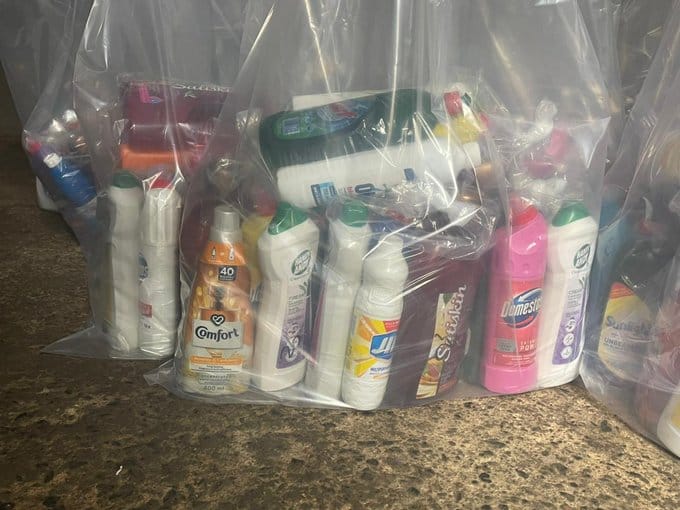
The bottling area was perhaps the most disturbing. On a long, grimy table stood rows of empty containers, far from pristine. Some were old, grimy plastic bottles, clearly scavenged and only hastily rinsed. Others were brand-new, but their labels were cheaply printed, the colors slightly off, the logos of trusted giants like Unilever’s Omo and Colgate-Palmolive’s Handy Andy just a fraction of a millimeter misaligned. It was here that the toxic chemical soup was being funnelled, destined for the shelves of spaza shops and street vendors across Gauteng.
“Look at this,” one officer said, pointing to a vat of thick, blue liquid meant to mimic a popular fabric softener. “The raw ingredients cost a fraction of the real thing. They mix it, bottle it in uncleaned containers, and sell it at a price that undercuts the legitimate market entirely. But the risk… the risk to a child who gets a rash, or a family breathing in these fumes…” he trailed off, shaking his head.
Major General Bafana Hadebe, the provincial head of the Hawks, surveyed the haul. Pallets of finished goods, already boxed and ready for distribution, were stacked high. The sheer scale was staggering. “We are talking about millions of rands’ worth of chemicals and finished products,” he stated, his voice firm. “This is not just a matter of lost revenue for multinational corporations. This is an assault on the safety of our people. These criminals have no regard for human life. They are selling poison.”
Outside, the police tape had drawn a crowd. And as the news spread, the reaction from the locals of Windmill Park was far from unified.
On one side of the tape stood Thandi, a mother of three. “I buy that blue soap,” she whispered, her eyes wide with a mixture of fear and defiance. “At the tuck shop down the road, it’s half the price of the one at Shoprite. It foams up nice, and it smells clean. How was I supposed to know it was fake? We are poor people. We need options.”
Her sentiment was echoed by a group of men standing nearby. “These big companies have been ripping us off for years,” one of them spat. “Now when someone comes along to give the people a chance to save a few rand, they send the police. They are protecting their profits, not us.”
But across the street, an elderly woman named Nomsa clutched her chest, her face etched with worry. “I told my daughter not to buy those cheap goods. I used a strange washing powder last month, and my skin burned for a week. These people are playing with our health,” she said, gesturing towards the house. “They say these chemicals can cause cancer. What is a little money saved compared to your life?”
Her sentiment was the one the Hawks were banking on. As the forensic team meticulously bagged evidence—from the massive barrels of caustic soda to the smallest, grimy bottle—the core of the investigation shifted. The seized items were loaded into a truck, destined for state laboratories where they would undergo rigorous testing.
The results of those tests would be crucial. They would scientifically determine the exact health risks posed by the counterfeit detergents. Were they simply a diluted, less-effective product? Or were they, as many feared, a carcinogenic time bomb, silently poisoning the communities they were meant to serve?
For the Hawks, the bust in Windmill Park was a significant victory, dismantling a major node in the illicit trade network. But as the crowd slowly dispersed, the argument on the street corner remained unresolved. It was a stark reminder that the fight against counterfeit goods is not just a battle between law enforcement and criminals, but a complex war fought in the heart of communities, where the desperation for affordability clashes with the fundamental right to safety. The probe continues, with investigators now tracing the distribution network and hunting for the masterminds who fled, leaving a community divided and a trail of chemical risk in their wake.
About The Author