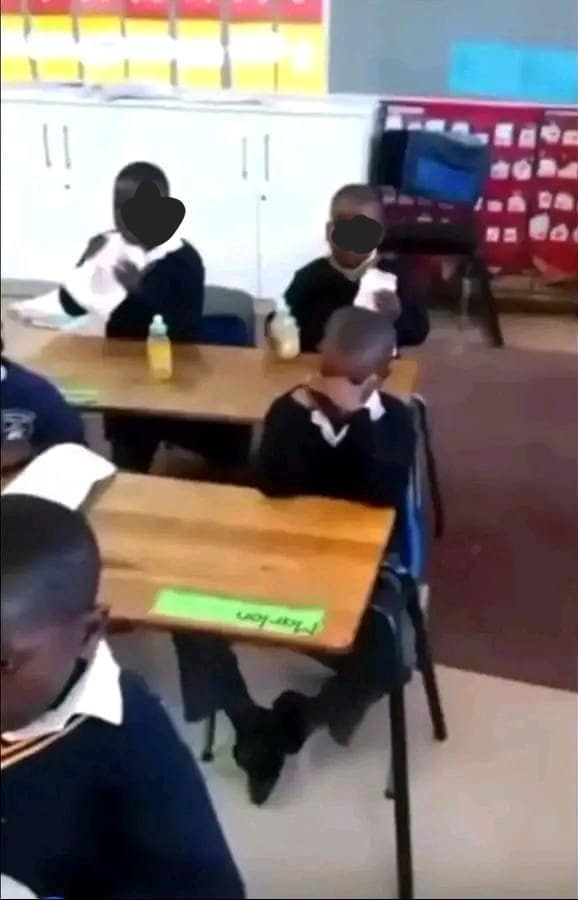
George, Western Cape – In a classroom at Thembalethu Primary School, a six-year-old boy sits quietly at his desk. All around him, his classmates are laughing, chatting, and eagerly unwrapping their pies—a special treat bought for the school’s fundraising “pie day.” The boy has no pie. No juice. Nothing. As a cellphone camera pans across the room, he does the only thing a humiliated child can think to do: he covers his face with his small hands, trying to disappear.
That video, recorded by his teacher and shared on a parents’ WhatsApp group on Tuesday, 10 March 2026, has since exploded across social media, sparking a firestorm of outrage, a formal police complaint, protests at the school gates, and an outpouring of community support that has raised over R48,000 for the child and his family. But more than that, it has forced South Africa to confront a painful question: how do we still shame children for being poor?
‘They Ate While He Hid His Eyes’: The Video That Shook a Nation
The footage, lasting just over a minute, is devastating in its simplicity. Learners are seated at their desks, eating pies and drinking cold drinks. In the background, a woman’s voice—allegedly that of the Grade 1 teacher—can be heard issuing instructions. At one point, she calls out another pupil by name, telling him not to look back at the child without food.
The boy, understanding all too well that he is the subject of the recording, keeps his head down, his small hands pressed against his face. He does not cry. He does not protest. He simply waits for it to be over.
The teacher, according to reports, explicitly states that the video is being shared on WhatsApp to “show parents what happens to children who do not bring money for pie day” . It was, she later claimed through the education department, an attempt to communicate with the child’s mother about the missed payment. But the method—publicly shaming a six-year-old for his family’s financial circumstances—has been universally condemned.
It has since been confirmed that the teacher did, after filming the video, purchase a pie and a drink for the child and give it to him. The Western Cape Education Department (WCED) confirmed this, but added a crucial caveat: “The manner in which this was done, however, was totally inappropriate”.
A Family’s Anguish: ‘We Didn’t Even Know’
The boy’s mother, speaking to the media in the days following the incident, described her devastation. The family, she explained, is unemployed and struggling to make ends meet. The R40 required for the pie day fundraiser was simply beyond their reach.
But what cuts deepest is that they had no idea any of this had happened until a community activist arrived at their door late at night.
“We didn’t have data, so we never saw the video in the WhatsApp group,” the mother said, her voice breaking. “If other parents hadn’t made the video go viral after they couldn’t reach us, and if community activist Faith Mdaka hadn’t come to our house late at night to explain that our child was bullied by a teacher, we would not have known. Our child would have kept suffering in silence”.
The emotional toll on the family has been severe. The mother described her son as withdrawn, a child who “hardly speaks, prefers to be alone with us at home and does not play with other children outside”. The incident, she fears, has compounded existing vulnerabilities, reinforcing a sense of shame and otherness that no child should carry.
‘The Evil Witch’: Community Fury and a School Protest
By Wednesday morning, 11 March, the video had spread like wildfire across TikTok, X (formerly Twitter), and WhatsApp. The public reaction was immediate and visceral.
“We will never forget my Grade 4 teacher for treating me this way,” wrote one user on X, sharing their own painful childhood memory. “To this date, I always relate to my learners how my teacher would isolate me, treat me this way because my dad couldn’t afford money”. Another user simply posted: “What a horrible person she is. Utterly disgusting. He is just a child, why do that to a child? ” A third, less charitably, labelled the teacher “The EVIL WITCH”.
The anger was not confined to the internet. By midday Wednesday, nearly 800 community members, activists, and parents had gathered outside Thembalethu Primary School, some forcing their way onto the grounds to demand immediate action. Chanting and carrying placards, they called for the teacher’s dismissal, arguing that her conduct was abusive and violated the child’s fundamental rights.
Phumeza Tyazi, a community member who joined the protest, articulated the sentiment shared by many: “The teacher could have handled the situation differently. Instead of humiliating the child and violating his rights, she could have let the child leave the room or shared her pie with him. She had no right to film the child”.
Jewel Jonkers, Director of the Education District Southern Cape Region, confirmed that the recording itself was a breach of the Protection of Personal Information Act (POPIA), which strictly prohibits photographing or filming learners without parental consent, except for specific educational purposes.
Teacher Suspended, Formal Investigation Launched
Facing mounting public pressure and the potential for further escalation, the WCED acted swiftly. On Wednesday afternoon, spokesperson Bronagh Hammond confirmed that the teacher had been temporarily suspended pending a formal investigation by the department’s Labour Relations Directorate.
Hammond stressed that the teacher had no prior disciplinary record, but noted that the department was treating the matter with the utmost seriousness. “The department remains committed to ensuring that all learners are treated with dignity and care, and that appropriate professional conduct is upheld at all times,” she said.
The South African Democratic Teachers’ Union (SADTU) also weighed in, with spokesperson Nomusa Cembi issuing a strong statement: “Teachers are expected to uphold the rights of learners to privacy and confidentiality; avoid any humiliation, and refrain from any form of abuse—physical and psychological”. In a cruel irony, Cembi noted that the union’s regional office in George had recently partnered with the South African Council for Educators (SACE) to host workshops on professional conduct—sessions that were open to all teachers.
‘God Is Like That’: From Outrage to Ubuntu
Amid the anger, a counter-narrative of compassion and solidarity began to emerge. Social media influencer and 2025 Emerge Africa Humanitarian Award winner Mandisi Tshingana saw an opportunity to turn collective outrage into tangible support.
Taking to his platforms, Tshingana launched a fundraising drive for the young boy and his family, appealing to the public’s sense of ubuntu. The response was overwhelming. Within hours, donations poured in from ordinary South Africans, as well as public figures like actress Sana Mncunu.
By Wednesday evening, Tshingana announced that the fund had reached R30,102.81. By Thursday morning, that figure had climbed to over R48,000. The money, Tshingana confirmed, would be handed directly to the family to assist them while they look for work and to provide some measure of security for the little boy at the centre of the storm.
“A person who didn’t have R50 will see themselves having R50 000. God is like that,” Tshingana wrote in a reflective Facebook post.
The WCED also confirmed that psychological support and counselling have been arranged for both the child and his family, to help them process the trauma of the public shaming and the intense media scrutiny that followed.
A Reckoning for Schools and Society
As the investigation continues, the incident has reignited a painful national conversation about poverty, dignity, and the role of schools in either bridging or deepening social divides. For countless South Africans, the image of a child hiding his face while others eat is not just a viral video—it is a memory.
The Thembalethu Primary School “pie day” saga is, at its core, a story about power: the power a teacher holds over a child’s self-worth, the power of a cellphone to broadcast humiliation, and the power of a community to push back. For the six-year-old boy who just wanted to disappear, the hope is that the donations, the counselling, and the outpouring of love will help him understand one thing: the shame was never his to carry.
About The Author