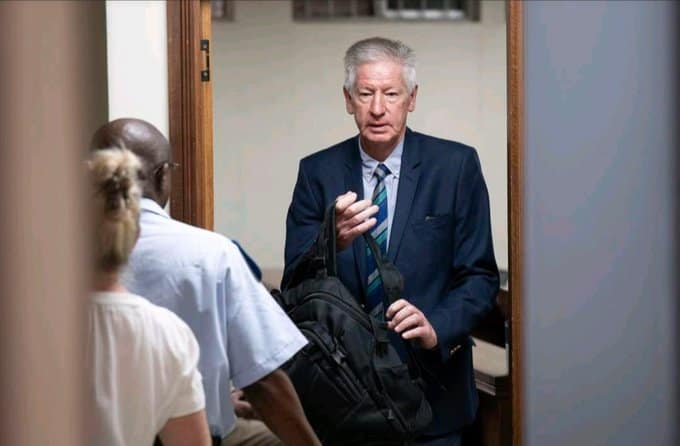
In a significant development in one of South Africa’s most sprawling corporate scandals, a former high-ranking executive at the collapsed retail giant Steinhoff International has been handed a direct prison sentence for his involvement in a massive fraud. Hein Odendaal, who once served as a director of Steinhoff Africa (now Pepkor), was sentenced in the Specialised Commercial Crimes Court in Pretoria for his part in defrauding the company of approximately R376 million.
The sentence marks one of the first significant convictions of a senior figure from the inner circle of the once-dominant furniture retailer, whose dramatic implosion in December 2017 sent shockwaves through global financial markets and wiped out billions of rands in shareholder value.
Odendaal, who had been out on warning, was present in court when Magistrate Elsje Botha delivered the verdict and sentence. He was found guilty on multiple counts of fraud, forgery, and uttering (presenting a forged document as genuine). The charges stemmed from a web of fictitious transactions between 2009 and 2011, long before the company’s ultimate collapse, but which prosecutors argued were part of the same culture of deceit that eventually brought the company down.
The Mechanics of the Fraud
The court heard how Odendaal, along with his co-accused, facilitated the fraud by approving and processing payments for goods and services that were never delivered. The scheme involved a network of shell companies and false invoices designed to siphon money out of the retail giant. These transactions were deliberately structured to circumvent internal controls and were fraudulently recorded in the company’s books to mask their true nature.
Prosecutor Sophia Yoko argued that Odendaal, as a senior executive, was not merely a passive beneficiary but an active architect of the fraud. “He was in a position of trust, a gatekeeper of the company’s finances,” Yoko stated during sentencing arguments. “Instead of upholding his fiduciary duty to the company and its shareholders, he abused his authority to line his own pockets and those of his associates. This was not an error of judgment; it was a calculated and sustained criminal enterprise.”
The state presented evidence that Odendaal signed off on payments to entities that existed only on paper, with funds subsequently being funneled back to the conspirators. The R376 million figure represents a fraction of the total estimated losses from the wider Steinhoff fraud, which some analysts have suggested could run into hundreds of billions of rands.
The Sentence and Its Implications
In handing down the sentence, Magistrate Botha emphasised the gravity of white-collar crime and its devastating impact. She rejected arguments for a suspended sentence or correctional supervision, stating that the magnitude of the fraud and the breach of trust demanded a custodial sentence to serve as a deterrent to other executives in positions of power.
“Crimes of this nature erode public confidence in the market and the economy,” Magistrate Botha said. “The accused was at the apex of corporate leadership. His actions were motivated by pure greed and have had far-reaching consequences for employees, pension funds, and ordinary South Africans who invested their savings in what they believed was a reputable company.”
Odendaal was sentenced to an effective 10 years in prison. His legal team indicated they would study the judgment and consider an appeal.
The conviction is a major victory for the Hawks’ Priority Crime Specialised Investigation unit and the National Prosecuting Authority (NPA), which have faced criticism for the slow pace of investigations into the complex Steinhoff matter. For years, victims, including the Public Investment Corporation (which invests government employee pensions), have waited for accountability.
The Wider Steinhoff Context
The sentencing of Odendaal brings the spotlight back to the epicenter of the scandal. Steinhoff’s near-collapse was triggered by the discovery of “accounting irregularities” by its then-new management, forcing the company to delay its financial results. This led to a catastrophic loss of investor confidence, with the share price plummeting from over R50 to just a few cents.
The man at the centre of the storm, former CEO Markus Jooste, remains a fugitive from justice in a sense, facing a plethora of civil claims and criminal charges. Jooste is widely seen as the mastermind behind the complex web of off-balance-sheet entities and inflated asset values that propped up the company for years. He died by suicide in March 2024, hours after the Financial Sector Conduct Authority (FSCA) imposed a record R475 million fine on him.
While Jooste’s death ended the criminal case against him, the pursuit of other key figures continues. Odendaal’s sentencing sends a clear signal that other executives and accomplices who were part of the fraudulent schemes will not escape justice. For the thousands of former Steinhoff employees who lost their jobs and the countless investors who lost their life savings, Odendaal’s imprisonment is a small but significant measure of justice, proving that the consequences of corporate greed can, finally, lead to handcuffs and a prison cell.
About The Author