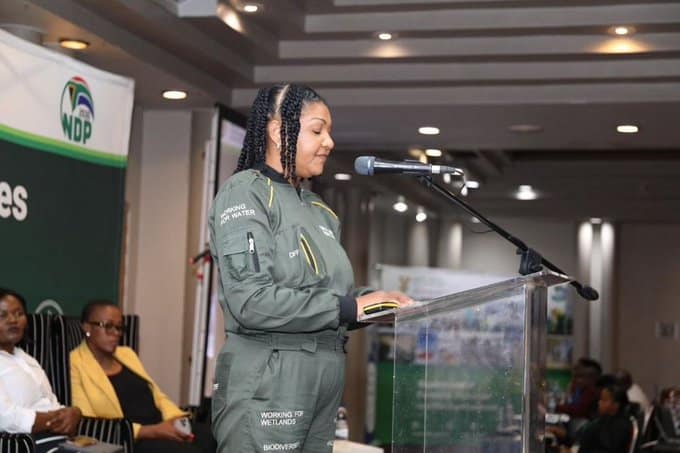
In a stark warning issued to industry leaders and municipal representatives, Deputy Minister of Forestry, Fisheries and the Environment Bernice Swarts has declared that South Africa’s current approach to waste management is “unsustainable” and requires an immediate and radical shift in strategy.
Speaking at the National Waste Dialogue held in Pretoria on Tuesday, Deputy Minister Swarts painted a grim picture of a country choking on its own refuse. She cautioned that the nation’s heavy reliance on landfills is not only an environmental hazard but a ticking time bomb with profound social and economic consequences.
“We cannot continue to dig holes in the ground and call it a solution,” Swarts said to a gathering of policymakers, environmentalists, and private sector stakeholders. “Waste is not just an environmental problem; it is a social justice issue and a massive economic leak. We are essentially throwing valuable resources into the ground, resources that could be powering our economy and creating jobs.”
The Scale of the Problem
The Deputy Minister’s urgent appeal comes against a backdrop of alarming statistics. South Africa generates approximately 122 million tonnes of waste per year, according to recent departmental data. However, only a fraction of that—roughly 10%—is recycled, with the vast majority ending up in one of the country’s hundreds of landfill sites.
Many of these landfills are rapidly reaching capacity, and a significant number are unlicensed or poorly managed, leading to groundwater contamination, air pollution, and health crises in surrounding communities. The problem of illegal dumping, particularly in underserved townships and informal settlements, exacerbates the issue, turning public spaces into health hazards and degrading the environment.
Moving from a Linear to a Circular Economy
Deputy Minister Swarts argued that the solution lies in transitioning away from a linear “take-make-dispose” economy toward a circular one, where materials are kept in use for as long as possible.
“We need to fundamentally change our mindset. Waste is a resource we are choosing to throw away,” she emphasized. “By embracing the circular economy, we can unlock new industries. We can create a new generation of waste pickers and recyclers who are not just surviving on the margins but are recognized as formal micro-entrepreneurs and key partners in our value chain.”
She called for urgent interventions, including:
- Extended Producer Responsibility (EPR): Ensuring that manufacturers and brand owners take physical and financial responsibility for the entire lifecycle of their products, from design to end-of-life.
- Municipal Accountability: Demanding that local governments improve waste collection services and separate waste at source, making recycling easier for households.
- Infrastructure Investment: Encouraging public-private partnerships to build materials recovery facilities and support recycling enterprises.
A Social and Economic Imperative
The Deputy Minister highlighted the often-overlooked human element of the crisis. She noted the thousands of informal waste pickers who form the backbone of South Africa’s current recycling efforts, often working in dangerous conditions for meagre returns.
“If we are serious about tackling waste, we must be serious about the people who currently do the dirty work of recycling for free,” she said. “Formalizing the waste sector is not just about efficiency; it is about dignity. It is about taking people who are vulnerable and giving them the tools, the safety, and the compensation they deserve.”
The economic argument was equally compelling. Swarts pointed to the potential for job creation in sorting, processing, and remanufacturing. With unemployment at crisis levels, the “waste economy” presents a significant, untapped opportunity for labour-absorbing growth.
Looking Ahead
The Deputy Minister concluded her address with a call to action, urging all sectors of society to take ownership of the problem. She warned that without a collective effort—from government policy and corporate responsibility to individual household behaviour—South Africa risks being buried under its own waste.
“We have the policies, we have the strategies. What we need now is the will and the urgency to implement them,” Swarts said. “The time for talking is over. We need effective, on-the-ground solutions, and we need them now.”
About The Author