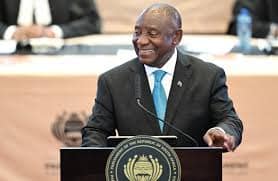
The dust from President Cyril Ramaphosa’s 2025 State of the Nation Address (SONA) had barely settled when a new kind of storm began brewing, not in the parliamentary chambers, but on the raw, unfinished floors of a high-rise construction site. The date was February 13, just one day after the President stood at the podium to unveil his ambitious plan to deploy 10,000 new labour inspectors, and a shaky, 47-second cellphone video was already spreading across WhatsApp and TikTok, threatening to undermine his message with raw, on-the-ground cynicism.
The video, since watermarked with the handle “MPATSECK,” opens on a scene of urban development. Sunlight glints off steel rebar and half-poured concrete. In the foreground, a man in a dusty hard hat and high-visibility vest leans against a scaffold pole. He gestures expansively with a calloused hand, his face creased not with concern, but with a broad, dismissive grin. He speaks in a fluid mix of isiZulu and Sesotho, his words aimed at the worker filming him.
“The big man in Cape Town, hey, he says he is sending us inspectors,” the man begins, his tone laced with amusement. “Ten thousand of them! To count us, to check our papers.” He laughs, a deep, resonant sound that echoes off the concrete. “Let them come. We see them at the gate, we see them from the top floor. By the time they find the lift, poof! The Malawians are bricklayers. The Zimbabweans are carrying cement. Me? I am just the site manager, drinking my tea.”
The video ends abruptly, but its impact was just beginning.
Identified online only by his alias, MPATSECK, the man in the video was quickly labelled by social media sleuths as a Mozambican national, a detail that added a layer of complex irony to the clip. Here was a foreign national, allegedly in a position of authority on a South African site, openly mocking a policy designed to curtail the very employment of people like him.
The video landed like a grenade in a country grappling with a national unemployment rate of 32.1%. Ramaphosa’s inspector plan, announced during the SONA, was a direct response to the growing, desperate anger over jobs. The promise of 10,000 permanent inspectors was meant to be a hammer against employers who, in the President’s words, “undermine the law and exploit the desperation of both foreign and South African nationals.”
But MPATSECK’s video flipped the script. To many South Africans watching the clip, it wasn’t a story of law enforcement, but of impunity. It visually confirmed a deep-seated suspicion: that foreign nationals aren’t just taking jobs, but are managing the very systems that keep locals out. The comments section beneath reposts of the video became a roaring fire.
“They are laughing in our faces,” wrote one user. “We are crying for a job, and they are up there, on our buildings, mocking us.” Another added, “This is the proof. It’s not about skills, it’s about a system. They hire their own, from the manager down to the labourer. What is an inspector going to do?”
The outrage quickly pivoted to the ruling party. “ANC must fall,” became a common refrain, with users arguing that the government’s policies had lost control of the country’s labour market entirely. The video was used as Exhibit A in a broader argument about sovereignty, border control, and the perceived failure of the state to protect its citizens’ primary economic interests.
However, as the video’s virality grew, so did the counter-narratives. Voices urging caution pointed out the unverified nature of the claims. Was MPATSECK truly a Mozambican national, or was that an assumption based on his name and appearance? Was he truly the manager, or just a site foreman with a flair for drama? No official confirmation of his identity or legal status had surfaced.
Furthermore, some commenters shifted the focus from the man in the video to the South Africans watching it. “Instead of filming him, why aren’t you up there learning to lay that brick?” one user challenged. “He is laughing because he knows the truth: we don’t want to do the work. My cousin is a qualified plumber, but he’d rather sit at home and wait for a government job than get his hands dirty.” This sentiment highlighted a painful, parallel debate about skills, ambition, and the mismatch between the jobs available and the jobs sought by the local workforce.
By the weekend, “MPATSECK” had become a symbol—though what he symbolized depended entirely on who was watching. To the angry unemployed, he was the face of foreign dominance and local exclusion. To the sceptics of government enforcement, he was the proof that bureaucracy would always lose to the agility of the informal and semi-formal economy. And to those concerned about the nation’s skills development, he was a mirror reflecting the country’s own shortcomings.
The video, lasting less than a minute, had done what hours of parliamentary debate could not: it had taken a policy promise and dragged it into the dust, dirt, and defiance of the South African streets. And somewhere, behind a scaffold on a high floor, MPATSECK’s laugh continued to echo, a viral soundbite for a nation divided by the very bricks it was trying to lay.
About The Author