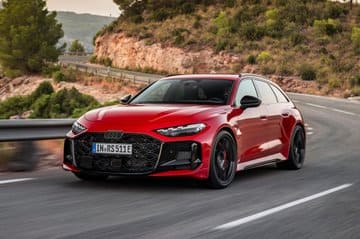
The four rings of Audi have long stood for a blend of understated elegance and ferocious performance. But with the unveiling of the all-new RS5 Plug-In Hybrid on Friday, February 20, 2026, the Ingolstadt-based manufacturer has thrown subtlety out the window and replaced it with a staggering 639 horsepower. The result is a machine that has the automotive world divided: some see it as a technological masterpiece; others, including a prominent Top Gear writer, see it as something else entirely—”fat.”
The new RS5, available in both sleek Sedan and versatile Avant (wagon) body styles, represents a seismic shift for Audi’s performance division. It is the first RS5 to embrace plug-in hybrid technology, and it does so with a level of aggression that suggests Audi is serious about taking on the likes of the BMW M3 Touring and the Mercedes-AMG C63, both of which have also adopted electrified powertrains.
Under the bonnet lies a familiar friend, but one that has been significantly enhanced. The 2.9-liter twin-turbo V6, a mainstay of Audi’s performance lineup, has been tuned to produce a robust 510 horsepower on its own. But the real magic happens at the rear axle, where a powerful 177 horsepower electric motor has been integrated. The combined output is a mind-bending 639 PS (that’s 630 horsepower in imperial terms) and a colossal 825 Nm of torque.
The numbers are breathtaking, and they translate into real-world performance that would have been unthinkable in a family-friendly wagon just a decade ago. The RS5 Sedan and Avant will catapult from 0 to 100 km/h in just 3.6 seconds, a time that puts it in the company of dedicated supercars. The top speed is, as per German convention, electronically limited to 250 km/h, but opting for the dynamic package can extend that to 280 km/h, or even 290 km/h for those who tick the right boxes.
The Tech: Quattro Evolved
To manage this monumental power, Audi has deployed its legendary quattro all-wheel-drive system, but with a modern twist. The rear electric motor is not just there for a boost; it plays an integral role in the car’s handling dynamics. It is paired with a new electromechanical torque-vectoring rear differential, a piece of engineering that can actively distribute power between the rear wheels, effectively pushing the car into a corner and allowing for controlled drifts.
The result, Audi claims, is a car that feels agile and responsive despite its considerable heft. The electric motor provides instant torque, filling in any lag from the turbocharged V6 and providing a surge of acceleration the moment the driver’s right foot demands it.
There is also a “boost button” mounted on the steering wheel, a feature borrowed from motorsport and hypercars. Press it, and the powertrain unleashes its full combined output for a limited period, perfect for overtaking or attacking a track-day straight.
The “Fat” Controversy
But for all its technological wizardry, the new RS5 has attracted criticism for one inescapable figure: its weight. The Avant, the wagon version that will likely be the biggest seller, tips the scales at a substantial 2,370 kilograms. The sedan is marginally lighter but still well over 2,300 kg. That is a lot of car.
Tim Oldland, a writer for the venerable British motoring publication Top Gear, was among the first to voice what many were thinking. In a social media post that quickly went viral, he simply called the car “fat.” It was a blunt, almost schoolyard insult, but it resonated. In an era where enthusiasts mourn the increasing weight of performance cars, the RS5’s heft is a glaring target.
“2,370 kg for an Avant is… a lot,” Oldland wrote, sparking a debate that has raged across forums and comment sections. Defenders of the car point out that the weight is largely due to the battery pack required for the plug-in hybrid system. They argue that the performance figures speak for themselves and that the electric torque more than compensates for the mass. Critics counter that no amount of electric trickery can completely mask the laws of physics, and that a car this heavy will feel its weight in corners and under braking.
The Aesthetics: Big Exhausts and Bold Styling
While the weight debate continues in the technical forums, the design conversation is equally passionate. The new RS5 adopts a significantly more aggressive stance than its predecessor. The front end is dominated by the massive, single-frame grille, flanked by gaping air intakes that feed the radiators and brakes.
At the rear, the designers have made a statement. The exhaust pipes are, to put it mildly, enormous. They dominate the diffuser, a visual declaration that, despite the electric motor, there is still a V6 burning fossil fuels under the bonnet. The wide wheel arches, necessary to cover the wider track and massive wheels, give the car a planted, muscular stance.
Fan reaction to the styling has been overwhelmingly positive. On social media, images of the RS5 have been shared thousands of times, with comments praising its “mean” look and “road presence.” The Avant, in particular, has attracted a cult following among those who appreciate the practicality of a wagon combined with supercar-slaying performance.
The Battle of the Heavyweights
The new RS5 enters a competitive arena that has become increasingly crowded and increasingly electrified. Its primary rival, the BMW M3 Touring, has set the standard for high-performance wagons. Mercedes-AMG offers the C63 Estate, which has also adopted a four-cylinder plug-in hybrid powertrain, a decision that has proven controversial among purists.
Audi is betting that customers will prefer the emotional appeal of a V6 (even if it is “only” a V6) over the four-cylinder of the Mercedes, and that the sheer force of the RS5’s numbers will overcome any qualms about weight. With 639 PS on tap, it outguns both its direct rivals on paper. Whether that translates to a better driving experience on a twisting back road or a racetrack remains to be seen.
Pricing and Availability
For those convinced by the specs and undeterred by the weight, the new RS5 will be available to order starting in the northern hemisphere summer of 2026. Pricing in Germany, the home market, starts at €106,200 for the base sedan, with the Avant commanding a slight premium. As with all Audis, the final price will balloon rapidly once the options list is explored.
The car represents a significant investment, but for that money, buyers get a vehicle that can do it all: commute in near-silence on electric power, haul the family and their luggage, and then, at the touch of a button, transform into a 639-horsepower track-day weapon. It is a Jekyll and Hyde machine for the modern age.
Conclusion: A New Chapter
Love it or hate it, the new Audi RS5 Plug-In Hybrid is a landmark vehicle. It signals Audi’s commitment to electrifying its performance lineup without sacrificing the drama and emotion that enthusiasts crave. The weight is a concern, and the debate over it will not go away. But as cars get heavier, they also get faster, safer, and more capable.
Whether the RS5 will be remembered as a great driver’s car or simply a very fast, very heavy luxury cruiser will depend on the feedback of those who get behind the wheel. For now, the automotive world is left to argue, to dream, and to wait for the first road tests. The “fat” Avant is coming, and it is bringing 639 horsepower with it.
About The Author