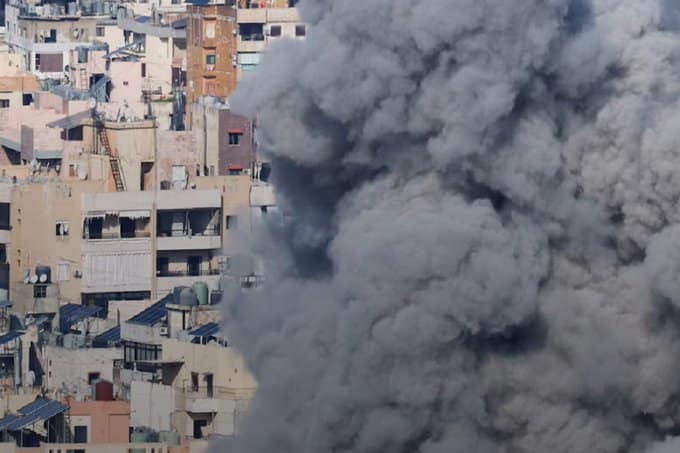
As tensions in the Middle East escalate toward what many fear could be a regional conflagration, a prominent South African geopolitical analyst has issued a stark warning: the United States is increasingly acting not as an independent global power broker, but as an extension of Israeli strategic interests.
Thembisa Fakude, a senior research fellow at the Afrasid Institute (a think tank focused on Africa-Asia relations and global geopolitics), argues that Israel’s significant sway over US foreign policy decision-making has reached a point where Washington’s ability to act as a neutral arbiter—or even in its own stated interest—has been critically compromised.
Fakude’s comments come in the wake of coordinated military actions involving the US and Israel against Iranian targets and assets, a dynamic he believes proves that the “special relationship” has evolved into something far more consequential for global stability.
The Shift from Broker to Partner in Conflict
Historically, the United States has positioned itself as the indispensable nation in Middle East peace processes, often maintaining diplomatic ties with all sides to facilitate negotiation. However, Fakude contends that this posture has eroded.
“What we are witnessing is not the United States managing a conflict; we are witnessing the United States being managed by one of the conflict’s primary parties,” Fakude said in an interview this week. “Israel’s influence over the levers of power in Washington—from Congress to the Pentagon to the think tanks—is so profound that it has fundamentally reshaped American strategy in the region.”
He points to the recent joint military posturing and intelligence sharing against Iran as a prime example. Rather than de-escalating rhetoric, Fakude argues, the US has adopted the hardline stance of the current Israeli government, effectively green-lighting operations that serve Tel Aviv’s strategic goals under the cover of American military backing.
The ‘Strategic Asset’ Narrative vs. Reality
Fakude challenges the long-held Western assertion that Israel is America’s “greatest strategic asset” in the Middle East. Instead, he posits that this narrative has been cultivated to justify unwavering support, even when that support isolates the US from the broader Arab and Muslim world and fuels anti-American sentiment.
“The question we must ask is: whose interests are being served by drawing the US deeper into a conflict with Iran?” Fakude asks. “For decades, Israeli hawks have viewed Iran as the primary existential threat. By leveraging their influence in Washington, they have successfully framed the containment of Iran as an American national security priority, rather than an Israeli one.”
This influence, he notes, is not merely a result of shared democratic values or cultural ties. It is the product of a highly organized and well-funded lobbying apparatus, think tanks staffed with pro-Israel advocates, and a political structure where criticism of Israel is often met with severe political consequences.
Implications for US Independence
The analyst warns that this dynamic has stripped Washington of its strategic independence. In a rapidly multipolar world—where the US is competing with China and Russia for influence—being perceived as simply a proxy for Israeli policy in the Middle East damages American credibility.
“It makes it nearly impossible for the US to pivot or adapt,” Fakude explains. “If the US wanted to pursue a diplomatic thaw with Iran to counterbalance Chinese influence in the region, can it? The influence networks in Washington would likely block such a move before it even started. The tail is wagging the dog.”
This lack of flexibility, he argues, is dangerous. It reduces the bandwidth for diplomacy and increases the likelihood of miscalculation that could drag the entire region—and by extension, the US—into a war with no clear exit strategy.
A Global South Perspective
Fakude’s analysis, coming from a South African research institute, also highlights a growing perspective from the Global South. Many non-aligned nations view the current crisis not as a sudden explosion of violence, but as the predictable result of decades of unchecked Israeli influence over American policy, coupled with the systematic marginalization of Palestinian rights.
“The suffering we see in Gaza, the escalation with Iran, the instability in the Red Sea—it is all connected,” Fakude states. “And as long as US policy remains captive to a foreign government’s domestic political agenda, there will be no peace. There will only be perpetual war.”
The Counterargument
Proponents of the US-Israel alliance argue that the relationship is mutually beneficial, based on shared intelligence, technological innovation, and democratic values. They contend that Israel is a vital partner in a volatile region and that US support acts as a deterrent against broader aggression from Iran and its proxies.
However, Fakude’s warning taps into a growing unease among international observers who see the current trajectory as untenable. As the US heads into an election cycle, and as the Middle East teeters on the brink, the question of who truly shapes American foreign policy—and at what cost—remains more pressing than ever.
About The Author