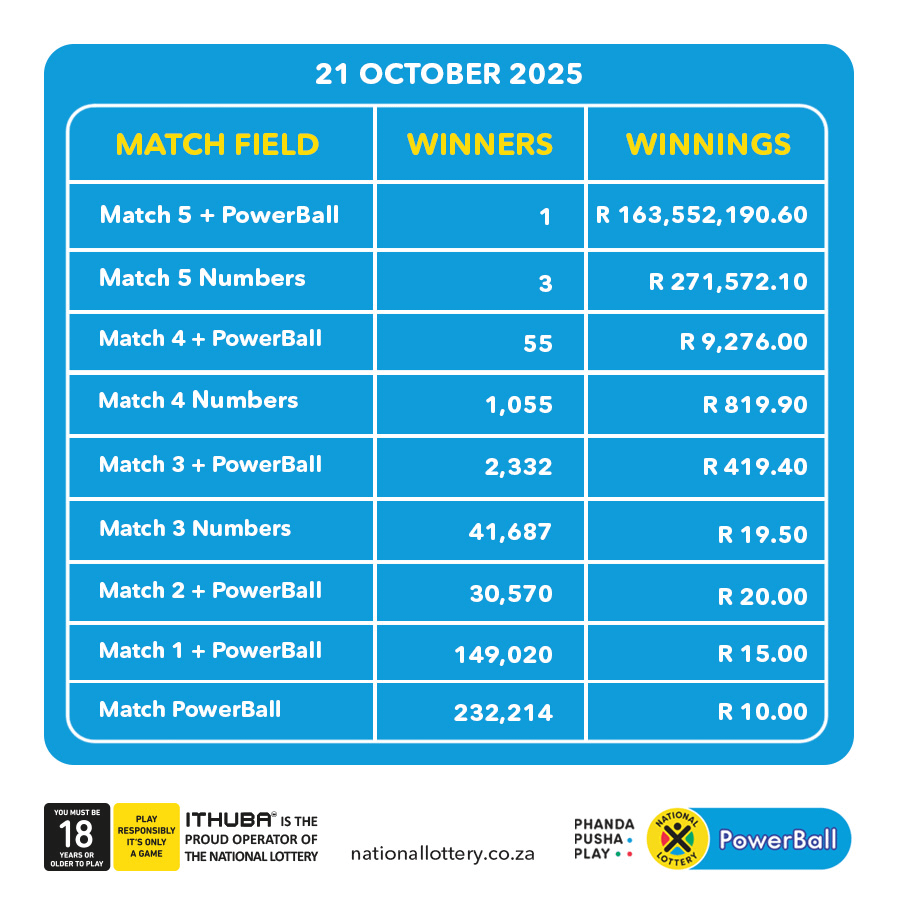
In the quiet hum of a Tuesday evening, the familiar ritual of the South African PowerBall draw unfolded, but its outcome would send seismic waves of excitement, envy, and skepticism across the nation. On October 21, 2025, the lottery’s random number generator did not produce one, but two new multi-millionaires, splitting the game’s top prizes in a stunning display of fortune that has since captivated and divided the public.
The official confirmation came from Ithuba, the national lottery operator, in a statement that underscored both the scale of the win and its modern, digital nature. A single, lucky player managed to correctly predict the winning numbers for the main PowerBall draw, securing a life-altering jackpot of R163,552,190.60. Simultaneously, another player, holding a separate ticket, clinched the PowerBall Plus prize, a staggering R31,018,628.00. The combined windfall of nearly R194 million solidified the night as one of the most significant in the lottery’s recent history.
The Anatomy of a Record Payout
In a move to ensure transparency in an increasingly digital age, Ithuba emphasised that both winning tickets were purchased online. The entire process, from the ball draw to the subsequent audit, was live-streamed, allowing thousands of viewers to witness the moment fate was digitally assigned.
“The integrity of our draw process is paramount,” stated an Ithuba spokesperson. “The draws are overseen by independent auditors, and the fact that these wins were secured via our digital platforms highlights the security and accessibility of modern lottery participation.”
The ripple effect of the double jackpot was immense. Beyond the two headline winners, thousands of other players found their fortunes changed, if on a smaller scale. Total prize payouts across all nine divisions soared past the R200 million mark, a tidal wave of wealth distributed to players from every corner of South Africa. From the R5,842.85 won by those matching four numbers and the PowerBall, to the thousands who secured smaller fixed-amount prizes, October 21st became a payday for a small army of hopefuls.
A Digital Echo Chamber: Celebration and Cynicism Collide
As news of the double win broke, social media platforms became the primary arena for the national conversation, and the reaction was a study in contrasts.
Heartfelt congratulations poured in from well-wishers. “Congrats to the winners! Maybe this is a sign that it’s possible for any of us. Life-changing stuff!” posted one user on X (formerly Twitter), capturing the optimistic spirit of many.
However, this celebration was swiftly met with a powerful undercurrent of cynicism. The very fact that both grand prizes were won by digital players—anonymous and untraceable—fuelled long-standing suspicions among a skeptical segment of the public.
“Two jackpots on the same night? And both online? Sorry, but that feels a bit too convenient,” commented one skeptical user, a sentiment echoed and amplified across countless threads. “How do we even know these are real people? The system feels rigged for show,” argued another, questioning the very legitimacy of the outcome.
This digital dissent, while entirely unsubstantiated by any evidence, points to a broader crisis of trust in institutions, where a massive, random event can feel too improbable to be true. Ithuba has consistently denied any foul play, pointing to their certified systems and independent oversight, yet the whispers persist in the online echo chambers.
The Anonymity of Fortune
For now, the two winners remain enigmatic figures, known only to Ithuba and themselves. They have 365 days to come forward and claim their fortunes. When they do, they will face the monumental decision that has defined every major lottery winner: to step into the glare of public scrutiny or to fiercely guard their newfound privacy in a world suddenly full of newfound “friends,” financial advisors, and complex dreams.
For one, a future of R163 million awaits; for the other, a “secondary” prize of R31 million, which, in any real-world context, is an unimaginable fortune. Their lives have been irrevocably split into a ‘before’ and ‘after’ by a sequence of numbers on a digital ticket.
As South Africa wakes up to the reality of two new millionaires in its midst, the October 21st PowerBall draw has become more than just a lottery result. It is a R194 million Rorschach test—a story of life-changing luck for some. For others, a catalyst for deep-seated doubt, proving that even in the face of audited, transparent fortune, perception often trumps reality.
About The Author