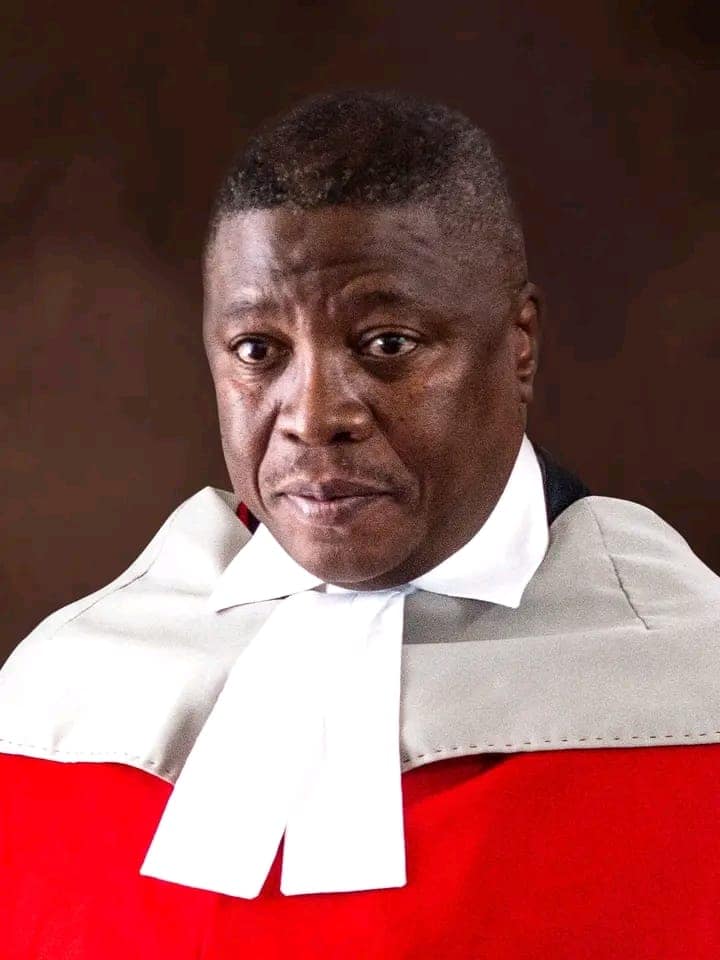
In an unprecedented public address that lays bare the tensions within South Africa’s highest echelons of justice, Chief Justice Mandisa Maya has confirmed a deepening constitutional and ethical crisis surrounding Deputy Judge President Aubrey Ledwaba, who stands accused of accepting a R2.5 million bribe to grant bail to murder-accused businessman Katiso Molefe.
The allegations, if proven, strike at the very heart of judicial integrity, suggesting that the scales of justice can be tilted by cash. The claim is that Ledwaba, in his capacity as a senior judge, orchestrated the release of Molefe—a figure facing a high-profile murder charge—in exchange for a multi-million rand payoff.
A Request Denied: The Chief Justice’s Limited Powers
In a carefully worded statement delivered from the Office of the Chief Justice, Justice Maya revealed that in light of the “serious and potentially damaging” nature of the allegations, she personally intervened. She formally requested that Deputy Judge President Ledwaba take voluntary leave pending the outcome of the ongoing Madlanga Commission of Inquiry, which is tasked with investigating the veracity of the bribery claims.
In a move that underscores the delicate balance of power within the judiciary, Justice Maya confirmed that Judge Ledwaba refused her request.
“The principle of judicial independence is a cornerstone of our democracy,” Justice Maya stated, her tone measured yet firm. “It means that a judge cannot be summarily suspended or compelled to step aside by a colleague, no matter how senior. Such actions are reserved for a process overseen by the Judicial Service Commission and, ultimately, Parliament.”
This admission highlights a critical vulnerability in the system: while the executive branch has seen ministers placed on “enforced leave,” and the Parliament has its own mechanisms, the judiciary operates on a stricter set of protocols designed to protect it from political interference, even when that protection appears to shield a judge from immediate accountability.
“Watching Closely”: A Promise of Scrutiny and Ultimate Accountability
Despite her limited executive power, Chief Justice Maya sought to reassure a skeptical public. She emphatically stated that the judiciary is “not a law unto itself” and remains steadfastly committed to the principles of impartiality and integrity.
“The matter is being monitored with the utmost seriousness,” she asserted. “We are acutely aware that public confidence is the currency of the judiciary. Without it, the entire edifice of justice crumbles. We will not allow that to happen.”
Her comments place immense pressure on the Madlanga Commission to conduct a swift and transparent investigation. Every finding and every piece of evidence presented will be scrutinized not just by legal experts, but by a public growing increasingly weary of corruption scandals.
A Nation’s Trust on the Line
The standoff between the country’s top judge and a senior colleague accused of corruption has sent shockwaves through the legal community and beyond. It presents a stark narrative: a chief justice armed with moral authority but constrained by constitutional design, and a subordinate judge invoking the very principles of independence meant to protect the bench as a shield against temporary removal.
For the public, the case transcends the individuals involved. It has become a litmus test for the judiciary’s ability to self-correct and hold its own members accountable. The question on every South African’s mind is no longer just whether Judge Ledwaba is guilty, but whether the system designed to determine his guilt is robust enough to survive the strain of the allegation itself.
As the Madlanga Commission continues its work, the nation waits, watching to see if the hallowed halls of justice can withstand the corrosive accusation of a R2.5 million price tag.
About The Author