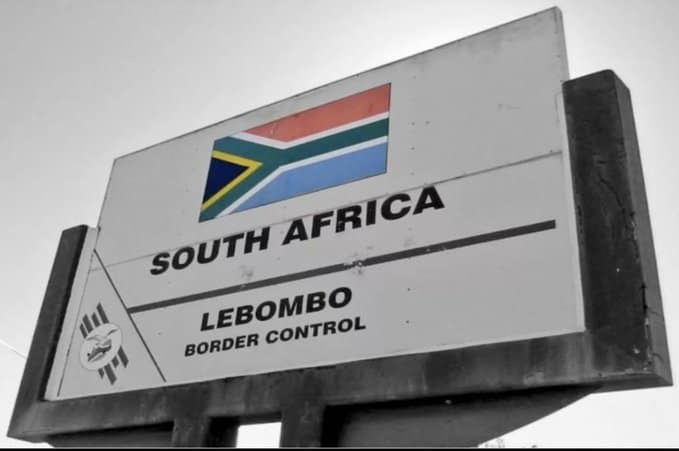
The heat at Beitbridge is a living thing. It rises from the tar in visible waves, distorts the air above the endless queue of trucks, and settles into the lungs of the thousands who move through this threshold each day. They call it the Malume Zone—the uncle’s crossing—a stretch of border that belongs not to the officials in their starched uniforms, but to the informal traders, the runners, the men and women who have turned the gap between two countries into a livelihood.
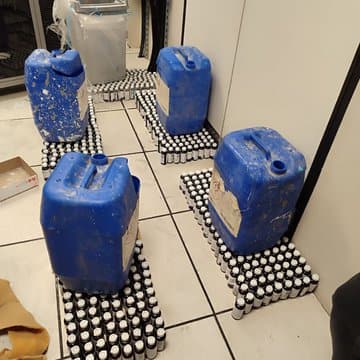
It was here, amid the chaos of hawkers hawking smuggled Zimbabwean mangoes and South African cooking oil, that a ZIMRA officer’s attention snagged on a set of blue jerry cans. At first glance, they were unremarkable—the kind of containers used to transport water across the Limpopo during the dry months, or to carry engine oil for the overloaded commuter omnibuses that choke Beitbridge town. Paint residue clung to the exterior, a crude attempt at misdirection. But the weight was wrong. The sound when shaken was not the slosh of liquid soap or the thick glug of paint.
The officer gestured. The cans were opened. And there, nestled inside like contraband secrets, were 800 bottles of BronCleer cough syrup.
The Liquid Gold of the Black Market
BronCleer is, in its country of origin, an unremarkable pharmaceutical. A codeine-based cough suppressant manufactured in South Africa, it sits on pharmacy shelves alongside antihistamines and painkillers, purchased legitimately by thousands of flu-stricken citizens. But once it crosses the Limpopo, the medicine undergoes a metamorphosis. In Zimbabwe, where the government banned codeine-based syrups in 2018 following a surge in recreational abuse among urban youth, BronCleer becomes contraband. It becomes currency. It becomes, in the parlance of the street, “cleaners” or “brown bottle”—a cheap, accessible high for teenagers in high-density suburbs and, increasingly, primary school children in rural towns.
The scale of the Beitbridge seizure is significant but not exceptional. ZIMRA has intercepted similar hauls with grim regularity: 500 bottles in a fuel tank false compartment last March, 1,200 bottles concealed under a shipment of second-hand clothing in November, 300 bottles tucked inside hollowed-out loaves of bread in a bakery delivery van. Each bust reveals not merely a smuggling route, but an ecosystem.
“The syndicates are sophisticated,” says Tendai Biti, a Harare-based investigator specializing in cross-border crime. “They have buyers in South Africa, transporters who move the goods, distributors in Bulawayo and Harare, and street-level dealers who break bulk into single doses. Intercepting 800 bottles is a victory, but it is a tactical victory in a war that is fundamentally strategic. While we play whack-a-mole at the border, the demand continues to grow.”
The Malume Zone
To understand how 800 bottles of cough syrup travel 800 kilometers from a Johannesburg warehouse to a Beitbridge inspection table, one must understand the geography of the Malume Zone. The term is colloquial, not cartographic—a stretch of the border crossing informally ceded to the informal sector. Here, registered traders with ZIMRA-issued rebates move goods across the line with relative ease, their volumes too high and their documentation too dense for thorough inspection.
It is an open secret that the rebate system is exploited. Legitimate traders moving legitimate goods are approached by smuggling rings who pay a fee to have their contraband included in consolidated shipments. A pallet of clothing arrives concealing cartons of BronCleer. A shipment of electrical appliances reveals bottles tucked inside microwave ovens. The paint residue on the blue jerry cans was not an attempt to disguise the contents—it was an attempt to disguise the containers themselves, to make them indistinguishable from the thousands of legitimate paint cans moving through the border each week.
“We are not naive,” says a ZIMRA official who spoke on condition of anonymity, given the sensitivity of ongoing investigations. “We know the rebate system has vulnerabilities. But it is also the lifeline of cross-border trade. If we seal every loophole with concrete, we starve the very informal economy that feeds thousands of families on both sides of the border.”
The South African Frustration
The BronCleer seizure was reported in Zimbabwean media as a law enforcement success. But in South Africa, the headlines landed differently. On community radio stations in Musina and WhatsApp groups in Soweto, the dominant sentiment was not praise for ZIMRA’s vigilance, but frustration at the conditions that made the smuggling possible in the first place.
“Why is our medicine ending up in foreign seizures while our own clinics run dry?” asked Nthabiseng Dlamini, a nurse at the Tshilidzini Hospital in Limpopo. Her facility has experienced intermittent shortages of essential medications, including codeine-based analgesics, for the past eighteen months. “We have patients in pain who are told to come back next week. Meanwhile, truckloads of the same medication are being driven north because someone is willing to pay more.”
The point is not academic. South Africa’s pharmaceutical supply chain has been under significant strain, with the National Department of Health acknowledging tender irregularities and distribution bottlenecks that have left provincial depots understocked and overburdened. Into this gap steps the parallel market. Smugglers purchase BronCleer from legitimate wholesalers at bulk rates, often using front companies or complicit pharmacists, then sell it to Zimbabwean buyers at a markup that would be illegal in a properly regulated market.
“There is no shortage of BronCleer in South Africa,” says Yusuf Abramjee, a crime prevention activist who has tracked the illicit drug trade across SADC. “There is a shortage of BronCleer in South African public health facilities. The private sector has ample supply. The smugglers are not buying from state depots; they are buying from private distributors who are perfectly within their rights to sell to anyone with a wholesale license. The problem is not that the medicine leaves the country. The problem is that it leaves the country while our own citizens cannot access it.”
The Border as Sieve
The Beitbridge border post is the busiest entry point in Southern Africa, processing an average of 30,000 people and 2,000 trucks daily. Its infrastructure was designed for a fraction of that volume. The result is a perpetual state of overwhelmed inefficiency that smugglers have learned to exploit.
South African Border Management Authority officials, still in the early stages of a multi-year consolidation of port control functions, acknowledge the challenges. “We are engaged in a continuous process of capacity building,” said a spokesperson, offering the polished opacity of diplomatic language. “Operational details regarding specific smuggling methods are not disclosed for security reasons.”
The opacity is itself a source of frustration. Civil society organizations have called for a parliamentary inquiry into border security failures, pointing to a pattern of high-profile busts that reveal systemic vulnerabilities. The BronCleer seizure, in this context, is not an isolated incident but a recurring symptom.
“We catch the couriers, we seize the product, and the networks continue operating,” says David Matsena, a former South African Police Service detective who now advises private sector clients on supply chain security. “Until we disrupt the financial flows, until we extradite the syndicate leaders, until we harmonize pharmaceutical regulations with our neighbors, we are bailing water from a sinking ship with a teaspoon.”
The Human Cost
In Harare’s Mbare township, a seventeen-year-old boy named Tafara sits on an overturned crate outside his grandmother’s flea market stall. He has been using BronCleer since he was fourteen, when a friend told him that mixing the syrup with carbonated soda produced a high that made the hunger go away. He does not know where his dealer sources the bottles. He does not know that 800 of them were seized at Beitbridge last week. He only knows that the price has gone up, and that the high is harder to find.
“Sometimes I want to stop,” he says, picking at a scab on his forearm. “But when you stop, everything is too loud. Too bright. Too much.”
His grandmother, who raised him after his mother migrated to South Africa for domestic work and never returned, does not know what BronCleer is. She knows that her grandson has changed, that he sleeps too much and eats too little, that his school sent him home three months ago and he has not gone back. She knows that the boy who once helped her carry stock from the wholesaler now spends his days in the alley behind the market.
“He was a good child,” she says, arranging second-hand shoes on a plastic sheet. “I don’t know what happened.”
The Border Waits
At Beitbridge, the afternoon heat has eased slightly. The queue of trucks has not moved in two hours. A hawker balances a tray of airtime vouchers on her head. A child sells boiled eggs from a bucket. The ZIMRA officials who seized the 800 bottles have filed their paperwork and moved on to the next inspection.
The BronCleer, now evidence, sits in a storage facility in Beitbridge town, awaiting destruction. Soon it will be poured into industrial drums, mixed with solvent, and incinerated. The blue jerry cans that concealed it will be crushed and recycled. The smugglers will factor the loss into their operating costs and send another shipment.
At the border, the threshold between nations, the line between legal and illegal, medicine and poison, supply and shortage blurs into the heat haze. The Malume Zone continues its restless commerce. The trucks inch forward. The runners run. And somewhere, in a warehouse on the South African side, another 800 bottles are being packed into blue jerry cans, waiting for their turn to cross.
About The Author