On a challenging, sun-drenched course at Apalachee Regional Park, South African athlete Karabo More delivered a performance of grit and strategic brilliance, igniting her team’s campaign on the second leg of the mixed relay at the World Athletics Cross Country Championships this Saturday, 10 January 2026. Her heroic effort was the cornerstone of a historic and hard-fought sixth-place finish for Team South Africa, positioning them among the elite in a fiercely competitive global field.
The mixed 4x2km relay, a dynamic and tactical event, saw South Africa—comprising More, middle-distance specialist Sipho Dlamini, former junior champion Lerato Nkosi, and veteran anchor Liam Fortuin—enter as underdogs against powerhouse teams from Ethiopia, Kenya, and the United States. The task was monumental, but the squad carried a quiet determination, fueled by months of high-altitude training in the Drakensberg.
A Torrid Start and a Calculated Response
The opening leg, run by Sipho Dlamini, unfolded aggressively. The leading pack set a blistering pace, and Dlamini, battling valiantly, handed over in eighth position. The baton passed to Karabo More, a 23-year-old from Potchefstroom known more for her consistent strength than explosive speed. As she tore onto the winding, undulating circuit, she faced a daunting gap to the leaders and the immediate pressure of athletes from Great Britain and Uganda breathing down her neck.
What happened next was a masterclass in paced racing and mental fortitude. While the leaders began to feel the burn of the fast start, More ran her own race. She maintained a powerful, metronomic rhythm, her technique impeccable over the tough, grassy terrain and the course’s signature “The Wall” incline.
“Going out, I knew I couldn’t get drawn into a panic,” More shared post-race, still catching her breath. “My coach told me, ‘The race will come back to you. Own your space, push the hills, and fly the downs.’ I just focused on closing the gap meter by meter.”
The Charge That Changed the Race
Midway through her two-kilometer leg, the More strategy paid dividends. As several early front-runners faltered, she began picking them off with relentless efficiency. One by one, she moved past the Ugandan, then the British, and finally the Japanese runner, her powerful kick on the downhill sections drawing roars from the crowd. By the time she approached the exchange zone, she had surged into fifth place, having made up three critical positions and, more importantly, injecting the team with a palpable surge of belief.
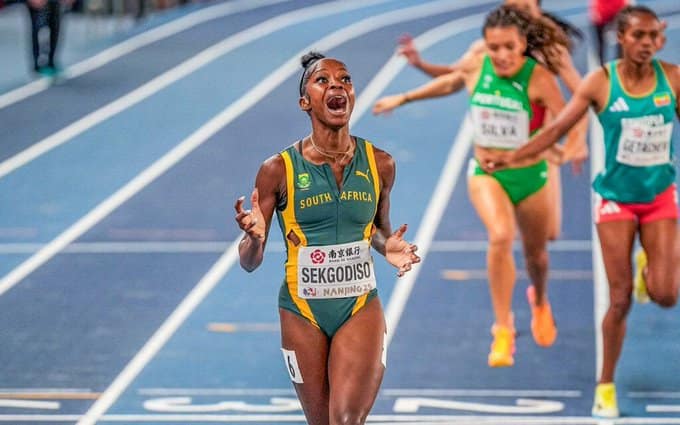
The visual of More, her South African vest streaked with dust and sweat, digging deep to not only hold position but advance it, became the defining image of the South African campaign. She handed off seamlessly to Lerato Nkosi, whose eyes were wide with adrenaline.
“Seeing Karabo come in like a warrior, in fifth… it changes everything,” Nkosi said. “You’re not just running your leg; you’re running to honour the fight she just gave.”
Consolidating a Historic Finish
Nkosi, on the third leg, ran with the heart of a lion to defend the top-five position against a relentless counter-attack from a strong Australian athlete. She slipped to sixth but kept the team firmly in contention. The final burden then fell on the shoulders of experienced anchor Liam Fortuin. With the podium just ahead but agonizingly out of reach, Fortuin’s mandate was clear: hold the line.
In a dramatic final kilometer, with the bell clanging and the crowd on its feet, Fortuin engaged in a neck-and-neck sprint finish against a charging Canadian. Displaying immense composure, he found an extra gear in the final 100 meters, securing sixth place by a fraction of a second, ensuring South Africa would finish as the top non-East African nation in the event.
A New Benchmark for South African Cross Country
The sixth-place finish marks South Africa’s best-ever result in the World Cross Country Championships mixed relay, a significant milestone for the athletics program. It serves as a resounding declaration that South African distance running is building a new era of depth and competitiveness on the world stage.
“Today was about heart and execution,” said team manager and former champion Hendrick Ramaala. “We came here to compete, not just participate. Karabo’s leg was the catalyst—it showed the world and, most importantly, showed our own athletes what is possible. To finish sixth, ahead of so many traditional distance running nations, is a tremendous achievement. This is a foundation we can build on for Paris 2027 (Olympics) and beyond.”
For Karabo More, the performance is a career-defining moment, propelling her from a promising talent to a proven world-class competitor. As the team stood together under the Florida sun, draped in their green and gold flags, their expressions mingled exhaustion with undeniable pride. They had not only navigated a grueling physical test but had also successfully charted a new course for South African cross country, leaving an indelible mark on the global landscape of the sport.
About The Author