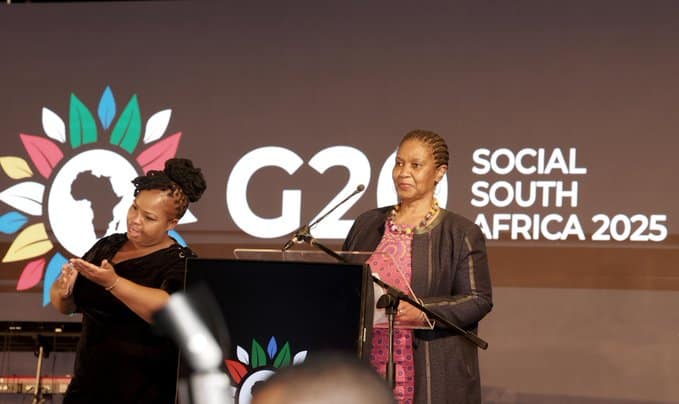
In a rousing and unapologetic address that resonated as a clarion call for self-determination, former Deputy President Dr. Phumzile Mlambo-Ngcuka challenged African leaders and citizens to seize control of their destiny, arguing that the continent’s path to eradicating poverty and driving global change lies not in aid, but in the intelligent and equitable harnessing of its own vast wealth.
Speaking at the opening of the G20 Social Summit on Tuesday, Dr. Mlambo-Ngcuka reframed the global narrative on Africa, moving it from a continent of need to one of unparalleled opportunity. Before an energized audience of local and international delegates at the Birchwood Hotel and OR Tambo Conference Centre, she declared that the tools for transformation are already in Africa’s hands.
A Continent of Abundance, Not Scarcity
“Let us banish, once and for all, the damaging and false narrative of a poor continent,” Dr. Mlambo-Ngcuka stated, her voice firm with conviction. “We are custodians of immense riches. We hold the keys to our own liberation.”
She pointed to the continent’s commanding share of the world’s most critical resources: over 60% of the world’s uncultivated arable land, vast reserves of renewable energy potential, and a treasure trove of minerals essential for the modern and green economies—from cobalt and platinum for electric vehicles to the coltan in smartphones.
“The fertility of our soil can feed the world. The minerals beneath our feet power the globe’s technology. The sun that shines on our lands can light up our cities and industries. This is not poverty; this is power,” she asserted, igniting applause from the assembly.
From Raw Materials to Value and Vision
The core of her argument was that Africa must cease being merely the exporter of raw materials and become the master of its own value chains. She called for a continental industrial strategy focused on local beneficiation, where minerals are processed into components, and agricultural produce is manufactured into finished goods on African soil.
“We cannot continue to export our jobs and our wealth along with our raw commodities. The time for simply digging and shipping is over. The time for making, building, and creating is now,” she urged. This, she argued, is the most direct route to creating dignified work, building resilient economies, and financing robust social services to lift millions out of poverty.
Homegrown Action Over External Reliance
Dr. Mlambo-Ngcuka emphasized that this transformation requires a fundamental shift in mindset—from looking outward for solutions to cultivating internal capacity and leadership. She stressed that while international partnerships are valuable, they must be based on mutual respect and shared benefit, not dependency.
“Real, sustainable progress is homegrown. It is built by African innovators, African businesses, and African governance that prioritizes its people. It starts with us holding ourselves and our leaders accountable for managing our natural inheritance wisely and justly,” she told the captivated audience.
Her speech served as a powerful bookend to Deputy President Paul Mashatile’s opening remarks, moving the conversation from the need for global solidarity to a clear-eyed blueprint for how Africa can command that solidarity through its own strength and strategic leadership. By the end of her address, the message was clear: Africa’s future will not be shaped in distant capitals, but by the choices and actions taken within the continent itself.
About The Author