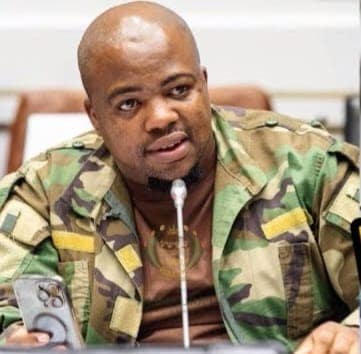
A parliamentary and legal firestorm has erupted, pitting controversial forensic investigator Paul O’Sullivan against uMkhonto weSizwe Party (MKP) Member of Parliament, Sibonelo Nomvalo, in a clash that strikes at the heart of political accountability, the credibility of state capture probes, and the rules of parliamentary engagement.
The dispute centres on a series of explosive allegations made by O’Sullivan, primarily through sworn affidavits and public statements, targeting Nomvalo. While the precise content of the claims remains partially shrouded in legal and procedural language, sources familiar with the matter indicate they involve serious accusations related to past business dealings, potential breaches of the Executive Ethics Code from a previous role in provincial government, and questions about the legitimacy of his academic qualifications.
Nomvalo’s Fierce Rebuttal: “A Theatre of Lies”
In a combative press conference held on the parliamentary precinct, a visibly incensed Nomvalo launched a full-throated counteroffensive. He did not merely deny the allegations; he framed them as a coordinated attack on the integrity of the MKP and a deliberate distraction from core parliamentary duties.
“Paul O’Sullivan is a mercenary of misinformation, a so-called forensic investigator who operates as a political hitman for hire,” Nomvalo declared, his voice rising. “His dossier is a fiction, a theatre of lies constructed to smear my name and destabilize the MKP’s work in holding the executive to account. We reject each and every one of his claims in the strongest possible terms. They are baseless, defamatory, and born from a sinister agenda.”
The Core Demand: “Appear in Person and Prove It”
Moving beyond denial, Nomvalo issued a direct and public challenge, turning the procedural tables on the investigator. He revealed that O’Sullivan had submitted his allegations to Parliament’s recently established Ad Hoc Committee on the Review of the Code of Ethical Conduct for Members. However, O’Sullivan reportedly requested to submit evidence virtually or in writing, citing security concerns and the sensitivity of his work.
Nomvalo categorically rejected this.
“He must come before the committee, in person, under oath, and present his so-called evidence,” Nomvalo demanded. “He cannot lob grenades from the shadows and hide behind affidavits and media leaks. If he has the courage of his convictions, let him face the committee like everyone else. Let him be subject to cross-examination. Let us see the provenance of his documents. This is about fairness and due process. We will not allow trial by media or trial by clandestine affidavit.”
O’Sullivan’s Stance: “Evidence Speaks for Itself”
Reached for comment, O’Sullivan stood by his work. In a written response, he stated, “My investigations are evidence-based and conducted with rigorous integrity. The affidavits and documentation submitted speak for themselves and have been provided to the appropriate constitutional bodies, including Parliament. My primary concern is the exposure of corruption and state capture, not political point-scoring. I have cooperated fully with the committee’s processes within the security parameters necessary for such sensitive matters.”
He further suggested that calls for his physical appearance were a “delaying tactic” and an attempt to “intimidate a witness.”
Parliamentary Procedure at the Heart of the Storm
The stalemate has thrust the nascent Ad Hoc Committee into an unenviable position, testing its procedures and authority. Legal experts are divided on the matter. Some argue that the committee has the power to summon any person to give evidence, as O’Sullivan is the initiator of the complaint. Others contend that complainants are not always required to appear, especially if their evidence is comprehensively documented.
Committee Chairperson, experienced MP Sarah Bhengu, confirmed receipt of the complaint and O’Sullivan’s submissions. “The committee is seized with the matter and will determine the appropriate way forward in line with our rules and the need for a fair process for all involved,” she stated, urging calm and patience.
Political Ramifications and the Shadow of State Capture
The clash transcends a personal feud. For the MKP, a party already positioning itself as a radical anti-establishment force, this is a pivotal moment. They are framing the attack on Nomvalo as an assault on the entire party by “old-guard forces” threatened by their ascent. “They cannot beat us at the ballot box, so they seek to tarnish us with manufactured scandals,” a senior MKP official stated off-record.
For O’Sullivan’s supporters, many of whom see him as a fearless anti-corruption crusader, this is a test of whether Parliament can seriously handle serious allegations against its own members, or if it will retreat into procedural protectionism.
The political theatre is set, with high stakes for all involved: the credibility of a parliamentarian, the reputation of a controversial investigator, the procedural integrity of a parliamentary committee, and the ongoing, volatile public narrative around corruption and accountability in South Africa. The next move rests with the Ad Hoc Committee, but the war of words has guaranteed that this will be fought as fiercely in the court of public opinion as in the committee room.
About The Author