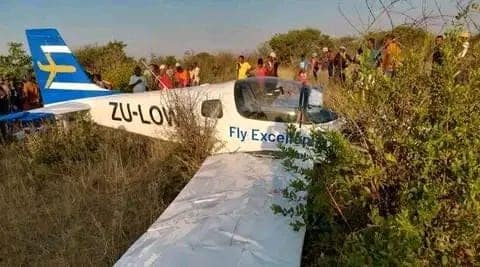
The evening sky over Klipgat, a rural settlement in the Sofasonke area, was supposed to be quiet. As the sun dipped below the horizon on Thursday, February 19, 2026, residents were settling into their nightly routines. Then, a sound tore through the stillness: the sputtering, coughing death rattle of an engine, followed by a heavy, ground-shaking thud.
By the time emergency crews picked their way through the difficult terrain, guided by the insistent beep of an emergency locator beacon, there was nothing left to save. A light aircraft, its fuselage twisted and broken against the hard earth, had claimed two lives. The pilot and a student pilot were declared dead at the scene; their training flight ended in catastrophe.
The crash, which occurred shortly before 6 p.m. on Thursday, has plunged a small aviation community into mourning and reignited urgent questions about the safety of general aviation in South Africa. In recent months, the country has witnessed a troubling spate of light aircraft accidents, each one a reminder that flying, even for pleasure or training, carries inherent and unforgiving risks.
The Final Flight
According to preliminary information from aviation authorities, the aircraft involved was a small, fixed-wing plane, the type commonly used for private travel and flight instruction. It had departed from a nearby airfield earlier in the afternoon, ostensibly for a routine training exercise. On board were two individuals: a qualified pilot, seated in the instructor’s position, and a student pilot, learning the ropes of aviation.
What happened in the final moments before the crash remains a mystery that crash investigators will now spend months trying to unravel. Did the engine fail? Did they encounter sudden, unexpected weather? Was there a medical emergency on board? Or was it a catastrophic mechanical failure that gave the pilot no time to react?
Witnesses on the ground reported hearing the engine spluttering, a sound that suggests a loss of power. Some said they saw the plane flying lower than usual, as if the pilot was desperately searching for a place to put down. But in the rural Klipgat area, flat, open fields are mixed with rocky outcrops, homesteads, and power lines. There were a few good options for an emergency landing.
The aircraft’s emergency locator beacon, a device designed to activate on impact and transmit a distress signal, did its job. Shortly before 6 p.m., the signal was picked up by the Aeronautical Rescue Coordination Centre (ARCC), which immediately triggered a search and rescue operation.
The Grim Discovery
Local first responders, including police and emergency medical services, worked with the ARCC to pinpoint the crash site. The terrain was challenging, and darkness was falling fast. When they finally reached the wreckage, they were met with a scene of devastation.
The aircraft was destroyed. There were no survivors. Both occupants, whose identities have not yet been officially released pending notification of next of kin, were pronounced dead at the scene. For the emergency workers, it was a grim reminder of the fragility of life. For the families of the two aviators, it was the beginning of an unimaginable nightmare.
In a statement released late Thursday night, police confirmed the deaths and opened an inquest docket. The South African Civil Aviation Authority (SACAA) dispatched a team of investigators to the site, their job to sift through the twisted metal, examine the engines, and piece together the final seconds of the flight. It is painstaking, meticulous work, and it will be weeks or months before a preliminary report is released.
A Community in Shock
The aviation community in South Africa is a close-knit one. Pilots, instructors, and students often know each other, train together, and share a common passion for the skies. The news of a crash, especially one involving a student, sends ripples of grief and anxiety through flight schools and airfields across the country.
“It’s every instructor’s worst nightmare,” said a veteran flight instructor, speaking on condition of anonymity. “You strap in next to a student, you’re teaching them, you’re guiding them, and you are responsible for their life and your own. When something goes wrong, it goes wrong so fast. My heart breaks for both of them and for their families.”
The identity of the two deceased has not been released, but it is believed they were associated with a local flying school or private aviation club. In the coming days, tributes will pour in from fellow pilots, and memorial services will be held. But for now, there is only silence and shock.
A Troubling Pattern
Thursday’s crash is not an isolated incident. In recent months, South Africa has seen a worrying increase in light aircraft accidents. In November 2025, a plane crashed in the Free State, killing the pilot. In January 2026, another light aircraft went down in Mpumalanga, injuring the occupants. Each crash is investigated individually, but together, they paint a picture of a sector under pressure.
Aviation safety experts point to several potential factors. The high cost of aircraft maintenance in South Africa, exacerbated by a weak economy and a struggling rand, may lead some owners to defer essential repairs or cut corners. The availability of spare parts, many of which must be imported, can lead to lengthy downtimes and, potentially, the use of non-certified components.
There is also the question of pilot training and currency. Flying is a skill that requires constant practice. If pilots are not flying regularly due to cost or availability, their skills may degrade. For student pilots, the learning curve is steep, and the margin for error is small.
“General aviation is the backbone of our pilot training system,” said an aviation safety consultant. “But it is also the most vulnerable part of our aviation ecosystem. These are not big commercial airliners with multiple redundancies and layers of oversight. These are small machines flown by individuals. When something goes wrong, the consequences are often fatal.”
The Investigation Begins
As the sun rose on Friday morning over Klipgat, the crash site remained cordoned off. Investigators in white coveralls moved slowly through the wreckage, photographing, measuring, and documenting. The wreckage will eventually be recovered and taken to a secure facility for a more detailed examination.
The engine will be sent for a teardown inspection, where experts will look for signs of mechanical failure. The instruments will be analysed to determine the aircraft’s speed, altitude, and heading in its final moments. The pilots’ training records and medical histories will be scrutinised.
It is a long, slow process, and it offers little comfort to the families of the dead. They are left with questions that may never be fully answered. Why did the engine fail? Why could the pilot not land safely? Why did they have to die?
A Call for Action
In the wake of the crash, aviation safety advocates have renewed their calls for greater oversight and support for general aviation. They argue that the sector, which produces the pilots who will one day fly for commercial airlines, is underfunded and under-regulated. They want stricter maintenance requirements, more frequent pilot testing, and a national strategy to improve safety.
But they also acknowledge the economic realities. Flying is expensive. Making it safer often makes it even more expensive. And in a country with so many pressing priorities—crime, unemployment, poverty—aviation safety can easily fall down the list.
For now, the focus remains on the two lives lost. A pilot and a student, united in their love of flight, met their end in a field in Klipgat. The beacon that guided rescuers to their location has fallen silent. But the questions it raised will echo for a long time to come.
About The Author