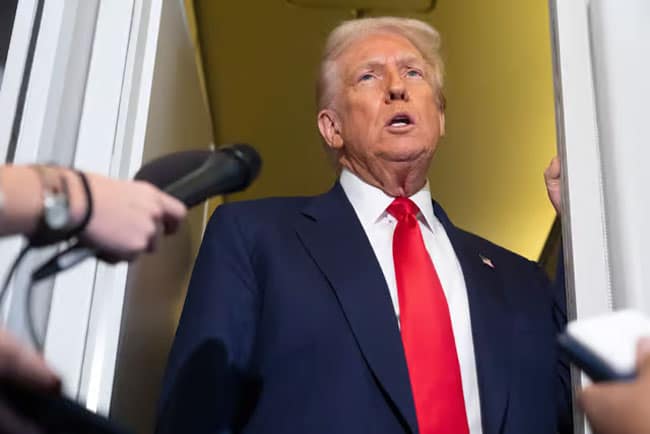
President Donald Trump has issued a directive for the US military to resume testing of nuclear weapons, an action that would mark the first time the country has conducted such tests in over 30 years. The move, announced just before a meeting with Chinese President Xi Jinping, is an attempt to “keep pace” with the nuclear programs of other global powers, namely Russia and China.
In a social media post, the President declared, “Because of other countries’ testing programs, I have instructed the Department of War to start testing our Nuclear Weapons on an equal basis.” This dramatic policy shift comes despite the US already possessing the world’s largest nuclear arsenal, with Russia trailing and China described by Trump as a “distant third.” The US has maintained a moratorium on nuclear testing since 1992, established by former President George H.W. Bush at the close of the Cold War.
The announcement follows a period of heightened rhetoric, including Trump’s denouncement of Russia for its own recent testing of a nuclear-powered missile—tests that the Kremlin insisted were “not nuclear.” While Trump acknowledged the “tremendous destructive power” of nuclear weapons, he asserted that updating and renovating the US arsenal was a matter of “no choice” during his current term, especially as he predicts China’s nuclear programme will achieve parity within five years.
Crucially, the President’s statement did not clarify whether the testing would involve a full nuclear explosion or merely a system capable of delivering a nuclear weapon. For the past 25 years, only North Korea has conducted a nuclear test explosion, with Pyongyang even declaring a moratorium in 2018.
Both Russia and China have reacted sharply to the news. The Kremlin stressed that its recent successful tests of new weapons—such as a missile capable of penetrating US defence systems and the ‘Poseidon’ underwater drone—did not involve the detonation of nuclear warheads. Russian spokesman Dmitry Peskov warned that if the US “departs from the moratorium, Russia will act accordingly.” China, meanwhile, urged the US to “earnestly fulfil its obligations” under the Comprehensive Nuclear-Test-Ban Treaty (CTBT).
Experts are highly critical of the proposed resumption. Daryl G. Kimball, executive director of the Arms Control Association (ACA), called the decision misguided, stating there is “no technical, military, or political justification” for the move. Kimball warned that such an action would likely “trigger a chain reaction of nuclear testing by US adversaries, and blow apart the nuclear Nonproliferation Treaty.” Restarting underground tests at the former Nevada site, last used in 1992, is estimated to take at least three years.
The controversy also reignites the debate over the size of global nuclear stockpiles. While Trump claims the US leads, both the Federation of American Scientists (FAS) and the ACA estimate that Russia holds a slightly larger number of warheads. The US decision comes just 100 days before the expiration of the New Strategic Arms Reduction Treaty (New Start) in February 2026, the final remaining nuclear arms treaty between the US and Russia.
About The Author