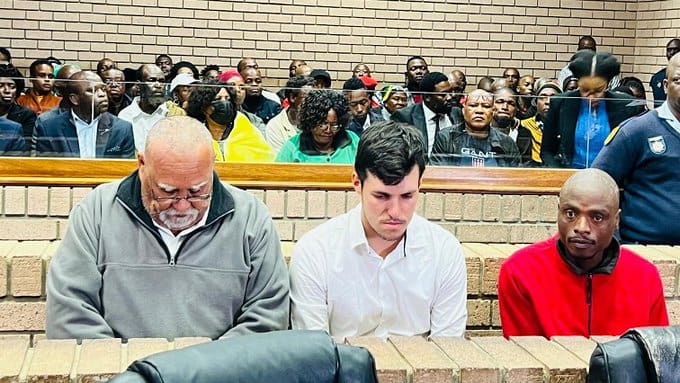
The gallery of the Pretoria High Court had been quietly filling since dawn, a slow procession of mourners, activists, journalists, and the simply curious, all drawn by the gravity of what was about to unfold. By the time Judge Thokozile Masipa entered the chamber at exactly 10 AM, there was standing room only, the air thick with anticipation and the particular tension that precedes a verdict in a case that has come to symbolize something far larger than itself.
When the words finally came—”Guilty on all counts”—a sound rose from the public gallery that was part gasp, part sob, part release. In the front row, Gloria Phakathi let out a wail that seemed to come from somewhere deeper than lungs, somewhere in the marrow of her bones. Her husband, Dumisani, had been dead for 14 months. Today, finally, someone had been held accountable.
The Crime: A Quiet Afternoon, A Brutal End
The facts of the case, as they emerged over the two-week trial, painted a picture of violence so senseless, so disproportionate, that it seemed almost incomprehensible. Yet for those familiar with the dynamics of South Africa’s fraught farming communities, it was a story with tragic echoes of the past.
On the afternoon of December 12, 2024, Dumisani Phakathi, a 45-year-old father of three and a resident on the farm Rietvlei in the Gauteng countryside, left his small dwelling to fetch water. The farm’s communal tap had run dry, so he walked to a stream that ran along the boundary of the property—a stream he had accessed for years without incident. It was a simple act, the kind of mundane errand that rural lives are built upon. He never returned home.
According to the state’s case, presented by prosecutor advocate Rendani Mamphiswana, Phakathi was confronted by three men—Hendrik Visser (58), his son Pieter Visser (31), and farm manager Kobus van Rensburg (49)—who accused him of trespassing and stealing water. What followed was not an arrest, not a warning, but a killing.
The court heard how the three men, armed with rifles and sjamboks, cornered Phakathi near the stream. Witnesses from a neighboring farm, testifying via video link to protect their identities, described hearing shouts, then screams, then the sharp crack of gunfire. When police arrived hours later, summoned by an anonymous caller, they found Phakathi’s body lying in the grass, multiple gunshot wounds to his chest and abdomen. Near him, spent cartridges. Near the cartridges, footprints leading back to the Visser farmhouse.
The Trial: Justice Delayed, But Not Denied
The trial itself was a study in contrasts. The accused, represented by a team of experienced advocates, maintained their innocence throughout, claiming that Phakathi had been caught stealing water and that they had merely confronted him, after which he had attacked them, forcing them to defend themselves. It was a classic “self-defense” narrative, one that has been deployed in farm violence cases for decades.
But the state’s case was meticulous. Ballistic evidence contradicted the self-defense claim—Phakathi had been shot at close range, multiple times, in positions inconsistent with a charging attacker. Witness testimony placed the three men together at the scene, acting in concert, not in self-defense but in pursuit. And perhaps most damningly, cellphone data showed calls between the three men in the hours after the killing—calls the state argued were attempts to coordinate their stories.
“This was not self-defense,” Mamphiswana told the court in her closing argument. “This was execution. This was three men who took the law into their own hands and decided that the life of a black man fetching water was worth nothing. This was murder, pure and simple. Premeditated murder.”
The defense argued that the state had failed to prove premeditation, that the killing, if it occurred, was a tragic accident during a confrontation that escalated unexpectedly. But Judge Masipa, delivering a verdict that took nearly two hours to read, was unpersuaded.
“The evidence before this court,” she said, her voice steady, “establishes beyond reasonable doubt that the three accused acted with a common purpose to confront and punish the deceased. They were armed. They pursued him. They shot him not once, not twice, but multiple times. This court finds that the state has proved the element of premeditation. The accused are guilty of murder.”
The Accused: Faces of a Troubled Landscape
In the dock, the three men received the verdict with varying degrees of composure. Hendrik Visser, the patriarch, stood rigid, his face a mask of controlled fury. His son Pieter appeared stunned, as if the possibility of conviction had never truly occurred to him. Van Rensburg, the manager, simply bowed his head and closed his eyes.
They are, in many ways, representative of a certain segment of South Africa’s farming community—white, Afrikaans-speaking, deeply rooted in the land and in a worldview that sees the countryside as their domain, their responsibility, their right. It is a worldview that has, historically, coexisted uneasily with the presence of black farm dwellers, who are often seen as labor first and people second, whose access to land and resources is conditional, precarious, subject to the whim of the farmer.
For organizations like the African Transformation Movement and the EFF, who have closely followed the case and whose members filled much of the public gallery, the convictions represent a long-overdue reckoning.
“For decades, farmers have acted as judge, jury, and executioner on their land,” said an ATM spokesperson outside the court. “They have killed with impunity, confident that the system would protect them. Today, that system has spoken. Today, justice has been done for Dumisani Phakathi. But let us not forget: there are many Dumisanis. There are many families still waiting for justice.”
The Victim: Dumisani Phakathi, Remembered
As the court proceedings unfolded, a quieter gathering took place in the small Gauteng township where Gloria Phakathi now lives with her three children. Neighbors, friends, and family members came to sit with her, to bring food, to pray. In the small living room, a single photograph of Dumisani sat on a table surrounded by candles—his face, smiling, alive, impossibly young.
“He was a good man,” Gloria said, her voice soft but steady. “He worked hard. He loved his children. He would do anything for anyone. He was just fetching water. That’s all he was doing. Just fetching water.”
Her eldest son, Thabo, 19, sat beside her, his face a mixture of grief and the hard anger of young manhood. “I want them to suffer,” he said quietly. “I want them to feel what we feel. I want them to know that my father was a person, not just a black body on their land.”
The Aftermath: Sentencing and Beyond
With the conviction secured, the case now moves to the sentencing phase, scheduled to begin in two weeks. The state will seek life imprisonment for each of the three accused, arguing that the brutality of the crime and the premeditation involved leave no room for leniency. The defense will likely present mitigating factors—the men’s ages, their lack of prior convictions, their contributions to their community—in an effort to secure a lesser sentence.
But for those who followed the trial, the verdict itself was already a form of justice—a recognition that what happened to Dumisani Phakathi was not an accident, not a tragedy, but a crime. A crime committed by men who believed themselves above the law, who believed that a black man’s life was theirs to take.
The Bigger Picture: Farm Violence in South Africa
The Phakathi case has reignited a painful national conversation about violence on farms—not the violence against farmers, which receives widespread media attention and political sympathy, but the violence committed by farmers against those who live and work on their land.
Human rights organizations have long documented cases of assault, torture, and murder of farm dwellers, often with little to no accountability. The quasi-feudal nature of many farming communities, where farmers control not only land and employment but also housing, water access, and even movement, creates conditions of extreme vulnerability for those at the bottom of the hierarchy.
“The Phakathi case is not an anomaly,” said a researcher from the Socio-Economic Rights Institute who has studied farm violence. “It is a window into a world that most South Africans don’t see—a world where farm dwellers live at the mercy of farmers, where access to basic necessities like water can be a death sentence, where the law is often whatever the farmer says it is.”
A Long Road
As the sun set over Pretoria, the crowds outside the high court slowly dispersed. Gloria Phakathi, supported by family, walked to a waiting car. She had come to hear the verdict, to see justice done, to carry that knowledge back to her children. The sentencing hearing would come, and then, perhaps, closure. But closure is a complicated thing when the person you love is never coming back.
“I will never forget that day,” she said, pausing at the car door. “The day they told me he was gone. I will never forget the sound of my children crying. But today, today I saw those men. I saw their faces when the judge spoke. And I thought: my Dumisani is in a better place. And they? They will rot in hell on earth.”
The car pulled away, disappearing into the Pretoria traffic. Behind it, the high court stood silent, its work done for the day. But the questions it raised—about justice, about land, about the value of a black life in rural South Africa—will linger long after the courtroom lights have been switched off.
About The Author