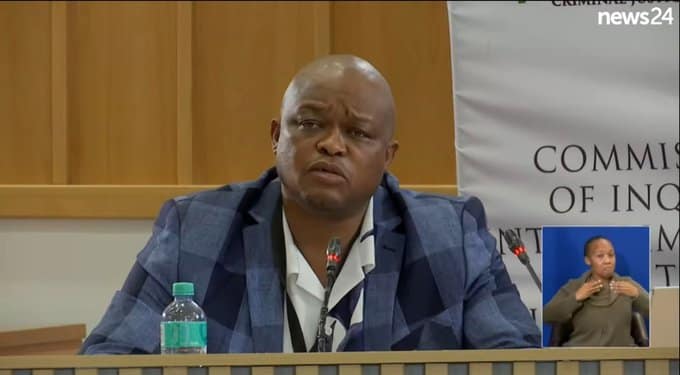
In a hearing that veered from the shocking to the surreal, the Madlanga Commission investigating allegations of misconduct within South Africa’s security services became the stage for a tale of international espionage, high-level bribery, and shadowy hitmen, all delivered by a single, self-proclaimed insider.
North West businessman Brown Mogotsi, taking the stand on Tuesday, did not so much drop a bombshell as he detonated a whole arsenal of unsubstantiated claims, sending shockwaves through the commission and triggering a firestorm of confusion and skepticism across social media.
A Web of Intrigue: Kings, Commissioners, and the CIA
Mogotsi’s testimony painted a picture of a South African state deeply compromised by foreign intelligence. In his narrative, the Central Intelligence Agency (CIA) had successfully recruited two of the nation’s most prominent figures.
He claimed that KwaZulu-Natal Police Commissioner, Lieutenant General Nhlanhla Mkhwanazi, a senior and respected figure in the South African Police Service (SAPS), was not merely a police officer but a CIA asset. Even more audaciously, he alleged that His Majesty, King Misuzulu kaZwelithini, the revered monarch of the Zulu nation, had also been recruited by the American agency.
Mogotsi presented these claims not as conjecture, but as fact, though when pressed, his evidence dissolved into the ether of hearsay and unnamed “reliable sources.” He suggested that this foreign influence was a root cause of instability and corruption within certain state structures, a grand conspiracy theory offered without a single piece of documentary or corroborative proof.
The Tenderpreneur, The Hitman, and The Former Minister
The web of allegations grew denser and more domestic. Mogotsi placed controversial tenderpreneur Vusimuzi Matlala at the center of a corrupt nexus within the SAPS. He did not mince words, describing Matlala as a “hitman” whose role was to facilitate and enforce corrupt multi-million rand tenders for police vehicles and equipment.
According to Mogotsi, Matlala was the linchpin in a sophisticated bribery scheme that reached the highest echelons of power. He alleged that Matlala had orchestrated bribes to former Police Minister Bheki Cele and other senior officials, ensuring that lucrative state contracts were funneled to a select few. Again, the specifics were murky, the timelines vague, and the evidence non-existent beyond Mogotsi’s own assertions.
The Bester Connection: A Self-Styled Kingmaker
Perhaps in an effort to bolster his own credibility, Mogotsi wove himself into one of South Africa’s most notorious recent crime stories. He claimed a pivotal role in the sensational arrest of Thabo Bester, the “Facebook Rapist” and “Master of Escape” who faked his own death and broke out of a maximum-security prison in 2023.
“I was instrumental in the arrest of Thabo Bester,” Mogotsi declared, portraying himself as a shadowy operative whose behind-the-scenes intelligence led to the recapture of the fugitive. This claim, like the others, was presented as a statement of fact, with no detail on what his role entailed or which law enforcement agencies he had supposedly assisted.
A Skeptical Bench and a Baffled Public
Presiding over the spectacle, Commission Chair Justice Mbuyiseli Madlanga maintained a demeanor of judicial patience, but his probing questions cut through the theatre. He repeatedly challenged Mogotsi on the foundation of his allegations.
“Mr. Mogotsi,” Justice Madlanga interjected at one point, his tone measured but firm, “these are exceptionally serious claims you are making. You speak of a sitting Police Commissioner and His Majesty the King being CIA agents. You allege bribes to a former Minister. The Commission is left with your word, and your word alone. Do you have any documentation, any recordings, any witnesses who can corroborate this?”
Mogotsi’s responses remained evasive, falling back on the need to “protect his sources” and the clandestine nature of his information.
Beyond the commission’s walls, the public reaction was one of widespread bewilderment. Social media platforms became a forum for satire and skepticism.
“So the CIA is recruiting Kings and Commissioners now? What’s next, the Spook of the Year awards at the Durban July?” tweeted one user. Another posted a meme from the film The Men Who Stare at Goats with the caption, “The Madlanga Commission, colourised.”
Many expressed concern over the credibility of the commission itself, worrying that such unsubstantiated testimony could undermine its critical work. “This is a serious commission investigating serious issues,” wrote a political analyst online. “Allowing this kind of conspiracy theory testimony without evidence does a disservice to the pursuit of truth and justice.”
An Unresolved Spectacle
As Mogotsi stepped down from the witness stand, he left behind a thick cloud of allegations and no clear path to verification. His testimony presented the Madlanga Commission with a dilemma: how to process claims that, if true, would represent a seismic breach of national security, but which, in their current form, resemble the plot of a pulp thriller.
The commission continues, but the shadow of Mogotsi’s unproven narrative will linger, a stark reminder of the blurred lines between whistleblowing, fantasy, and the deliberate manipulation of a public platform. For now, the questions he raised hang in the air, unanswered and, without evidence, ultimately unanswerable.
About The Author