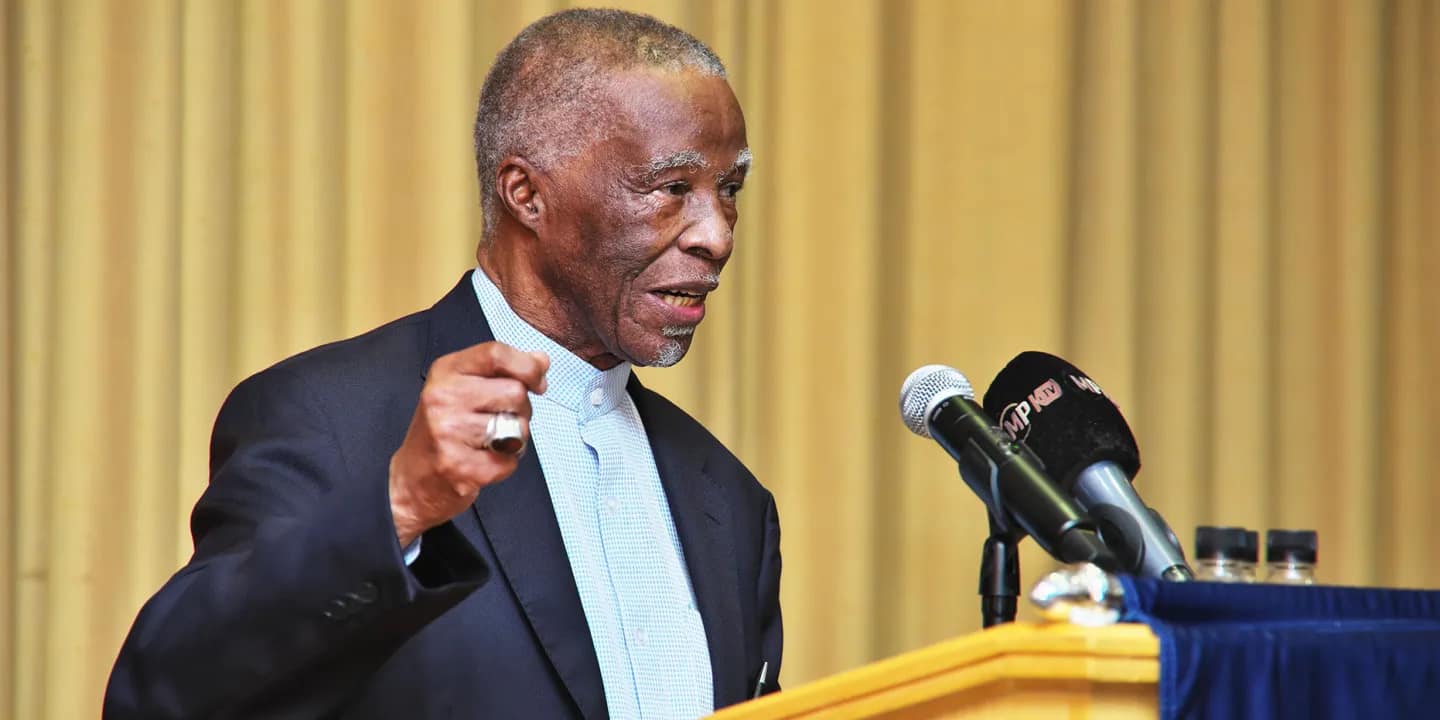
GQEBERHA – In a powerful and candid address, former President Thabo Mbeki has declared the current method of electing South Africa’s president to be fundamentally flawed, stating that Parliament has “no clue” about a candidate’s capabilities when appointing the nation’s leader.
Speaking at the launch of the National Dialogue for the Eastern Cape higher education sector at Nelson Mandela University, Mbeki pulled no punches in his assessment of the country’s state of affairs, describing a nation mired in multifaceted crises.
A Flawed Presidential Election Process
Drawing from his own experience, Mbeki highlighted the inherent problem with the indirect election of the president by the National Assembly. “The manner in which we elect the President is wrong. The question is never asked if a President is capable and a fit and proper person,” Mbeki stated.
He revealed, “When Parliament said I must become president, they did not have a clue what I was capable of doing, and they never asked.” He identified this as a critical issue that a proposed National Dialogue must urgently address.
A Nation in Crisis, Politicians Without Answers
Mbeki painted a stark picture of South Africa at 30 years of democracy, citing crises in the economy, politics, crime, corruption, and international relations. “There is nothing that does not say crisis,” he said.
His solution? A people-driven National Dialogue. After reviewing party manifestos before the 2024 elections, Mbeki concluded that politicians alone do not possess the answers. “Answers can only come from the people, not political parties,” he asserted, calling for a move beyond empty promises to tangible, practical solutions.
A Call to Action for the “Intelligentsia”
Mbeki placed a significant responsibility on the shoulders of the country’s “intelligentsia” – the academics and thought leaders within the higher education sector. He challenged them to step into the void, stating that politicians are not “thought leaders.”
He used the National Development Plan (NDP) as a key example of a missed opportunity. While he praised the NDP as a “brilliant vision,” he lamented that it was never translated into a practical, actionable plan—a failure he attributes directly to the intellectual community’s lack of intervention.
“The vision was never translated into practical steps… this is what you now need to contribute,” Mbeki told the audience, urging them to provide the intellectual backbone for the National Dialogue.
He also touched on the controversial National Health Insurance (NHI), criticising the lack of comprehensive engagement with health professionals. “Their intellectual input has not been made,” he noted, underscoring his broader point about the exclusion of expert knowledge.
Mbeki’s message culminated in a powerful charge to the higher education sector: to change defeatist narratives and provide the actionable ideas needed to steer South Africa away from its current trajectory. “You have a responsibility,” he said. “You are the only body that can legitimately say: ‘We are the thought leaders.’”
About The Author