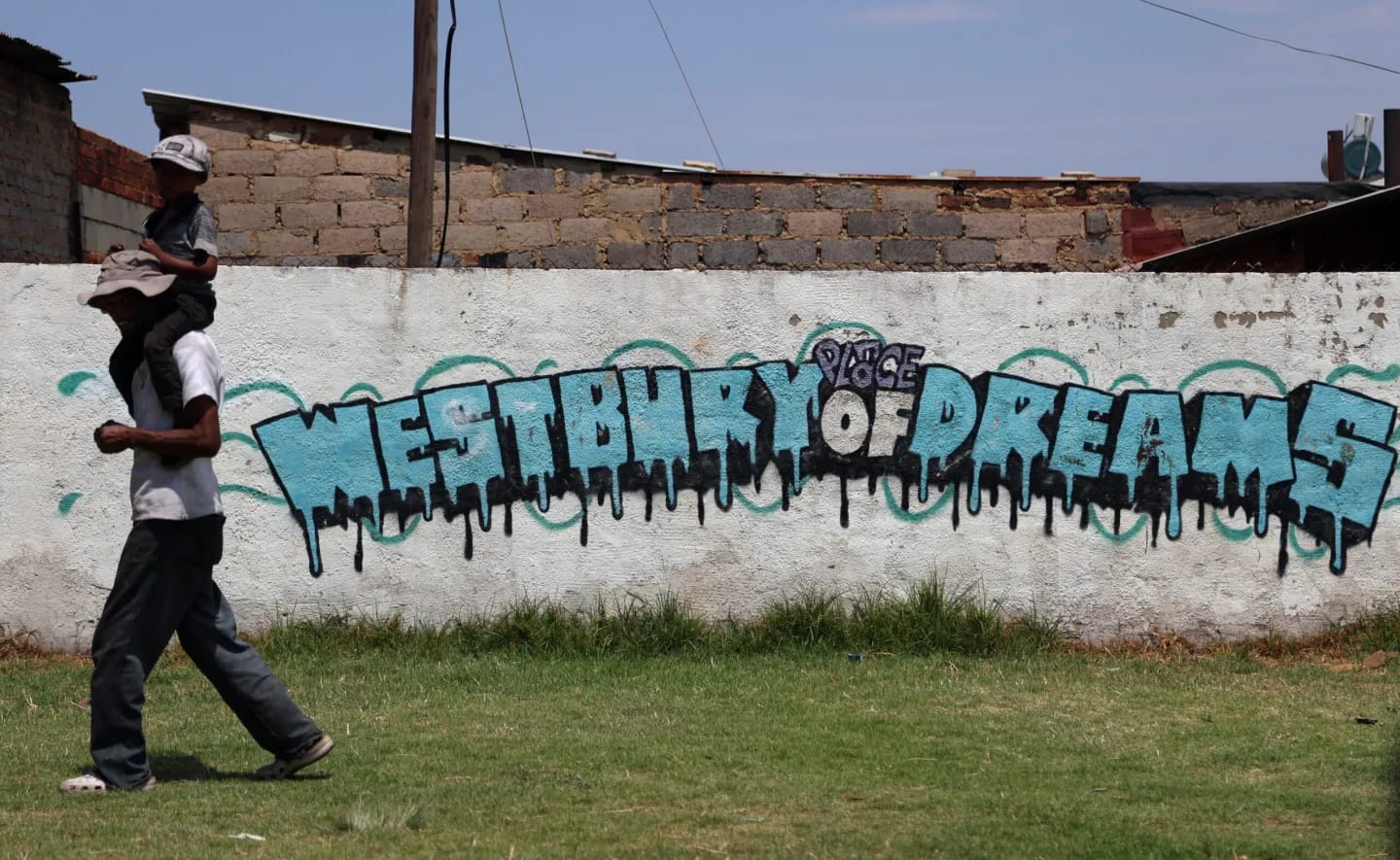
The bullet that kills doesn’t discriminate. It doesn’t care if you’re a gangster, a teenager, or just someone in the wrong place at the wrong time. In the streets of Westbury, Johannesburg, this is not a philosophical idea; it is a daily truth.
Last week, on Croesus Street, the truth came calling again. The staccato rhythm of gunfire left two teenagers dead and five others wounded. As the sirens wailed and the news vans descended, the residents of this predominantly coloured suburb felt a familiar, crushing sense of déjà vu. They had seen this script before.
The Man Behind the Trigger
In the shadowy world of the Varados, one of Westbury’s two dominant gangs, we meet Peter. His name is a pseudonym, a shield provided by journalists to a man who claims he has no need for one.
Peter says he killed for the first time shortly after his 21st birthday. He was nervous, he admits, his finger trembling on the trigger. The act was for his gang, a rite of passage into a brotherhood defined by violence. Since that day, he claims five more lives have been taken by his hand. Each one, he insists, was an act of revenge, a tit-for-tat in a bloody feud with the rival Fast Guns.
“It is just for blood, and my job is to shoot,” he says, his gaze steady and cold. He speaks with a chilling matter-of-factness, believing divine providence guides his aim. “The Almighty looks after me; that is how I survive.”
A Cycle of Empty Promises
The community has learned not to trust in promises, either from heaven or from the government. When a mass shooting makes headlines, the police arrive in a show of force and political theatre.
Residents recall 2023, when a young man named Cresando Otto was killed. The then Police Minister, Bheki Cele, arrived in a cavalcade of black BMWs, flanked by the Gauteng premier and the Johannesburg mayor. In the Westbury Recreational Hall, he gave a stern command to his top brass: “Sanitise this place; strip it and sanitise it.”
He promised a stronger police presence, a crackdown on corruption, and a new partnership with the community. But the extra patrols soon vanished, and the shootings resumed. This pattern has bred a deep, corrosive distrust. Many residents believe corrupt police officers are not just failing to stop the violence, but are actively enabling it.
In response to the latest killings, National Police Commissioner Fannie Masemola has ordered a crackdown on “lolly lounges” – the informal drug dens that fuel the conflict. But for many, these are just more words.
Where Do the Guns Come From?
Peter makes a bombshell claim: the guns he used for his killings were sold to the Varados by the police. According to him, firearms seized in police operations are sometimes sold on to the very gangs they were taken from.
The police vehemently deny this. Brigadier Brenda Muridili, a police spokesperson, stated, “The SAPS has a record of all firearms which have been seized during operations, and Sophiatown Police Station does not have any firearms missing as per the latest audit.”
Yet, experts like David Bruce, an independent researcher on policing, argue that understanding the flow of illegal firearms is critical to reducing violence. “The next step is to improve the quality of information on what the sources of these illegal firearms are,” Bruce says. Without that, the cycle is endless.
The Shopfronts of Despair
The root of this war is a thriving drug trade. On a Monday morning, not far from the Sophiatown Police Station, a drug corner operates from a simple table on a stairwell in a block of flats. Graffiti on the walls marks it as Varados turf.
Here, the crew is a portrait of a community’s lost potential. The youngest are teenagers; the older men could be their fathers. They talk about the jobs they had long ago—one a welder, another a taxi driver. Now, they sell Mandrax and crystal meth to customers from their own community.
Dean, who has sold drugs for 21 years, was shot at just days before. “All I want to do is make money. I would leave this if I could find a job,” he says, a sentiment echoed by many. “If there were jobs, it would sort out this drug problem.”
Nearby, a group of Gauteng’s Crime Prevention Wardens, the ‘amaPanyaza’, patrols. Residents watch them with cynical amusement. “Ja, I don’t know what they are supposed to do, they don’t even have guns,” one man laughs.
A Pastor’s Mission and a Father’s Fear
In the Westbury Recreation Centre, a government-hosted anti-drug campaign feels disconnected from the harsh reality outside. Pastor Alister Fortuin, a man with an unparalleled understanding of the conflict, shakes his head.
“It’s the wrong approach,” he says. “You’ll never get someone who is on drugs or on alcohol coming to a place like this. Why aren’t we going house to house?”
Fortuin is one of the few who can claim to have been a member of both the Varados and the Fast Guns. Like Peter, he was an enforcer who killed for the first time at just 13 years old.
“You become so numbstruck. I can see the way that boy is. I was like that — you just don’t care,” he reflects.
Fortuin served 22 years in prison, found God, and turned his life around. When he was released, he discovered 80% of the gang members he grew up with were dead. The survivors who had risen in the ranks had moved out to plush suburbs, leaving behind a new generation of younger, meaner recruits.
Now, his mission is to save Westbury’s youth through the local scout group, focusing on children in primary school before the gangs can claim them. But his fight is personal and painful. His own son is in jail for possessing a firearm and drugs.
“If only I could have a place where I could take all these boys. A piece of land far away, there I could empower them,” he muses.
It is a dream of escape, a flicker of hope in a suburb where the dominant sounds are the whispers of drug deals and the echoing blasts of gunfire—where for young men like Peter, a job is not a means to live, but a license to kill.
About The Author