In the often-unpredictable world of international football fandom, hope and desperation can birth the most compelling of fantasies. This week, the South African football community was briefly captivated by one such tantalizing, yet entirely fictional, prospect: that Georgian wizard and Paris Saint-Germain winger Khvicha “Kvaradona” Kvaratskhelia could be eligible to swap his white kit for the gold and green of Bafana Bafana.
The rumor, which spread like wildfire across social media platforms, suggested that the dazzling 23-year-old attacker possessed South African heritage, potentially opening a path for him to bolster the national team’s attack. The fantasy was fueled by a specific context: Georgia’s recent setbacks in their 2026 FIFA World Cup qualifying campaign. With their hopes dimming, the notion that Kvaratskhelia might seek a quicker route to a global tournament with a rising Bafana Bafana side felt, to some, just plausible enough to share.
However, a swift and thorough fact-check has definitively extinguished this speculative fire, confirming the story as a classic case of “too good to be true.”
Tracing the Roots: A Georgian Through and Through
The core of the rumor hinged on a fictional backstory. In reality, Khvicha Kvaratskhelia was born in 2001 in Tbilisi, Georgia, and grew up in the city of Rustavi. His family is deeply rooted in Georgian football; his father, Badri, was also a professional footballer who played for Georgian clubs. There is no evidence—ancestral, familial, or otherwise—to suggest any connection to South Africa. The player’s entire identity and footballing upbringing are intrinsically Georgian.
The Unbreakable FIFA Rulebook
Beyond the biographical inaccuracies, the dream was impossible due to the clear and unyielding regulations of FIFA. Kvaratskhelia is not a newcomer to the international stage; he made his senior debut for Georgia in 2019 and has since earned over 45 caps, becoming the undisputed star of his national team.
According to FIFA’s statutes, a player is permanently tied to a national association once they have played in an official competitive senior match for one nation. While there are limited exceptions for players with dual nationality who have only featured in friendly games, Kvaratskhelia’s extensive competitive record for Georgia—including European Championship and World Cup qualifiers—makes any switch a legal impossibility. The door, in this case, was not just closed; it was sealed shut by a binding contractual agreement with the Georgian Football Federation.
Reaction from the Ground: Amusement and Realism
On South African social media, particularly on X (formerly Twitter), the rumor was met with a mix of amusement and healthy skepticism. Many fans quickly pointed out the obvious holes in the story, with one user quipping, “As much as I’d love to see Kvaratskhelia in a Bafana jersey, the only thing he shares with SA is that we all admire his skills.” The brief frenzy became a moment of collective daydreaming, followed by a pragmatic return to reality.
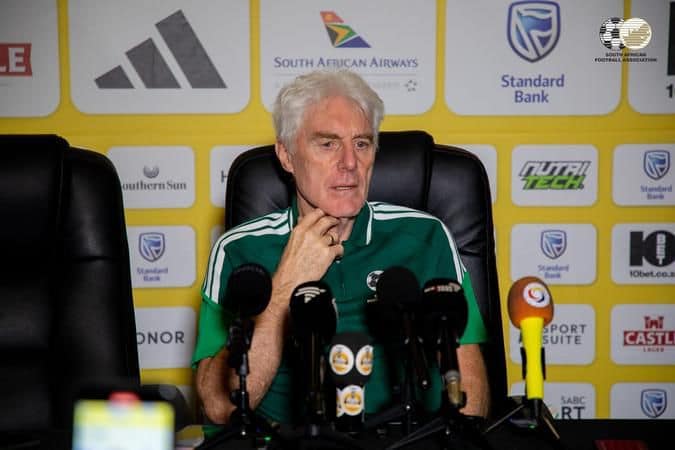
The debunking of this rumor also serves to highlight the genuine progress being made by the actual Bafana Bafana squad. Under the guidance of coach Hugo Broos, the team is steadily progressing through its CAF World Cup qualifying group on its own merits, building a cohesive and resilient unit. The focus, as it should be, remains on developing homegrown talent like Percy Tau, Evidence Makgopa, and Teboho Mokoena, rather than chasing phantom transfers of international stars.
While the image of Kvaratskhelia weaving his magic for Bafana Bafana was a thrilling one, it was ultimately a digital mirage. The episode is a reminder that in the age of viral information, even the most alluring football fairytales must be weighed against the unassailable truths of genealogy and FIFA’s rulebook.
About The Author