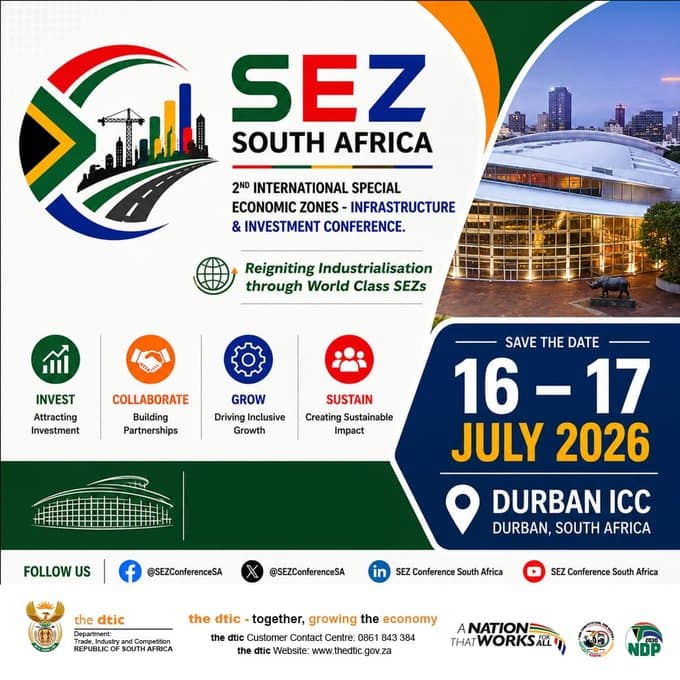
In a concerted push to revive South Africa’s flagging industrial base and attract much-needed foreign direct investment, the Department of Trade, Industry and Competition will host the second International Special Economic Zones (SEZ) Infrastructure and Investment Conference in Durban from 16 to 17 July 2026. The high-level gathering is set to bring together a diverse array of investors, policymakers, industry leaders, and development finance institutions, all united by a shared goal of unlocking the transformative potential of South Africa’s SEZ network to drive inclusive economic growth and job creation.
The conference, which follows the inaugural edition held in 2024, comes at a critical juncture for the country’s economy. With growth projections remaining tepid, unemployment stubbornly high, and infrastructure bottlenecks constraining industrial expansion, the government is placing renewed emphasis on SEZs as strategic catalysts for reindustrialisation. These designated zones, which offer targeted tax incentives, streamlined regulatory processes, and dedicated infrastructure support, are intended to attract both domestic and international investors in sectors ranging from automotive manufacturing and agro-processing to renewable energy and digital technologies.
Trade, Industry and Competition Minister Parks Tau is expected to deliver the keynote address, where he is likely to outline ambitious plans to expand the country’s SEZ footprint and address persistent challenges that have hampered their effectiveness. These include bureaucratic red tape, unreliable energy and water supply, logistical inefficiencies at ports and rail networks, and the slow pace of land release for development. “South Africa cannot afford to be a bystander in the global race for investment,” a senior official in the department said ahead of the conference. “Our SEZs must become engines of growth that not only attract capital but also foster innovation, skills development, and meaningful participation by black-owned enterprises.”
The Durban location is particularly significant, given the city’s status as Africa’s premier logistics and manufacturing hub. The eThekwini municipality has been actively positioning itself as an investment destination of choice, leveraging its world-class port infrastructure and proximity to key industrial corridors in KwaZulu-Natal. The conference will feature site visits to existing SEZs in the province, including the Dube TradePort and the Richards Bay Industrial Development Zone, allowing potential investors to see firsthand the opportunities and challenges on the ground.
The two-day programme will include panel discussions, masterclasses, and one-on-one business matching sessions, with a focus on practical solutions to infrastructure deficits, financing models for large-scale projects, and strategies to integrate local suppliers into global value chains. International delegates from countries with successful SEZ models—including China, Singapore, and the United Arab Emirates—are expected to share insights on best practices and lessons learned from their own industrialisation journeys.
However, the conference also takes place against a backdrop of scepticism from some quarters, where critics argue that South Africa’s SEZs have underperformed relative to their potential. Concerns have been raised about insufficient monitoring of job creation targets, limited linkages with local economies, and the risk of creating enclaves that benefit foreign investors without translating into broad-based development. Organisers have acknowledged these criticisms, emphasising that the conference will serve as a platform for frank dialogue and course correction.
As Durban prepares to welcome delegates from across the globe, the stakes could not be higher. For a country in desperate need of an economic revival, the conference represents more than just a networking opportunity—it is a litmus test of whether South Africa can translate its policy ambitions into tangible outcomes. In a world where capital flows to certainty and efficiency, the message from Durban will need to be clear: South Africa is open for business, and its SEZs are ready to power the next wave of industrial transformation.
About The Author