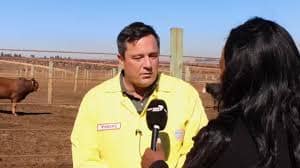
The vaccines, sourced from Biogenesis Bago, are expected to provide urgent support to the provinces and regions most affected by the outbreak. Steenhuisen made the announcement during a joint sitting of the National Assembly and the National Council of Provinces, where Members of Parliament debated President Cyril Ramaphosa’s recent State of the Nation Address.
The debate will continue on Wednesday at 2 pm, with the president scheduled to respond on Thursday at 2pm.
Steenhuisen, who also leads the Democratic Alliance and is part of the Government of National Unity, said the president’s speech showed that the country has begun to recover after years of economic difficulty. He credited the coalition government’s reform agenda and fiscal discipline for recent improvements.
He pointed to 4 consecutive quarters of positive GDP growth, inflation at its lowest level in 20 years, stabilised national debt, easing interest rates and declining borrowing costs. He also noted that the rand has strengthened and unemployment is at its lowest level in 5 years.
However, he cautioned that projected growth of about 1.5 percent remains well below the 3 percent or more needed to reduce poverty and create enough jobs.
Steenhuisen urged faster economic reform, including expanding Operation Vulindlela to sectors such as rail, water and telecommunications. He called for increased private sector participation and reforms to empowerment policies to focus more broadly on skills, ownership and opportunity.
On local government, he stressed that appointments must be based on merit and that officials should be held accountable. He also supported easing labour market restrictions to encourage job creation and strengthening intelligence-led policing to address crime.
Regarding foot and mouth disease, Steenhuisen welcomed the decision to classify the outbreak as a national disaster, saying this would enable a coordinated national response. He explained that South Africa lost its vaccine production capacity in 2005 and has relied mainly on imports from the Botswana Vaccine Institute.
Under a new strategy, additional international suppliers have been secured. For the first time in more than 20 years, the Agricultural Research Council has produced a batch of vaccines for operational use. The facility is currently able to produce 20000 doses per week, with plans to increase this to 200000 doses per week by 2027.
By the end of March, the country expects to receive more than 5 million vaccine doses from 3 suppliers. More than 2 million doses have already been administered nationwide, and daily vaccinations are ongoing.
Steenhuisen also announced that private veterinarians will be allowed to register under the Animal Diseases Act to assist with the national rollout. The goal is to vaccinate 80 percent of the national herd by December.
He emphasised that protecting agriculture is about safeguarding economic growth, jobs and stability. While reaffirming the Democratic Alliance’s commitment to the Government of National Unity, he said the party would continue to push for stronger reforms and responsible use of public funds.
He concluded that although progress has been made, much work remains and the need for action is urgent.
About The Author