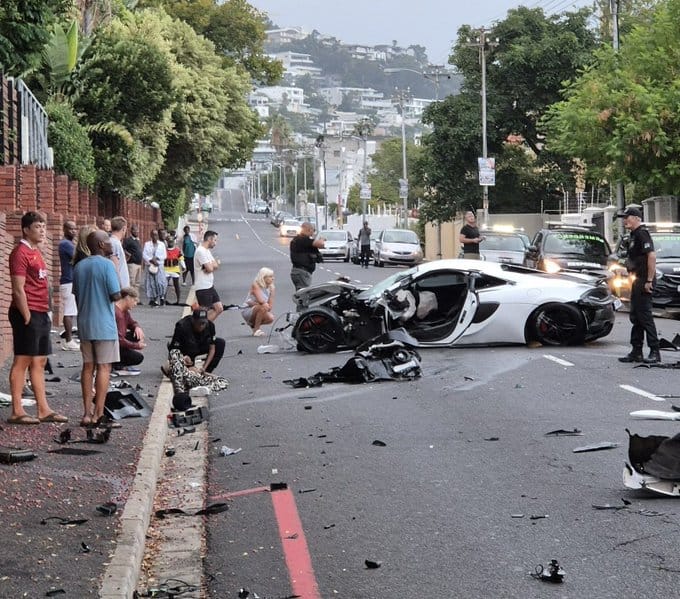
The image was designed for virality. In November last year, a burnt-orange McLaren 720S, a supercar worth over R5 million, sat crumpled against a lamppost in the affluent Cape Town suburb of Sea Point. Steam hissed from its shattered engine as onlookers filmed on their phones. The man behind the wheel, Nigerian rapper Prince Daniel Obioma—known to his fans as 3GAR—emerged from the wreck with a swagger that suggested the crash was just another music video scene.
For weeks, the incident fuelled tabloid headlines and social media chatter. How did a musician, even a successful one, afford such a machine? Was it a rental? A loan from a wealthy friend? The questions lingered, but the story eventually faded, overtaken by the relentless churn of celebrity news.
Then, in February, the Special Investigating Unit (SIU) came knocking. And suddenly, the McLaren crash wasn’t a story about a reckless rich kid anymore. It was the beginning of a sprawling forensic trail that would lead investigators deep into the murky world of identity theft, government grant fraud, and a shadow network of complicit officials.
The Man Behind the Persona
Prince Daniel Obioma, 32, presents himself as the archetype of the modern Afrobeats success story. With a string of streaming hits, music videos shot in luxury locations, and a carefully cultivated image of wealth, he had positioned himself as a player in the burgeoning pan-African entertainment scene. His lyrics often celebrated the “hustler’s” journey from nothing to something.
But according to documents now in the possession of the SIU, a significant portion of the wealth funding that lifestyle did not come from record sales or concert tickets. It came from the pockets of the most vulnerable South Africans: social grant recipients.
The investigation began not with the rapper himself, but with the car. The McLaren, registered in South Africa with false documentation, was the first thread pulled by forensic auditors. They wanted to know how a foreign national with no declared substantial income could afford a vehicle that costs more than most houses. What they found was an intricate identity fraud scheme that had been running for years.
The Mechanics of the Fraud
According to the SIU’s preliminary findings, Obioma is alleged to be the mastermind of a syndicate that acquired the identities of deceased or vulnerable South African citizens. Using these stolen identities, the group would apply for social grants—including disability and child support grants—to which they were not entitled. The payments were then redirected to bank accounts controlled by the syndicate.
The scale of the operation is still being quantified, but sources close to the investigation suggest that millions of rand in grant money may have been siphoned through the scheme. The funds, investigators believe, were laundered through a series of front companies and used to finance a lavish lifestyle that included luxury vehicles, designer clothing, and high-end rental properties in Cape Town’s most exclusive neighbourhoods.
The McLaren crash became a critical piece of evidence because it forced the vehicle into the official record. When insurance assessors and traffic officials ran the serial numbers, discrepancies emerged. The car had been imported under questionable circumstances, and the documentation used to register it was linked to one of the front companies now under investigation.
The Human Cost
While the headlines have focused on the rapper and his wrecked supercar, the SIU is keen to emphasise the human toll of the alleged fraud. Social grants in South Africa are a lifeline. For the elderly, the disabled, and the millions of children living in poverty, the monthly payment is often the difference between eating and going hungry.
“Every rand stolen from the social grants system is a rand taken from a child, from a grandmother, from someone with no other means of survival,” said a senior SIU investigator who spoke on condition of anonymity. “When we see luxury cars bought with that money, it is not just a crime against the state. It is a crime against humanity.”
The investigation has identified several individuals whose identities were used in the scheme. Some are deceased and could not have applied for the grants attributed to them. Others are alive but were completely unaware that their identity documents had been duplicated and used to open bank accounts. For those individuals, the discovery has meant months of bureaucratic battles to clear their names and restore their access to legitimate social services.
The Net Widens
Obioma was taken into custody following a joint operation between the SIU’s investigative directorate and the Hawks’ serious commercial crime unit. His luxury apartment in Cape Town’s V&A Waterfront was searched, and authorities seized electronic devices, financial records, and several high-value items believed to have been purchased with proceeds of crime.
The rapper’s legal team has dismissed the allegations, arguing that their client is a legitimate businessman and artist who has been targeted because of his high profile. In a statement released through his representatives, Obioma maintained his innocence and expressed confidence that he would be cleared.
“I came to South Africa to build a life and share my music,” the statement read. “I have always operated within the law. These accusations are baseless, and I look forward to proving my innocence in court.”
But the SIU’s investigation is far from over. The unit has indicated that Obioma is just one piece of a much larger puzzle. Several government officials, including employees at the South African Social Security Agency (SASSA) and at least one major commercial bank, are under scrutiny for their alleged role in facilitating the fraud.
A Pattern of Exploitation
The case has reignited debate about the vulnerability of South Africa’s social grant system, which disburses payments to over 18 million citizens each month. While the system has been praised for its reach and efficiency, it has also been plagued by fraud and corruption for decades. Identity theft, in particular, has become a favoured tactic of criminal syndicates, who exploit weak verification processes and collusion within the bureaucracy.
For anti-corruption advocates, the 3GAR case is a stark illustration of how organised crime has evolved. No longer content with small-scale theft, syndicates now use sophisticated methods to steal en masse, laundering the proceeds through legitimate-seeming businesses and lifestyles.
“The days of the cash-in-transit heist are not over, but they are being supplemented by a quieter, more insidious form of theft,” said a researcher at a Johannesburg-based anti-corruption NGO. “When you steal from the social grant system, you are stealing from millions of people at once. And because it happens on paper, in databases, it can go unnoticed for years.”
What Happens Next
Obioma is currently out on bail, with strict conditions including the surrender of his passport and regular reporting to a Cape Town police station. His next court appearance is scheduled for late March, where the State is expected to present a fuller picture of the evidence against him.
The McLaren, meanwhile, sits in an impound lot, its once-gleaming bodywork a testament to the fragility of ill-gotten gain. For the SIU, it is more than a wrecked car; it is a symbol of how a moment of recklessness can unravel years of careful deception.
As the investigation continues, the residents of Sea Point and the fans of 3GAR are left with a more complicated story than the one that first went viral. The crash was never just about a car. It was about a lifestyle built on a lie—and the thousands of South Africans who paid for it.
About The Author