The Commission Room fell silent at 9:17 AM when the door opened and the man they had been waiting for walked through. He was not accompanied by lawyers or spokespersons. He carried no entourage, no folders of meticulously prepared exhibits, no retinue of assistants. He carried only himself: a tall, lean figure in a charcoal suit that had been appropriate for funerals and court appearances and the long, lonely vigils of an investigator who had seen too much and been believed too little.
His name was Adv. Thabo Mokoena, but the people who mattered—the activists, the grieving mothers, the journalists who had tracked the Madlanga Commission’s slow excavation of police impunity—knew him simply as “the senior investigator.” He had served the Independent Police Investigative Directorate for twenty-three years. He had opened over 800 dockets. He had secured exactly forty-three convictions. He had learned to measure the distance between the law on paper and the law in practice in units of grief.
“I am prepared to proceed,” he said.
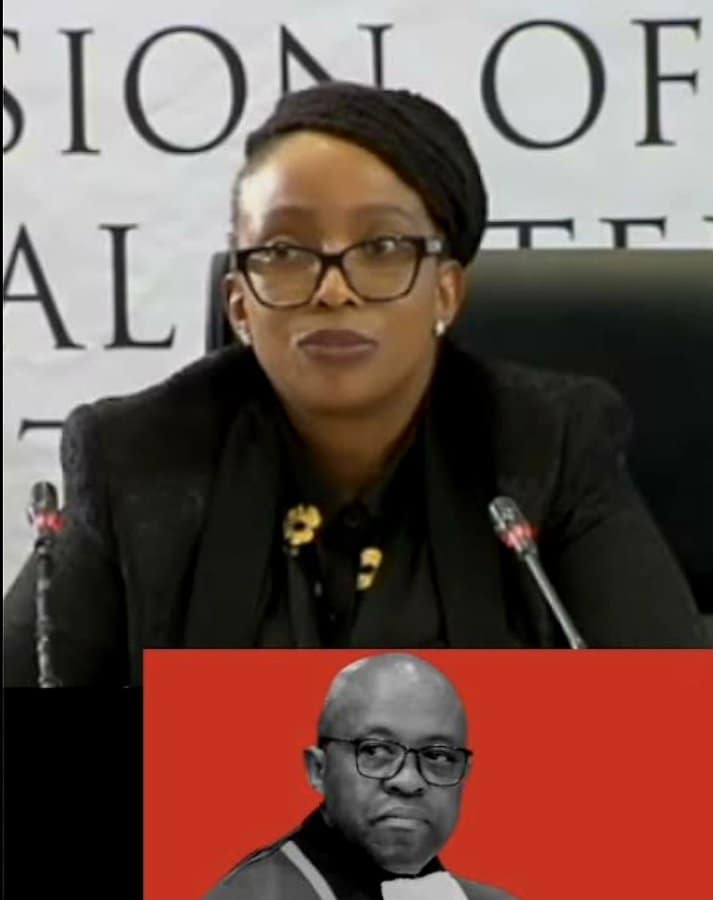
Justice Madlanga inclined her head. The oath was administered. And Adv. Mokoena, who had spent his entire career speaking only through the dry language of affidavits and evidentiary summaries, began to tell the story of how South Africa’s police oversight mechanism had been systematically dismantled from within.
The Early Warnings
He began not with a scandal, but with a pattern. 2016. A teenager in Katlehong, shot in the back by officers responding to a housebreaking complaint. The boy had been unarmed. He had been running away. The officers claimed he had lunged at them with a knife. No knife was found at the scene. The knife that later appeared in the evidence bag was catalogued three days after the shooting, bearing no fingerprints, bearing no DNA, bearing the unmistakable scent of fabrication.
“I presented the evidence to the senior public prosecutor,” Mokoena testified. “I showed her the timeline discrepancies. I showed her the forensic report indicating the knife had been wiped clean. I showed her the witness statement from a neighbour who saw the officers speaking together at length before any search for weapons was conducted.”
He paused. “The prosecutor looked at me. She said, ‘These are very serious allegations against serving police officers. Are you certain you want to proceed?'”
He had proceeded. The case file was submitted. It was never enrolled.
“That was my first lesson,” Mokoena said quietly. “The system does not resist you with force. It resists you with patience. It waits. It knows that you have other cases, that the bereaved family cannot afford endless legal representation, that the public’s attention span is limited. It waits, and eventually, you look away. Not because you have given up. Because you are exhausted.”
The Architecture of Silence
Over three hours of testimony, Mokoena mapped an infrastructure of impunity that extended from local charge offices to the highest echelons of police command. He described what he called “the buffer”—a network of middle managers within the National Prosecuting Authority whose function, whether by design or by acquired habit, was to intercept serious police misconduct cases before they could reach a courtroom.
He produced statistics. Between 2018 and 2024, IPID had referred 1,247 cases of alleged police killings to the NPA for prosecution. Exactly ninety-eight had resulted in indictments. The remainder had been returned with various notations: “insufficient evidence,” “witness unavailable,” “further investigation required.” The further investigation was rarely funded. The unavailable witnesses had often been intimidated. The insufficient evidence had often disappeared from police storage facilities.
About The Author