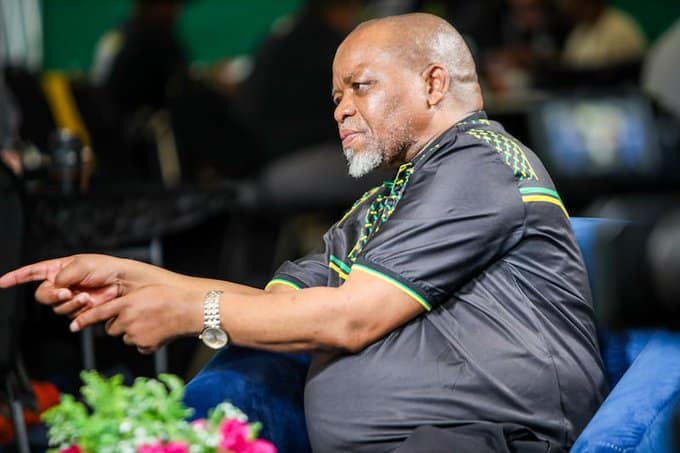
The deep fissures within South Africa’s ruling Tripartite Alliance have been thrust into the open, with African National Congress (ANC) National Chairperson Gwede Mantashe issuing a blunt and public warning to the South African Communist Party (SACP) that contesting elections alone would be a historic miscalculation leading to political marginalisation.
The stark caution comes amid increasingly assertive signals from the SACP’s leadership that, after decades of operating under the ANC’s electoral umbrella, the Party is seriously preparing to contest the 2026 local government elections independently. This move threatens to upend the foundational political calculus that has governed South Africa’s left since the dawn of democracy.
A Fractured “Golden Thread”
Addressing a community meeting in the Eastern Cape over the weekend, Mantashe, a former SACP chairperson and mineworkers’ union leader, framed the alliance not merely as a political arrangement but as an ideological and strategic necessity. “The alliance is a golden thread that runs through our struggle narrative,” he stated. “When you cut that thread, you risk unraveling the collective power of the working class. Contesting separately in the current political landscape is not an act of defiance; it is a direct path to the wilderness of irrelevance.”
His comments underscore a palpable anxiety within the ANC’s senior ranks. The SACP, while small in direct membership, provides critical ideological ballast, ground-level organisational capacity, and a dedicated bloc of voters for the ANC. Its departure from the shared electoral slate would not only split the vote on the left but also strip the ANC of its claim to be the pre-eminent home of progressive, working-class politics.
The SACP’s Mounting Frustration
The SACP’s push for autonomy is born from years of simmering discontent. Party leaders have consistently lamented being treated as a “junior partner” whose policy inputs—on issues ranging from the nationalisation of the Reserve Bank to a more radical economic transformation agenda—are routinely sidelined once ANC leaders take office. The final straw for many within the SACP has been the ANC’s embrace of the Government of National Unity (GNU) with the Democratic Alliance (DA), a party the communists view as a vehicle for “white monopoly capital.”
“How can we, in good conscience, campaign for an alliance that then gets into bed with our class enemy?” asked a senior SACP Central Committee member, speaking on condition of anonymity. “The ANC’s project has become one of managing capitalism, not dismantling it. We must now speak directly to the workers and the poor.”
Analysts Weigh the High-Stakes Gamble
Political analysts are divided on the potential fallout. Some echo Mantashe’s warning. “The SACP risks becoming the Azapo of the left—a party of profound ideological purity with a museum-like collection of policies, but with no tangible power to implement them,” said Professor Richard Pithouse of the University of the Witwatersrand. “The first-past-the-post system at the local level punishes fragmentation. They may win a handful of wards in deeply industrialised areas, but they could inadvertently hand control of key municipalities to the DA or the MK Party.”
Others, however, believe the SACP is reading the political moment correctly. “The ANC’s brand is severely damaged,” argued independent political analyst Ebrahim Fakir. “The SACP sees an opening to present itself as the uncorrupted, principled left alternative, especially to former ANC voters now flirting with the MK Party. This is a high-risk gamble, but the bigger risk for the SACP may be fading into total obscurity by remaining chained to a sinking ship.”
A Defining Moment for the Left
The 2026 local elections are now shaping up to be a watershed not just for municipal governance, but for the very structure of South African politics. Mantashe’s public intervention is a clear attempt to apply the brakes, appealing to shared history and warning of mutual destruction.
The ball is now in the SACP’s court. Its next Central Committee meeting, scheduled for next month, is expected to be the most consequential in decades. The decision they make will determine whether the Tripartite Alliance enters the polls as a frayed but still united front, or whether South Africa witnesses the birth of a new, and fiercely competitive, left-wing electoral force—with all the unpredictable consequences that entails. The warning from Luthuli House is clear: step out alone, and you step into the void.
About The Author