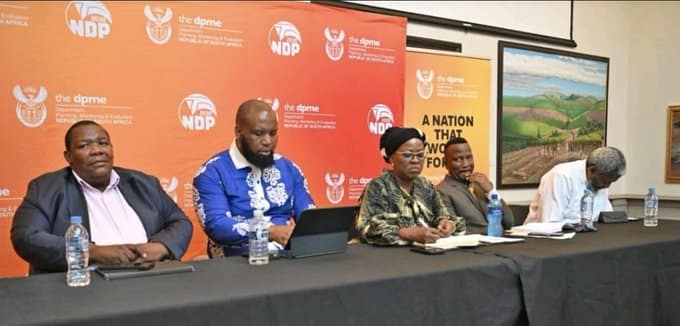
Pietermaritzburg – In a powerful show of unity aimed at revitalising South Africa’s flagging development agenda, Minister in the Presidency for Planning, Monitoring and Evaluation, Maropene Ramokgopa, has called on the country’s religious and traditional leaders to step forward as frontline partners in the push to achieve the National Development Plan (NDP) Vision 2030.
Addressing a gathering of izinduna, amakhosi, and interfaith leaders in Pietermaritzburg, Ramokgopa delivered a stark message: the government cannot succeed alone. She stressed that building strong, structured partnerships at the grassroots level is no longer a luxury but an absolute necessity for driving inclusive growth and ensuring that service delivery reaches the communities that need it most.
“Government Cannot Be Everywhere”
The Minister’s address was grounded in a sober assessment of the progress—or lack thereof—towards the NDP’s goals. With only four years remaining until the 2030 deadline, many of the plan’s ambitious targets, from eliminating poverty and reducing inequality to creating jobs and building a capable state, remain under significant pressure. Ramokgopa argued that the key to unlocking progress lies not in Pretoria, but in the villages, townships, and suburbs of the nation.
“Government cannot be everywhere at the same time,” Minister Ramokgopa told the assembled leaders. “But the institution of traditional leadership is there. The institution of the church and the faith-based community is there, every single day. You are the ones who sit with our people in their moments of joy, and more importantly, in their moments of deepest distress. You are the ones who witness firsthand where the water is not running, where the clinic is understaffed, and where the youth have given up hope.”
Her message was a call to action, urging these influential community pillars to move beyond symbolic roles and become active agents in monitoring development, holding government accountable, and mobilising their communities for positive action. She framed the partnership as a two-way street: government provides the resources and policy framework, while traditional and religious leaders provide the moral authority, local knowledge, and organisational muscle to ensure those resources translate into tangible change.
A Convergence of Moral and Customary Authority
The choice of Pietermaritzburg for the engagement was symbolic, placing the dialogue in the heart of KwaZulu-Natal, a province with a deep and complex relationship with both traditional leadership and religious institutions. The gathering saw a unique convergence of figures who often operate in parallel, if not separate, spheres.
Representatives from the KwaZulu-Natal Provincial House of Traditional Leaders, clad in full ceremonial regalia, sat alongside bishops, pastors, and sheikhs. The discussions moved from the abstract to the deeply practical. Traditional leaders spoke of their role as custodians of the land and the need for a greater say in development projects that affect their territories. Religious leaders shared stories of running feeding schemes, supporting orphans, and providing counsel in communities where the state’s presence is faint.
Ramokgopa acknowledged these existing efforts but pushed for them to be systematised and amplified. She proposed the establishment of joint monitoring committees at a local level, where a chief or a pastor could feed real-time information back to her department about the state of roads, schools, or police services.
“We need you to be our eyes and ears,” she said. “But more than that, we need you to be the voice that reminds our people that their future is in their hands. The NDP is not just a government document; it is a social compact. It requires all of us to contribute to the creation of a South Africa that belongs to all who live in it.”
Bridging the Trust Deficit
The Minister’s outreach is also seen as a strategic move to bridge the growing trust deficit between citizens and the state. In an era of frequent service delivery protests and a pervasive sense of disillusionment, traditional and religious leaders often remain the most trusted figures in their communities. By enlisting them as partners, the government hopes to rebuild credibility and communicate its message through channels that people inherently believe in.
However, the leaders present made it clear that their partnership would not be passive or uncritical. Responses from the floor emphasised that their involvement must come with genuine empowerment and a respect for their institutions. They raised concerns about being consulted only as an afterthought and demanded that their input translate into concrete action.
“We have been the bedrock of this nation long before the Union was formed,” one senior traditional leader commented. “We welcome the Minister’s words, but we want to see a plan. We want to see how our wisdom and our authority will be integrated into the actual planning, not just the monitoring afterwards.”
Vision 2030: The Final Push
As South Africa enters the final stretch towards the 2030 deadline, the meeting in Pietermaritzburg represents a significant shift in strategy. By moving beyond the usual political stakeholders and formally embracing the moral and customary authority of the nation’s spiritual and traditional guardians, Minister Ramokgopa is attempting to build a broader, more resilient coalition for change.
The success of this initiative will be measured not in speeches, but in the tangible improvement of lives in the furthest corners of the country. For now, the message from the government is clear: the church pew and the tribal council are no longer just places of worship and custom; they are now officially part of the engine room for building the South Africa envisioned in the NDP.
About The Author