The air hangs thick and heavy in the dusty yards outside the Ekapa Mine, a smell of sun-baked earth and diesel clinging to everything. But it’s the silence, broken only by the low, persistent hum of massive ventilation fans, that truly presses down on the huddled groups of families. They stand in small, tight circles, their eyes fixed on the mine’s entrance—a dark maw in the earth that has, for three agonizing days, refused to give up its secrets.
It began in the dead of night. Tuesday, 2:13 AM. The night shift was deep in the labyrinthine tunnels of the Ekurhuleni site, five miners working a face nearly two kilometers below the surface. Above ground, the world was quiet. Then, the earth groaned. A pocket of saturated clay and silt, weakened by recent rains, gave way in a catastrophic “mud rush.” Thousands of tons of liquid earth surged through a connecting tunnel like a brown river, a sudden, silent landslide in the absolute darkness. It didn’t just block their primary escape route; it sealed it, entombing a section of the tunnel in a plug of thick, quick-setting mud the consistency of concrete.
The initial alarm was raised not by a call, but by the absence of one. When the shift failed to report to the surface by 7:00 AM, the mine’s safety protocols kicked in. Communication with the five-man team was dead. A rescue team was dispatched, only to be met by the wall of mud. The scale of the disaster became terrifyingly clear.
Now, a somber, frantic city has sprung up around the mine’s entrance. Makeshift tents provided by the mining company offer little shelter from the relentless Highveld sun. Specialist rescue teams have been flown in from across the country. They are a different breed—hard-eyed, wiry men and women who move with a quiet, grim efficiency. Dressed in bright orange coveralls and carrying equipment that looks more suited to a space mission than a mine, they represent the only thread of hope for the families.
“They are the best,” a mine foreman, his face etched with exhaustion, says quietly to a group of reporters, his voice a low rumble. “High-angle rescue, confined spaces, underground hazards. If anyone can get through, it’s them.”
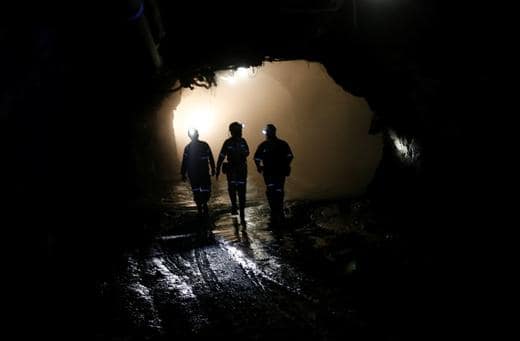
Their plan is painstaking and perilous. Drilling a large-diameter rescue shaft directly to the trapped workers’ last known location is the primary option, but it’s a race against time and geology. The ground is unstable, and every turn of the drill bit risks triggering another collapse. Simultaneously, a smaller, elite team is attempting a secondary approach: carefully, meter by meter, digging through the mud-plugged tunnel. They are propping the roof with hydraulic jacks as they go, working in stifling heat and near-zero visibility, the air thick with the smell of wet earth and the constant, terrifying threat of another surge.
For the families, the wait is a special kind of hell. Nomsa Khumalo clutches a threadbare blanket, her knuckles white. Her husband, Sipho, is down there. He has been a miner for 22 years, a man who hummed old struggle songs in the kitchen and could fix anything with a piece of wire. “He said the shaft felt ‘nervous’ that night,” she whispers, her voice cracking. “The earth was shifting. He felt it in his boots. He almost didn’t go.” She stops, a single tear tracing a path through the grime on her cheek. “I keep thinking, is he singing? Is he telling the others stories to keep them calm? Or is it silent down there?”
Next to her, a younger woman, Thandi Dlamini, is inconsolable, her body shaking with silent sobs. Her brother, Themba, was the baby of their crew, only 24, with a mischievous smile and a dream of buying his mother a brick house. He had only been on the job for six months.
Hopes are fading, that much is a palpable undercurrent in the air. The mine officials’ briefings are measured, their language carefully chosen. They speak of “challenging conditions” and “progress being slower than anticipated.” They refuse to give a timeline. But they also refuse to use the past tense. The five men are still referred to as “the trapped workers,” their families as “the awaiting families.” As long as they are not found, there is hope.
As dusk begins to settle, painting the mine dumps in hues of orange and purple, the rescue operation continues, lit by the harsh glare of portable floodlights. The giant drill bit, a monstrous metal tooth, continues its slow, grinding descent into the earth. The rescue team in the tunnel inches forward, their headlamps cutting weak, fleeting paths through the oppressive dark. A profound quiet falls over the waiting families. They are not just waiting for news. They are listening, with every fiber of their being, for any sound from the deep, dark earth that holds the ones they love. The night closes in, and the vigil continues.
About The Author