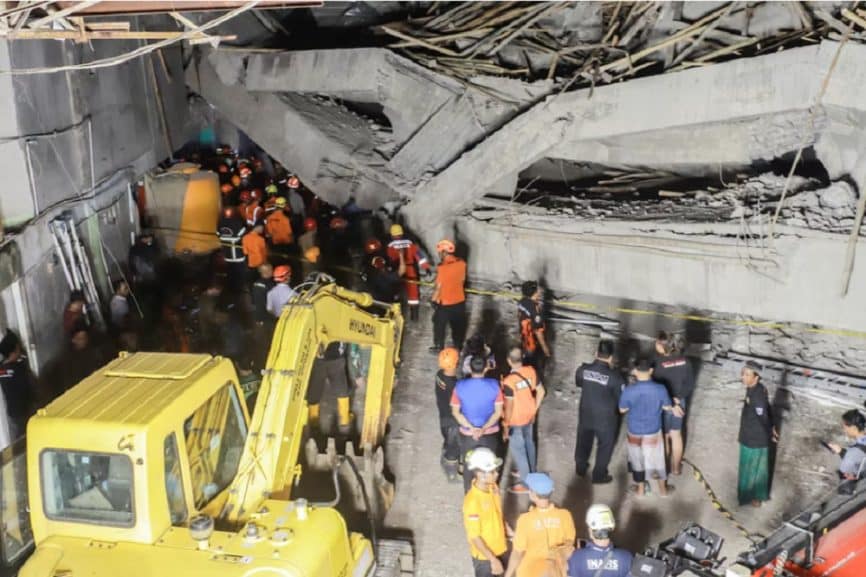
Rescue workers in Indonesia are engaged in a desperate race against time, digging through the rubble of a collapsed Islamic boarding school in East Java where 38 people are feared trapped. The tragic incident, which occurred on Monday during afternoon prayers, has already claimed three lives and injured nearly 80 others, casting a pall of grief and anxiety over the community of Sidoarjo.
The Al Khoziny boarding school, located approximately 780 kilometers east of Jakarta, crumbled suddenly, sending building materials crashing down on students and workers. According to Mohammad Syafii, the head of Indonesia’s national search and rescue agency, 99 people survived the disaster. The confirmed death toll currently stands at three, but the fate of the dozens still unaccounted for hangs in the balance, driving the urgent rescue operation.
Unstable Foundations and a Sudden Collapse
Preliminary investigations point to a catastrophic structural failure as the cause. Abdul Muhari, a spokesperson for the country’s disaster mitigation agency (BNPB), stated that the building collapsed during construction work. “This sudden occurrence caused building material to fall on dozens of students and workers,” he explained.
The agency’s initial assessment suggests that the building’s foundations were unable to support the weight of construction taking place on its fourth floor. This account was partially corroborated by the school’s caretaker, Abdus Salam Mujib, who was quoted by the state news agency Antara. While Mujib asserted that building work had concluded before prayers commenced, he conceded that the foundations could not bear the load of the new construction, painting a picture of a tragedy waiting to happen.
A Delicate and Perilous Rescue Mission
The rescue effort is fraught with difficulty and danger. Nanang Sigit, a local search and rescue official, highlighted the precariousness of the situation, revealing that 38 people remain missing and that authorities are hesitant to use heavy machinery like the excavators and cranes standing by. The primary fear is that aggressive digging could trigger a secondary collapse of the unstable remains of the structure, potentially harming any survivors and endangering the rescue teams.
This leaves responders with the painstaking and perilous task of clearing debris by hand or with light tools, a slow process where every minute is critical. The scene is one of both determined effort and agonizing uncertainty, as families and community members wait for news of their loved ones. With nearly 80 of the injured receiving treatment in local hospitals, the full human cost of this disaster is yet to be tallied, as the search for the missing continues under the shadow of the unstable ruins.
About The Author