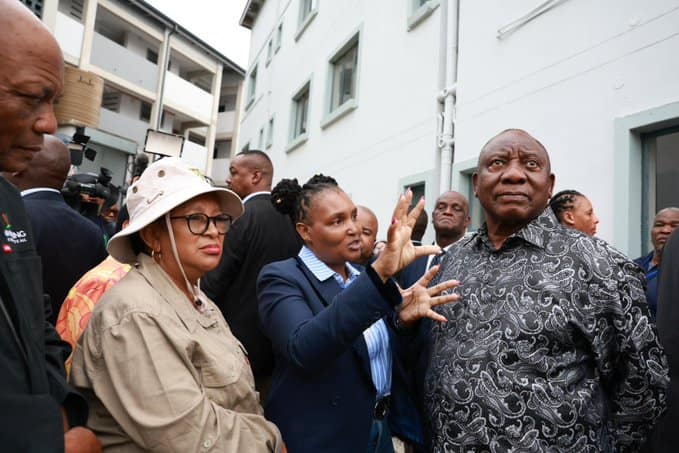
In the dusty, windswept streets of Bochabela, where skeletons of half-built structures stand as monuments to broken promises, President Cyril Ramaphosa walked the grounds of the long-delayed Dark and Silver City Community Residential Units on Friday, delivering a stark message to the nation: the seventh administration will not tolerate the corruption, negligence, and bureaucratic inertia that have turned housing delivery into a graveyard of hope.
Dressed in a casual golf shirt and walking shoes, the president moved through the unfinished development with the measured pace of a man surveying a battlefield. Behind him trailed a delegation of national and provincial officials, their faces a mixture of apprehension and resolve. Before him stood the silent, weather-beaten shells of what was supposed to be a flagship housing project—a vision of dignity for Mangaung’s working-class families that has instead become a symbol of systemic failure.
“I have come here today not to cut a ribbon, but to see for myself what happens when we take our eyes off the ball,” Ramaphosa said, his voice carrying across the site as residents gathered behind police barriers, some holding handwritten signs demanding answers. “This site represents a wound. It represents years of waiting, years of promises made and promises broken. And I am here to say: never again.”
A Project Born in Hope, Mired in Scandal
The Dark and Silver City project, officially known as the Bochabela Community Residential Units, was conceived more than a decade ago as a transformative housing initiative for the Mangaung Metro. Named after the vibrant local football club that once symbolized community pride, the development was intended to deliver over 1,200 quality housing units to families currently living in overcrowded backyard shacks and dilapidated hostels.
But somewhere between the architectural renderings and the ground-breaking ceremony, the project went off the rails. Construction began with fanfare in the early 2010s, only to grind to a halt as contractors were appointed and dismissed, budgets were allocated and reallocated, and allegations of tender fraud began to swirl. By 2018, the site had become a wasteland of rusting rebar, crumbling brickwork, and unfinished walls—a landscape that residents began calling “the ruins.”
Over the years, multiple investigations were launched. Forensic reports pointed to irregular procurement processes, inflated contracts, and the alleged involvement of a web of politically connected intermediaries who siphoned millions meant for construction. Despite these findings, no senior officials were held accountable, and the site remained frozen in time—a monument to impunity.
For the families of Bochabela, the failed project became a daily insult. Mothers who had been promised homes watched their children grow up in backyard shacks. Elderly residents who had been assured they would spend their final years in dignity passed away without ever seeing a finished unit. The empty structures became a playground for stray animals and a haven for criminals, a constant reminder of a government that had forgotten them.
A President’s Reckoning
Ramaphosa’s visit to Dark and Silver City was carefully choreographed but unmistakably personal. It came at the start of the seventh administration, following a national election that saw the African National Congress (ANC) lose its parliamentary majority for the first time in three decades. Housing delivery—or the lack thereof—was a central grievance cited by voters who turned away from the ruling party in droves.
The president chose Mangaung deliberately. This is the city where the ANC’s 2012 national conference gave rise to the “second transition” narrative, a promise to root out corruption and renew the movement. More than a decade later, Dark and Silver City stands as a damning indictment of how far that promise fell short.
“We cannot keep having ground-breaking ceremonies while people are still breaking ground with their own hands, trying to find a place to sleep,” Ramaphosa said, his tone shifting from reflective to confrontational. “We cannot keep holding media briefings to announce projects that never see the light of day. The time for talking is over. The time for delivery is now. And if there are people—whether in the private sector or in government—who stand in the way of that delivery, they will face the consequences.”
The president announced a multi-pronged intervention aimed at rescuing the Dark and Silver City project and, more broadly, resetting housing delivery across the country:
1. Immediate Site Remediation and Securing:
Within 30 days, the Department of Human Settlements, in coordination with the Mangaung Metro, will secure the site, clear debris, and conduct a full structural assessment to determine which existing structures can be salvaged and which must be demolished and rebuilt.
2. Special Investigating Unit (SIU) Referral:
Ramaphosa confirmed that he has referred the entire history of the Dark and Silver City project to the SIU for a comprehensive investigation, with a mandate to probe allegations of corruption, fraud, and maladministration. Crucially, he directed that any officials or contractors found to have been involved in wrongdoing face prosecution and that all unlawfully obtained funds be recovered.
3. A New Delivery Model:
The president announced that the seventh administration would pilot a new housing delivery model in Mangaung, one that centralizes project management, imposes strict performance benchmarks, and mandates quarterly public reporting. “We are going to name names,” he said. “We are going to publish who is responsible for every project, what the deadlines are, and whether those deadlines are met. South Africans have a right to know.”
4. Community Oversight Committee:
Residents of Bochabela will be given a formal role in overseeing the project’s revival, with a community oversight committee empowered to receive regular briefings, inspect progress, and escalate concerns directly to the presidency.
Voices from the Ground
For the residents who gathered to witness the president’s visit, the words were welcome but the skepticism was palpable. After years of false dawns, many in Bochabela have adopted a posture of weary cynicism.
“I have been waiting for this house for 12 years,” said Martha Sephiri, a 58-year-old domestic worker who lives with her three grandchildren in a single-room backyard shack a few hundred meters from the unfinished site. “I have seen presidents come and go. I have seen officials come with cameras, make speeches, shake hands, and then disappear. I want to believe him. But I will believe it when I have a key in my hand.”
Others were more hopeful but insisted on accountability. Thabo Mokoena, a local community organizer who has been tracking the project’s troubled history for years, said the president’s visit marked a turning point—if followed by action.
“The difference this time is that the president came here, walked the site, and looked us in the eye,” Mokoena said. “He did not send a deputy minister. He did not send a director-general. He came himself. That matters. But what will matter more is whether the people who stole this money are finally arrested. We know who they are. The community knows. The question is whether the law will finally catch up with them.”
The Broader Battle for Housing Delivery
Dark and Silver City is not an isolated failure. Across South Africa, thousands of housing projects remain stalled, entangled in contractor disputes, procurement scandals, or simple bureaucratic paralysis. The national housing backlog is estimated at over 2.3 million units, a figure that grows each year as urbanization accelerates and the population expands.
Human Settlements Minister Mmamoloko Kubayi, who accompanied the president on the visit, acknowledged the scale of the challenge but insisted that the seventh administration would adopt a fundamentally different approach.
“We have learned painful lessons from projects like this one,” Kubayi said. “We have learned that we cannot outsource accountability. We have learned that we cannot allow political connections to determine who gets contracts. We have learned that we must follow the money, and we must follow it relentlessly. Under the president’s leadership, we are going to do things differently. We have to. The people are watching.”
The minister also confirmed that a national audit of all stalled housing projects is underway, with the goal of either fast-tracking viable projects or scrapping those that are beyond recovery and redirecting funds to new developments.
A Test of the Seventh Administration
For President Ramaphosa, the Dark and Silver City visit is more than a photo opportunity—it is a test of whether the seventh administration can deliver on its central promise of renewal. The 2024 election results sent a clear message: South Africans are tired of corruption, tired of empty promises, and tired of waiting for services that never materialize.
The Government of National Unity (GNU), which brought together a coalition of parties after the ANC lost its majority, has made service delivery and anti-corruption central pillars of its agenda. Housing—tangible, visible, life-changing housing—is arguably the most potent symbol of whether that agenda is working.
Political analyst Dr. Levy Ndou noted that Ramaphosa’s hands-on approach in Mangaung reflects a strategic recognition that symbolic gestures are no longer enough.
“The president understands that his legacy, and the future of the GNU, will be defined by whether ordinary people feel a difference in their lives,” Ndou said. “Housing is visceral. It is personal. When a family gets a house, they feel seen. When a project like Dark and Silver City remains unfinished for a decade, they feel forgotten. The president is betting that by standing in the ruins, by naming corruption as the enemy, and by promising accountability, he can rebuild trust. But trust is fragile. And the clock is ticking.”
A Long Road Ahead
As the president’s motorcade departed Bochabela, the unfinished buildings of Dark and Silver City stood as they have for years—silent, incomplete, waiting. But for the first time in a long time, there was a sense that something had shifted.
Residents lingered at the barriers long after the president had left, talking among themselves, pointing at the structures, speculating about what would come next. Some were already planning for the community oversight committee. Others were mentally cataloging the names of officials they hoped would finally face justice.
For Martha Sephiri, the 58-year-old domestic worker, the calculation was simpler.
“I am old now,” she said, wiping dust from her face. “My knees are not what they used to be. I have carried water, I have cooked on paraffin stoves, I have watched my grandchildren grow up in a room smaller than most people’s kitchens. I just want to know—before I am too old to enjoy it—will I finally have a door I can lock? Will I finally have a place to call home?”
The president’s answer, delivered with a hand on her shoulder, was simple: “We are going to finish this. I give you my word.”
Now, for the residents of Bochabela, the waiting begins again—but this time, they are watching with eyes that have seen too many promises fade into dust. Whether Dark and Silver City will rise from its ruins or remain a monument to failure will be one of the defining tests of the seventh administration.
About The Author