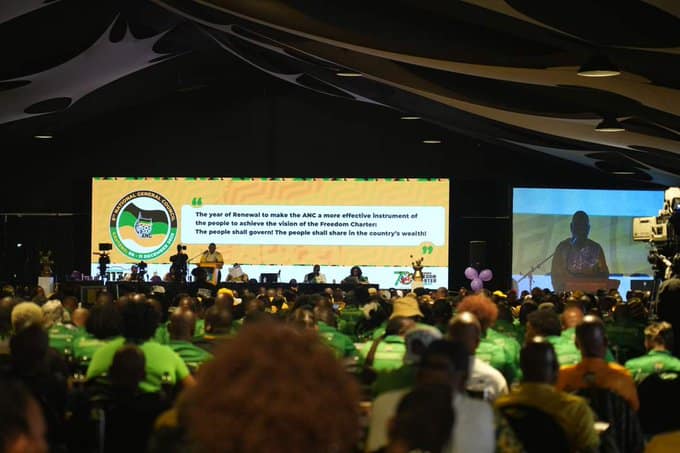
In his most direct and politically charged address on national identity and social cohesion to date, President Cyril Ramaphosa used the platform of the ANC’s National General Council at the Birchwood Hotel on Monday, 8 December 2025, to launch a robust counter-offensive against what he termed “manufactured and dangerous myths” of the systematic persecution of white Afrikaners in South Africa. Framing the issue as a matter of pressing national security, the President warned that these narratives are being weaponised not only to divide society domestically but also to justify harmful international economic and diplomatic pressure against the country.
Speaking to a hall of ANC delegates, the President’s tone was notably combative and strategic, moving beyond mere rebuttal to frame the discourse as an active threat. “There are forces, both within and outside our borders, that are peddling a pernicious falsehood: the lie that white South Africans, and Afrikaners in particular, are under threat in the country of their birth,” Ramaphosa stated. “This fiction is not a harmless opinion. It is a calculated narrative designed to sow distrust, to roll back the gains of our democracy, and to provide a moral pretext for those who seek to weaken our sovereign state and our economy.”
Connecting Domestic Discourse to Global Pressure
The address did not occur in a vacuum. It comes amidst a tangible strain in South Africa’s international relations, including looming trade disputes, withdrawal of investment, and diplomatic frostiness, particularly from some Western nations. These actions have often been publicly justified by foreign lawmakers and lobby groups citing concerns over “farm murders” and “targeted persecution” – claims that the South African government and independent crime statistics agencies have repeatedly challenged as misrepresented or inflated.
Ramaphosa explicitly linked the two, arguing that domestic disinformation has direct geopolitical consequences. “When these falsehoods are broadcast to the world, they become the basis for unjust tariffs, for biased travel advisories, and for the undermining of our constitutional order on the global stage,” he asserted. “We will not bow to this politics of fear. We will not allow the painful, complex, but necessary project of redress and reconciliation to be hijacked by those who seek to preserve the privileges of the past by fabricating a crisis in the present.”
A Defence of the Constitutional Project
The President’s speech served as a forceful defence of South Africa’s post-apartheid constitutional democracy. He acknowledged the nation’s ongoing challenges, including crime, inequality, and corruption, but stressed these were universal challenges affecting all citizens, not evidence of a state-sanctioned campaign against any one group.
“Our democracy, for all its flaws which we are working tirelessly to address, is built on a Constitution that guarantees equality before the law for all,” he said. “The claim of persecution is an insult to the millions of South Africans of all races who are working together to build this nation. It is an insult to the integrity of our courts, our police service, and our democratic institutions.”
Reactions and the Road Ahead
The speech has ignited fierce debate across the political spectrum. Opposition parties like the DA and FF Plus have condemned it as dismissive of legitimate minority concerns, while civil society organisations are divided. Some laud the President for finally confronting a toxic international narrative, while others argue that dismissing grievances outright risks further alienation.
Political analysts view the address as a pivotal moment. “Ramaphosa is attempting to draw a clear line in the sand,” said Prof. Somadoda Fikeni. “He is signalling that the government will no longer engage with the ‘persecution’ narrative on its own terms, but will treat it as a destabilising propaganda tool. This is a high-stakes gambit that reframes the national conversation around unity and sovereignty, but its success depends on consistent follow-through in both policy and diplomacy.”
The Birchwood speech marks a definitive shift in the Presidency’s rhetorical approach, transforming a sensitive social issue into a declared matter of national interest and international standing. It sets the stage for a more confrontational chapter in South Africa’s ongoing struggle to define its post-apartheid identity, both for its own citizens and for a watching world.
About The Author