The apology arrived at 11:47 PM on a Wednesday, distributed through the usual channels—a statement to media houses, a post on the official Gauteng Provincial Government account, a carefully worded message on the Premier’s personal X feed. It was, by any measure, a masterclass in political crisis management: swift, direct, and conspicuously free of the defensive qualifications that so often characterize such documents.
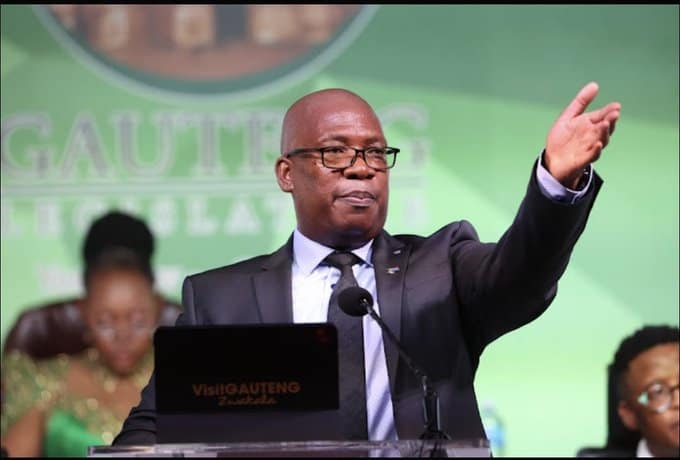
“I wish to apologise unreservedly for the misunderstanding caused by my recent remarks regarding the water challenges in our province,” Premier Panyaza Lesufi wrote. “Water shortages impact everyone, regardless of status. There is no privilege that can insulate any of us from the reality of this crisis.”
The words were measured, the tone contrite. But behind the carefully calibrated language lay a more complex truth: the Premier had, in a moment of unguarded candor, revealed something fundamental about how South Africa’s governing class experiences the country’s infrastructure collapse. His attempt to explain his own coping mechanism—booking a hotel room to bathe during extended water outages—had inadvertently illuminated the vast distance between the governed and those who govern them.
The backlash had been immediate and merciless. Within hours of his initial interview with a Johannesburg radio station, the clip was circulating across every platform. The hashtag #HotelLesufi trended for fourteen consecutive hours. Memes proliferated: Lesufi floating on an inflatable duck in a luxury hotel pool, Lesufi being handed fluffy white towels by obsequious staff, Lesufi checking into the Four Seasons while Johannesburg’s northern suburbs ran dry.
But beneath the mockery lay genuine anger. Anger from the residents of Soweto who had not seen running water in five days. Anger from the commuters of Diepsloot who queued for hours at communal standpipes. Anger from the mothers of Tembisa who boiled suspicious liquid from buckets because the taps had produced nothing but sediment for a week.
“At least he could afford a hotel,” read one of the more restrained comments. “We sleep next to empty taps and pray for rain.”
The Unremarkable Confession
What made Lesufi’s initial comments so incendiary was not their exceptional nature but their very ordinariness. He had not described a lavish weekend getaway or an extravagant display of conspicuous consumption. He had simply described what many affluent South Africans do when their municipal water supply fails: they seek alternatives. They purchase bottled water in bulk. They install storage tanks and filtration systems. They check into hotels.
The Premier’s sin was not that he behaved differently from other privileged South Africans. His sin was that he admitted it.
“I stay in a hotel, I bath there, and then I come back home,” he had told the interviewer, his tone matter-of-fact, almost instructional. “Because if I don’t get water, I can’t function. And if I can’t function, I can’t serve the people.”
It was the final clause that proved most damaging. The implicit equation—hotel accommodation equals functional governance equals service to the people—landed with the particular heaviness of statements that reveal more than their speakers intend. The Premier had not meant to suggest that his ability to serve required amenities unavailable to his constituents. He had not meant to suggest that leadership was contingent on comfort. But suggestion operates independently of intention, and the suggestion was unmistakable.
The Reality Beneath the Rhetoric
The water crisis that provoked Lesufi’s unfortunate formulation is neither new nor temporary. Gauteng, South Africa’s economic heartland and most populous province, has been experiencing increasingly severe water shortages for the better part of a decade. The causes are multiple and mutually reinforcing: aging infrastructure, inadequate maintenance, population growth exceeding planning projections, climate change altering rainfall patterns, and systemic dysfunction within the municipal authorities responsible for water distribution.
Rand Water, the bulk supplier that serves approximately 11 million consumers across Gauteng and parts of surrounding provinces, has repeatedly warned that its systems are operating at the limits of their capacity. The utility’s infrastructure, much of it constructed in the 1960s and 1970s, was designed for a significantly smaller population. Efforts to expand capacity have been hampered by funding constraints, procurement challenges, and the complex politics of intergovernmental coordination.
At the municipal level, the picture is even more concerning. Johannesburg Water, the entity responsible for distribution within the city, has acknowledged that its network loses approximately 35% of the water it receives through leaks and illegal connections. The figure is substantially higher in some historically disadvantaged areas, where infrastructure was deliberately underdeveloped during apartheid and has never been adequately upgraded.
“We are trying to fix a 747 while flying it through a thunderstorm,” a senior Johannesburg Water engineer told a parliamentary committee in 2024. “Every day, we identify new leaks. Every day, we repair some of them. But the rate of new failures exceeds our repair capacity. We are losing ground, not gaining it.”
About The Author