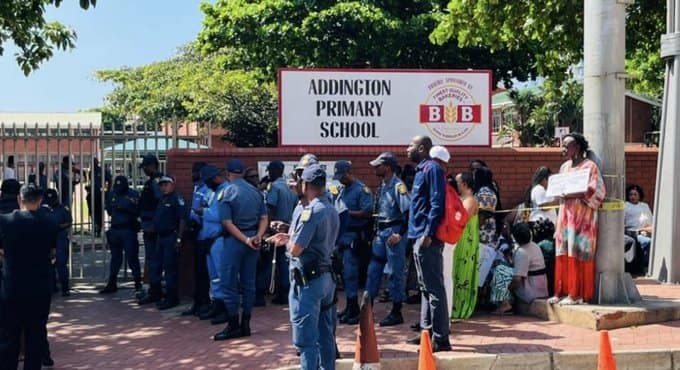
Tensions have escalated into open confrontation outside Addington Primary School in the Point area, as a second day of heated picketing continues over the unresolved placement of learners for the 2026 academic year. What began as a protest by frustrated parents has spiralled into a fraught clash between different community factions, each claiming a rightful priority for their children at the highly sought-after but severely overcrowded institution.
The scene outside the school gates is one of palpable distress and division. On one side, a group of parents, many from the immediate surrounding neighbourhoods, wave placards reading “OUR COMMUNITY SCHOOL FIRST” and “CAPACITY IS FULL.” They argue that the school, which officially operates well above its designed capacity, cannot responsibly accept more pupils without compromising education quality and safety for those already enrolled.
“We have been here for years. Our taxes and our loyalty are to this school,” said one parent, who identified herself only as Mrs. Naidoo. “Every year, they squeeze in more desks. The bathrooms are overwhelmed, the playground is unsafe with so many children, and the teachers are stretched beyond limits. We are not against education, but we are for sustainable education.”
Confronting them is another group of protesters—predominantly parents from areas further afield, including informal settlements and newly developed residential blocks. Their signs plead, “EVERY CHILD DESERVES A SCHOOL” and “DO NOT DENY OUR CHILDREN’S FUTURE.” They accuse the school and education department of gatekeeping and failing to plan for the area’s growing population, leaving their children in limbo weeks after the school year has begun.
“The system has failed. We applied on time, we followed the process, and now we are told there is no space,” said Sipho Dlamini, a father of a seven-year-old who remains at home. “Are our children less important because we live in a flat or a settlement? This school is a beacon of hope, and that hope is being denied.”
At the heart of the conflict is a chronic issue plaguing many schools in urban hubs: immense pressure for placement in well-performing schools amidst rapid urban migration and insufficient infrastructure expansion. Addington Primary, with its strong academic record and central location, has become a flashpoint.
The KwaZulu-Natal Department of Education has acknowledged the crisis, stating that officials are on-site attempting to mediate and process placements. In a statement, the department appealed for calm, noting that “the placement of learners remains a complex and emotive issue, especially in schools experiencing high demand. We are working within the existing policy framework to find equitable solutions, which may include directing learners to other schools with available space.”
However, the mention of “other schools” has further inflamed protesters from the unplaced group, who argue that the suggested alternatives are too distant, too costly to commute to, or perceived as underperforming.
Community leaders and local councillors have been called in to defuse the situation, but with emotions running high and children’s futures at stake, a swift resolution appears unlikely. The standoff at Addington Primary underscores a deepening national crisis in basic education infrastructure, where the right to learn is increasingly contingent on geography, capacity, and now, tense negotiations at the school gate.
About The Author