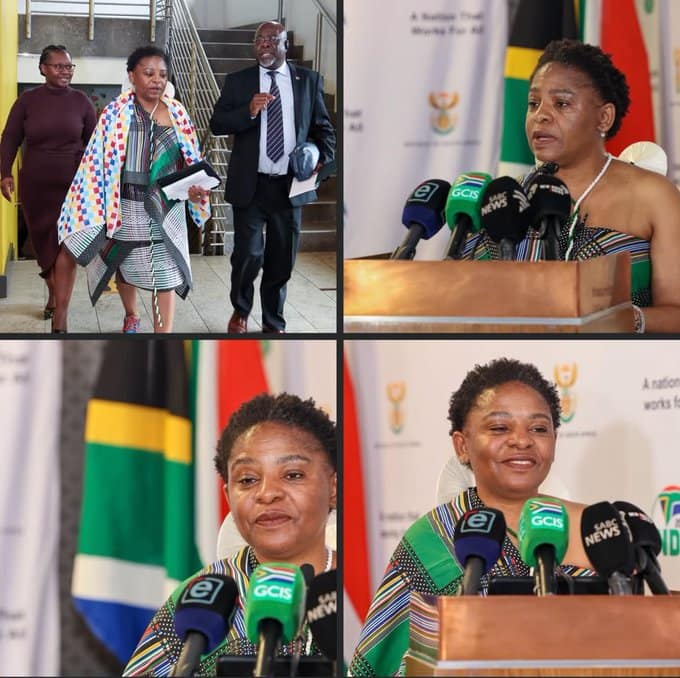
Minister in the Presidency Khumbudzo Ntshavheni addressed the media at the Ronnie Mamoepa Media Centre on Wednesday morning, delivering the post-Cabinet briefing on decisions taken during the Cabinet meeting held on 23 September 2026. The briefing covered a range of pressing national issues, from economic policy and infrastructure development to social welfare and international relations.
Ntshavheni began by outlining Cabinet’s commitment to accelerating the implementation of the government’s economic recovery plan, with a particular focus on infrastructure investment, energy security, and job creation. She confirmed that Cabinet had approved several measures aimed at streamlining procurement processes and removing bureaucratic bottlenecks that have delayed critical projects.
On the energy front, Ntshavheni provided an update on the government’s efforts to stabilise the national grid and reduce the frequency of load-shedding. She reiterated that the unbundling of Eskom remains a priority, though she acknowledged concerns raised by labour unions and pledged that workers’ rights would be protected throughout the restructuring process.
The Minister also addressed the ongoing crisis at the National Student Financial Aid Scheme (NSFAS), confirming that Cabinet had directed the Department of Higher Education and Training to urgently resolve the administrative failures that have left thousands of students without funding, accommodation, and food. “Cabinet is deeply concerned about the plight of our students,” Ntshavheni said. “We will not rest until the system works for them.”
On social welfare, Ntshavheni announced that Cabinet had approved additional funding for the Social Relief of Distress (SRD) grant and was exploring options for its long-term sustainability. She also touched on the government’s response to the recent floods and cold weather that devastated farming communities, confirming that disaster relief mechanisms were being activated.
Internationally, Ntshavheni highlighted South Africa’s ongoing diplomatic engagements, including preparations for the upcoming SADC Summit and the country’s participation in the United Nations General Assembly. She reaffirmed South Africa’s commitment to peace and stability in the region.
The briefing concluded with a question-and-answer session, during which journalists pressed the Minister on a range of topics, including corruption, crime, and the upcoming local government elections. Ntshavheni responded firmly, reiterating the government’s position that accountability and service delivery remain non-negotiable priorities.
For South Africans, the post-Cabinet briefing provided a snapshot of a government grappling with multiple crises while attempting to project competence and control. Whether the decisions announced will translate into tangible improvements remains the central question. For now, the message from Pretoria is one of urgency and resolve—but also one of significant challenges yet to be overcome.
About The Author