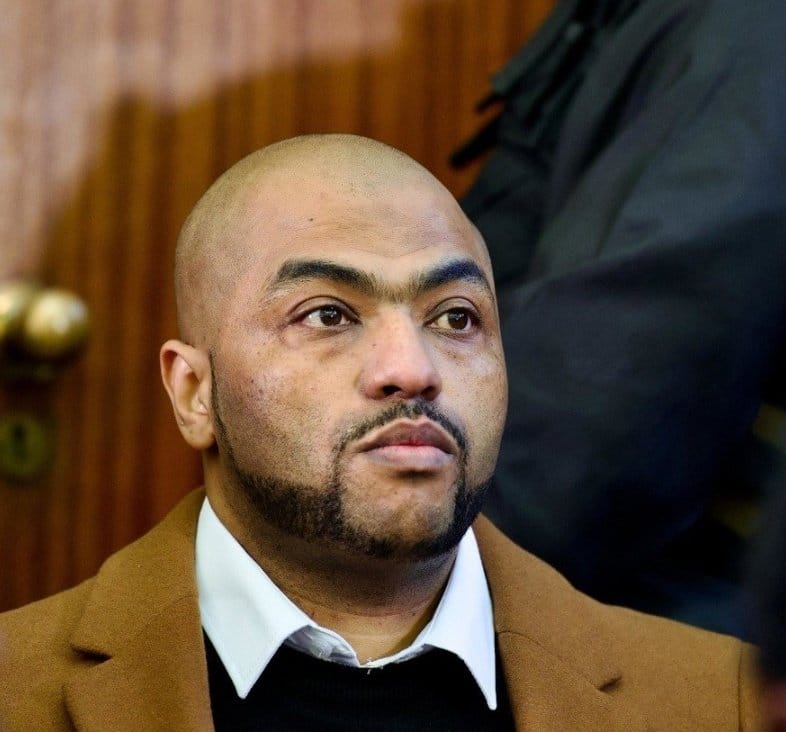
In a bold legal move that tests the limits of prisoner rights versus state security, convicted murderer and rapist Thabo Bester has launched a fresh application in the Johannesburg High Court, demanding a significant improvement to his prison conditions, which he argues are “unconstitutional and inhumane.” This latest bid adds another dramatic chapter to the saga of one of South Africa’s most infamous criminals, whose previous escape from a maximum-security facility already exposed critical flaws within the Department of Correctional Services (DCS).
According to a City Press report, Bester, who is currently held at the Kgosi Mampuru II C-Max facility in Pretoria, is not only challenging the specifics of his confinement but is also seeking a fundamental review of his status as a sentenced inmate. His legal team is arguing that he should be granted privileges typically reserved for awaiting-trial detainees, most notably the right to contact visits with family and his legal representatives. Currently, as a high-risk, sentenced prisoner, he is subject to non-contact visits, communicating through a glass partition.
A History of Grievances and a Notorious Escape
This application is not Bester’s first complaint about his treatment behind bars. Following his recapture in Tanzania in April 2023, after a nearly year-long manhunt, he was placed in what he has previously described as “near-solitary confinement.” In earlier affidavits, he claimed that being locked in his cell for 23 hours a day with minimal human interaction has had a severe and detrimental impact on his mental health.
These grievances, however, are set against the backdrop of his audacious May 2022 escape from the Mangaung Correctional Centre, a privately-run maximum-security prison. Bester orchestrated a elaborate ruse where he faked his own death by placing the body of another man, later identified as Katlego Bereng Mpholo, in his cell and setting it ablaze. The escape, carried out with the alleged help of his partner, Dr. Nandipha Magudumana, and several others, raised profound questions about corruption, security lapses, and the management of South Africa’s correctional facilities.
The State’s Firm Rebuttal: A Necessary Security Protocol
The DCS has firmly pushed back against Bester’s claims, stating that his treatment is standard for an inmate of his classification and history. In a pointed response, the department has explicitly denied practising solitary confinement, which is outlawed in South Africa. Instead, they classify his housing as “individual separation,” a routine security measure for high-risk inmates deemed a threat to the safety of others or themselves, or, critically, at high risk of escape.
“Thabo Bester enjoys the same privilege as other inmates,” a DCS spokesperson maintained, emphasising that his conditions are a matter of operational necessity, not punishment. Officials have pointed to his proven history of orchestrating a sophisticated escape as the primary justification for the stringent measures. The state’s argument will likely centre on the notion that Bester’s own actions have directly necessitated the very restrictions he is now challenging.
A Constitutional Clash with Broader Implications
The case sets the stage for a complex legal battle that pits the constitutional rights of a prisoner—including the right to dignity and to conditions of detention that are consistent with human dignity—against the state’s constitutional obligation to ensure safety, security, and the administration of justice.
Legal experts suggest that while all prisoners retain certain fundamental rights, these are not absolute and can be limited for legitimate security purposes. The court will be tasked with determining whether the conditions at Kgosi Mampuru II constitute a permissible limitation or an unconstitutional infringement.
Bester’s legal manoeuvres are being closely watched, not only for their immediate outcome but for the precedent they could set for the management of other high-profile, high-security prisoners. As he pursues this civil application for better conditions, the shadow of his impending criminal trial looms large. He, Dr. Magudumana, and several co-accused are scheduled to appear in the Free State High Court in February 2025 to face a litany of charges, including murder, fraud, violation of a corpse, and escaping from lawful custody.
The outcome of his current bid will determine whether the man who famously cheated the system can now use that same system to secure a measure of comfort, all while the state works to ensure he remains securely behind bars.
About The Author